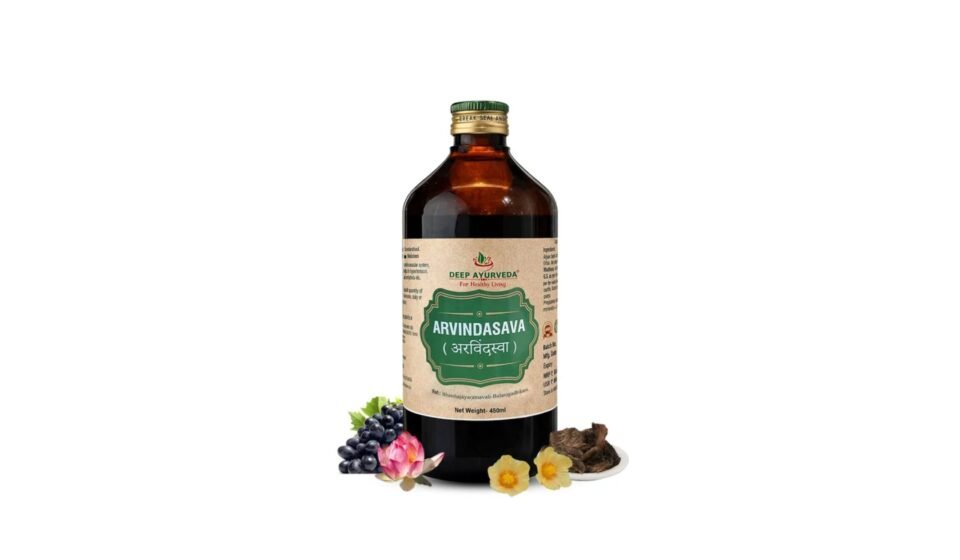
Arvindasava: Complete Guide to Uses, Benefits, Dosage, Side Effects, and Safety

As an Ayurvedic doctor, one of the questions I commonly hear from parents is, My child does not eat properly. Can Arvindasava help?
The answer is not simply yes or no.
In Ayurveda, poor appetite is not always treated as an isolated problem. I first try to understand how well the child is digesting food, whether there is gas or abdominal discomfort, how the bowel movements are, whether the child is gaining strength normally, and whether there is any underlying health concern.
Arvindasava, also known as Aravindasava or Arvindasavam, is a classical Ayurvedic fermented formulation traditionally associated with children’s health. It is particularly described in relation to poor appetite (Aruchi), weak digestion (Agnimandya), weakness or reduced nourishment (Balakshaya), and other conditions considered under pediatric Ayurveda.
The National AYUSH Mission’s Essential Drugs List also places Aravindasava in the context of Balaroga, Balakshaya, Agnimandya and Aruchi.
But there is something important I want every parent to understand:
Arvindasava should not be treated simply as an appetite syrup or a universal tonic for every child.
Its suitability depends on the child’s age, symptoms, digestive condition, overall health and the specific formulation being used.
In this guide, I will explain what Arvindasava is, why it is traditionally used, its ingredients, dosage, safety, possible side effects and when professional medical advice is more appropriate.
What Is Arvindasava?
Arvindasava is a classical Ayurvedic Asava formulation prepared through a traditional fermentation process.
Unlike an ordinary herbal syrup, an Asava undergoes fermentation. During this process, a small amount of self-generated alcohol is naturally produced. This is an important point for parents to know, particularly when the formulation is being considered for a child.
Classical Arvindasava contains a combination of herbs rather than relying on a single ingredient. Depending on the classical formulation, ingredients include Arvinda, Ushira, Gambhari, Nilotpala, Manjistha, Bala, Jatamansi, Musta, Sariva, Haritaki, Bibhitaki, Amalaki, Vacha, Arjuna, Yashtimadhu, Draksha and Dhataki, among others.
The formulation is traditionally associated with Kaumarabhritya, the Ayurvedic branch concerned with child health.
In simple terms
If a parent asks me, Doctor, what is Arvindasava mainly used for?
I would explain it this way:
Arvindasava is a traditional Ayurvedic fermented formulation used particularly in children when digestive strength, appetite, nourishment and general strength need Ayurvedic support.
However, that does not mean every child with poor appetite needs Arvindasava.
Why Is Arvindasava Traditionally Used for Children?
Children are constantly growing. Their nutritional requirements, digestion and physical strength change as they grow.
From an Ayurvedic perspective, proper nourishment depends not only on what a child eats but also on how well the food is digested and assimilated.
This is where the Ayurvedic concept of Agni becomes important.
When parents tell me:
My child eats very little.
I usually want to know more.
I may ask:
- Does the child feel hungry at regular times?
- Is digestion comfortable?
- Is there excessive gas or bloating?
- Are bowel movements regular?
- Does the child feel heavy after eating?
- Is the child active and energetic?
- Is the child growing normally?
- Has there been recent illness?
- Is the child’s diet actually providing enough nutrition?
Only after understanding these factors can we decide whether an Ayurvedic formulation is appropriate.
This is why Arvindasava should not simply be viewed as a product for increasing appetite.
Arvindasava Benefits and Traditional Uses
Arvindasava has several traditional Ayurvedic applications. The most important ones are related to digestion, appetite, nourishment and strength.
1. Supports Healthy Digestion
One of the traditional contexts of Arvindasava is Agnimandya, or reduced digestive capacity.
When digestion is not functioning properly, a child may have poor appetite, heaviness after meals, irregular bowel habits or abdominal discomfort.
From an Ayurvedic perspective, supporting healthy Agni is often more meaningful than simply trying to make a child eat more.
Arvindasava is traditionally used to support digestive function in such contexts.
2. Traditionally Used for Poor Appetite
Aruchi, or reduced interest in food, is another traditional indication associated with Arvindasava.
But I would advise parents not to assume that every child who refuses food needs a digestive formulation.
Sometimes poor eating habits are related to:
- frequent snacking
- excessive packaged foods
- irregular meal timings
- too many sugary drinks
- lack of physical activity
- inadequate sleep
- emotional or behavioural factors
In other cases, persistent poor appetite may have an underlying health cause.
So before using Arvindasava, it is worth understanding why the child is not eating properly.
3. Supports Nourishment and Strength
Classical Ayurvedic descriptions associate Arvindasava with Bala and Pushti, concepts relating to strength and nourishment.
This does not mean that Arvindasava directly guarantees weight gain or increased height.
A child’s growth depends on much more:
balanced nutrition + digestion + sleep + physical activity + overall health + normal development.
Arvindasava may have a role as part of an individualized Ayurvedic approach, but it should not replace proper nutrition.
4. Traditionally Used When Weak Digestion Affects Nourishment
Sometimes a child appears to eat reasonably well but still has digestive complaints or poor nourishment.
From an Ayurvedic perspective, this can lead the practitioner to consider whether digestion and assimilation are functioning properly.
This is one reason Arvindasava’s traditional use is broader than simply increasing appetite.
5. Traditional Support During Weakness
Classical Ayurvedic sources also describe Arvindasava in the context of weakness and reduced strength.
If a child has recently recovered from an illness and continues to have poor appetite or weakness, an Ayurvedic physician may consider supportive formulations based on the child’s individual condition.
However, persistent weakness should never automatically be attributed to poor digestion.
If weakness continues or is accompanied by weight loss, persistent fever or poor growth, the child should be medically evaluated.
Arvindasava Ingredients: What Is Inside the Formulation?
Arvindasava is a multi-herbal formulation. Its classical ingredients include herbs such as:
- Arvinda
- Ushira
- Gambhari
- Nilotpala
- Manjistha
- Bala
- Jatamansi
- Musta
- Sariva
- Haritaki
- Bibhitaki
- Amalaki
- Vacha
- Arjuna
- Yashtimadhu
- Draksha
- Dhataki
The exact ingredient list and proportions should always be checked against the specific product label and applicable formulation standard.
Why does a multi-herbal formulation matter?
In Ayurveda, we generally do not look at one herb in isolation.
A classical formulation is designed as a combination, where different ingredients contribute to the overall Ayurvedic action of the preparation.
For example, Draksha is traditionally associated with nourishing and strength-supportive formulations.
If you want to understand another classical fermented formulation based around Draksha, you can also read our detailed guide to Drakshasava.
The Role of Manjistha in Arvindasava
Manjistha is another ingredient found in the classical Arvindasava formulation.
Manjistha is well known in Ayurveda and appears in several traditional formulations, but I would caution against assuming that two medicines have the same purpose simply because they share one ingredient.
For example, Mahamanjisthadi Kwath contains Manjistha but has a different classical therapeutic context.
This is an important principle in Ayurveda:
The action of a complete formulation cannot always be predicted by looking at one ingredient.
Arvindasava Dosage: How Much Should You Take?
This is where I recommend parents to be particularly careful.
You may find different Arvindasava doses mentioned on different websites, classical references and product labels. This happens because dosage can vary according to the reference, formulation, age, condition and product instructions.
Therefore, I would not recommend taking a dose from a random website and applying it directly to your child.
Some Ayurvedic references provide specific dosage ranges, while individual manufacturers may provide their own directions.
For children
Children require particular care when determining dosage.
The appropriate amount may depend on:
- age
- weight
- digestive capacity
- health condition
- reason for use
- other medicines or supplements
- specific product formulation
Never increase the dose simply because the child is not responding quickly.
For adults
Arvindasava is traditionally associated more strongly with pediatric Ayurveda, but some commercial products also provide adult dosage directions.
If an adult is using it, the specific product label and physician’s recommendation should be followed rather than assuming that a children’s formulation has the same dosing requirements for adults.
How Should Arvindasava Be Taken?
If your Ayurvedic physician has recommended Arvindasava, follow the instructions given for your particular product.
In traditional practice, Arvindasava may be administered with an appropriate quantity of water.
A simple approach is:
- Measure the recommended dose accurately.
- Dilute it with water if advised.
- Follow the recommended timing.
- Do not exceed the prescribed quantity.
- Monitor how the child responds.
Do not use a household spoon to estimate a medicine dose when an accurate measuring cup or device is available.
Can Arvindasava Be Taken Daily?
This is another question parents often ask me.
The answer depends on why the formulation is being used and for whom.
Daily use should not automatically be assumed to be appropriate simply because Arvindasava is an Ayurvedic preparation.
If a child has ongoing appetite or digestive problems, I would rather identify the reason for the problem than keep giving a tonic indefinitely.
For longer-term use, especially in children, follow the advice of a qualified Ayurvedic physician or pediatric healthcare professional.
Does Arvindasava Contain Alcohol?
Yes, Arvindasava is a fermented Ayurvedic preparation and naturally generated alcohol is produced during fermentation.
This is different from adding ordinary drinking alcohol to the product.
The fermentation process is part of the traditional preparation of Asava formulations, and pharmacopoeial information describes self-generated alcohol in Aravindasava.
This is particularly important for parents because Arvindasava should not be thought of as exactly the same as a regular non-fermented herbal syrup.
Always check the product label for the manufacturer’s information.
Arvindasava Side Effects
I would not describe any Ayurvedic medicine as completely free from side effects.
Most people may tolerate a formulation well when it is appropriately selected and used, but individual reactions can occur.
Depending on the individual and circumstances, unwanted effects may include:
- digestive discomfort
- nausea
- loose stools
- acidity or irritation
- sensitivity to an ingredient
- allergic reactions
If a child develops an unusual reaction after taking Arvindasava, do not simply continue the medicine hoping that the symptoms will disappear.
Stop and seek advice from a qualified healthcare professional.
One important principle to remember
Natural does not automatically mean suitable for everyone.
Safety depends on the formulation, dose, age, health condition and individual response.
Arvindasava Safety and Precautions
1. Do not self-prescribe for very young children
The younger the child, the more important individualized medical guidance becomes.
For infants and very young children, do not start Arvindasava simply because someone recommended it or because another child is taking it.
2. Check the ingredient list
If your child has a known allergy or sensitivity, carefully review the product’s ingredient list.
If you are unsure about an ingredient, ask your doctor or pharmacist before using the product.
3. Be aware of the naturally generated alcohol
Because Arvindasava is fermented, it can contain naturally generated alcohol.
This is one reason why parents should understand what type of Ayurvedic preparation they are giving to their child rather than treating every liquid Ayurvedic medicine as an ordinary syrup.
4. Check the sugar-containing ingredients
Depending on the formulation, Asava preparations may contain sweetening substances used as part of the classical preparation.
If a person has diabetes or needs to closely control sugar intake, check the exact product ingredients and discuss its suitability with a healthcare professional.
5. Tell your doctor about other medicines
If your child is already taking prescription medicines, supplements or other Ayurvedic preparations, inform the healthcare professional before adding Arvindasava.
This helps avoid unnecessary combinations and allows the practitioner to consider the complete treatment plan.
6. Pregnancy and breastfeeding
Arvindasava is primarily discussed in the context of pediatric Ayurveda. If an adult who is pregnant or breastfeeding is considering using it, professional advice should be obtained first.
Arvindasava for Poor Appetite: What I Would Tell a Parent
If you came to my clinic and said:
Doctor, my child does not eat properly. Should I give Arvindasava?
I would first say:
Let’s understand why your child is not eating.
I would want to know:
- Is the child hungry at mealtimes?
- Is digestion comfortable?
- Are stools regular?
- Is there gas or bloating?
- What does the child normally eat?
- How often does the child snack?
- How much packaged food or sugary drinks are consumed?
- Is the child active?
- Is sleep adequate?
- Is growth progressing normally?
- Has the child recently been ill?
Only after considering these factors would I decide whether an Ayurvedic formulation is appropriate.
This is the difference between using a medicine thoughtfully and simply using a tonic because a child is a poor eater.
When Should Parents See a Doctor?
Please do not rely on Arvindasava alone if a child has persistent or concerning symptoms.
Medical evaluation is particularly important if there is:
- unexplained weight loss
- poor or abnormal growth
- persistent vomiting
- prolonged diarrhoea
- blood in the stool
- severe or recurrent abdominal pain
- persistent fever
- significant weakness
- breathing difficulty
- prolonged loss of appetite
- unusual tiredness or reduced activity
These symptoms may require investigation to identify the underlying cause.
Arvindasava vs Ordinary Herbal Syrup
Many people assume that Arvindasava is simply an Ayurvedic syrup.
It is not quite that simple.
| Feature | Arvindasava | Ordinary Herbal Syrup |
|---|---|---|
| Ayurvedic category | Asava | Depends on the product |
| Preparation | Fermentation-based | Usually non-fermented |
| Naturally generated alcohol | May be present | Usually absent, depending on formulation |
| Ingredients | Classical multi-herbal formulation | Product-specific |
| Use | Traditional Ayurvedic indications | Depends on the product |
This distinction is particularly useful for parents who are unfamiliar with Ayurvedic fermented preparations.
What Should You Look for When Buying Arvindasava?
If you are purchasing Arvindasava, do not choose it only because the product has a low price or attractive packaging.
I recommend checking:
Manufacturer information
Make sure the manufacturer and product details are clearly mentioned.
Ingredient list
Check the complete ingredients and compare them with the product’s stated formulation.
Batch and expiry
Always check the batch number and expiry date before use.
Dosage instructions
Follow the instructions for the specific product rather than copying a dose from another brand.
Storage
Store the product according to the manufacturer’s instructions.
Quality and authenticity
Prefer products manufactured and labelled according to applicable Ayurvedic regulatory and quality requirements.
Final Thoughts
Arvindasava has an important place in the traditional Ayurvedic approach to children’s health, particularly where appetite, digestion, nourishment and strength are concerned.
But I would encourage parents to look beyond the label of an appetite tonic.
If a child occasionally eats less but is active and growing normally, the answer may simply involve improving meal habits, diet quality, sleep and lifestyle.
If poor appetite is persistent or accompanied by weight loss, weakness, digestive problems or poor growth, the priority should be finding the underlying cause.
Arvindasava may be useful when it is appropriately selected, but the right medicine is always the one that matches the individual—not simply the symptom.
Frequently Asked Questions About Arvindasava
What is Arvindasava used for?
Arvindasava is a classical Ayurvedic fermented formulation traditionally associated with children’s health, particularly in relation to poor appetite, weak digestion, nourishment and strength.
Is Arvindasava good for children?
Arvindasava has a strong traditional association with pediatric Ayurveda, but it is not automatically suitable for every child. Age, health status, symptoms and dosage must be considered.
Can Arvindasava help with poor appetite?
It is traditionally used in the context of Aruchi, or reduced interest in food. However, persistent poor appetite should be evaluated to identify its underlying cause.
Does Arvindasava increase weight?
It should not be promoted as a guaranteed weight-gain medicine. Traditional Ayurvedic use relates more broadly to nourishment and strength, while healthy weight gain depends on adequate nutrition and overall health.
What is the dosage of Arvindasava?
There is no single dose that should automatically be applied to every person. Dosage can vary according to age, condition, formulation and product instructions. Follow the specific product label or qualified physician’s advice.
Can adults take Arvindasava?
Some commercial products provide adult directions, although Arvindasava is particularly associated with pediatric Ayurveda. Adults should follow the dosage and advice appropriate to the specific product.
Does Arvindasava contain alcohol?
Yes. As an Asava preparation, Arvindasava undergoes fermentation, which naturally produces alcohol. This is why it should not be considered identical to a standard non-fermented herbal syrup.
Is Arvindasava safe?
It may be well tolerated when appropriately selected and used, but no medicine should be considered universally risk-free. Age, dosage, allergies, health conditions and other medicines should be considered.
Can Arvindasava be given to infants?
Do not give Arvindasava to infants or very young children without advice from a qualified healthcare professional.
Is Arvindasava just an Ayurvedic appetite syrup?
No. Arvindasava is a classical fermented Asava formulation. Its traditional use is broader than appetite alone and includes digestion, nourishment and strength in the Ayurvedic pediatric context.