
Ushirasava: Complete Guide to Uses, Benefits, Dosage, Side Effects, and Safety

Ushirasava is a classical Ayurvedic fermented herbal formulation traditionally used when Pitta-related heat, burning sensations, Rakta (blood tissue) imbalance and certain bleeding or urinary complaints are involved. But there is an important point that is often missed: Ayurveda does not select Ushirasava simply because a person has body heat or one isolated symptom. Its suitability depends on the individual’s symptoms, constitution, digestive status, underlying condition and overall Ayurvedic assessment.
Ushirasava is an Asava, meaning it is prepared through controlled natural fermentation. The formulation commonly contains Ushira (vetiver) along with several other herbs and naturally fermented ingredients. Research on marketed Ushirasava preparations has also examined their physicochemical properties, microbial quality and marker compounds, highlighting why formulation quality and standardisation matter.
In this complete guide, we will look at Ushirasava benefits, traditional uses, ingredients, Ayurvedic properties, dosage, how to take it, possible side effects, alcohol content, precautions, interactions and the situations in which self-medication may not be appropriate.
What Is Ushirasava?
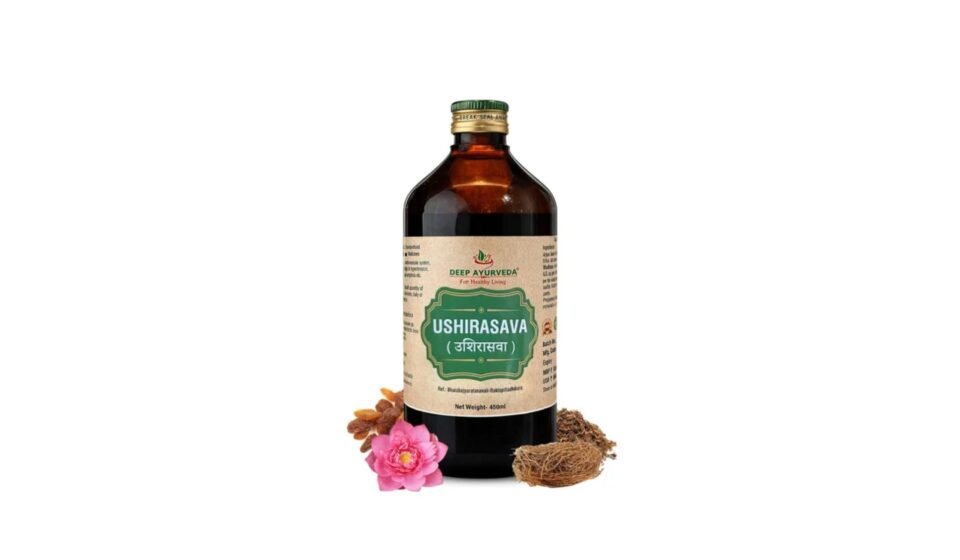
Ushirasava, also written as Usheerasava or Usirasava, is a classical Ayurvedic Asava formulation.
Its principal herb is Ushira, commonly identified botanically as Chrysopogon zizanioides (syn. Vetiveria zizanioides), popularly known as vetiver.
The word Asava refers to a class of Ayurvedic liquid preparations produced through fermentation. During preparation, naturally occurring fermentation generates alcohol within the formulation. This naturally generated alcohol contributes to preservation and extraction of constituents; it should not be confused with simply adding a conventional alcoholic beverage to the medicine.
Ayurvedically, Ushirasava is particularly interesting because its traditional application is closely connected with Pitta, Rakta, heat and burning-type presentations.
That is why simply calling Ushirasava a cooling syrup does not fully explain how Ayurveda approaches it.
Ushirasava in Ayurveda: Why Is It Traditionally Used?
To understand Ushirasava properly, it helps to understand three Ayurvedic concepts:
- Pitta Dosha
- Rakta Dhatu
- Daha, or burning sensation
According to Ayurveda, aggravated Pitta may manifest through features such as excessive heat, burning sensations, increased thirst, irritability, sweating and certain inflammatory or bleeding tendencies.
Rakta Dhatu is also closely associated with Pitta in Ayurvedic pathology. Therefore, when a person’s presentation suggests involvement of both Pitta and Rakta, a physician may consider formulations traditionally used for this therapeutic context.
This does not mean that every case of bleeding, burning or urinary discomfort is caused by Pitta.
That distinction is important.
A symptom is not the same as a diagnosis.
Ushirasava Ayurvedic Properties
The traditional Ayurvedic profile of Ushira helps explain why Ushirasava is commonly selected in heat- and Pitta-associated conditions.
Ushira is traditionally regarded as cooling
Ushira is known in Ayurveda for its Sheeta or cooling nature.
This is one reason preparations containing Ushira have traditionally been associated with conditions involving excessive heat, burning and Pitta aggravation.
Ushirasava and Pitta
The formulation is traditionally used when symptoms suggest aggravated Pitta, particularly where heat and burning are prominent.
Ushirasava and Rakta
Ushirasava is also traditionally associated with Rakta-related disorders and bleeding presentations in classical Ayurvedic practice.
Classical and secondary Ayurvedic references describe its use in contexts such as Raktapitta and other Pitta/Rakta-associated disorders.
Ushirasava Ingredients
Ushirasava is a polyherbal formulation rather than a single-herb medicine.
The exact ingredient list can vary according to the classical reference, manufacturing standard and commercial formulation. Therefore, the label of the specific product should always be checked before use.
Commonly described ingredients include herbs such as:
| Ingredient | Botanical identification | Traditional relevance |
|---|
| Ushira | Chrysopogon zizanioides | Cooling and Pitta-related use |
| Lodhra | Symplocos racemosa | Traditionally associated with Rakta and women’s health |
| Padmaka | Prunus cerasoides | Traditionally valued for cooling properties |
| Manjistha | Rubia cordifolia | Traditionally associated with Rakta and skin |
| Gambhari | Gmelina arborea | Traditional formulation support |
| Priyangu | Callicarpa species | Traditionally associated with astringent properties |
| Dhataki | Woodfordia fruticosa | Important fermentation-supporting herb |
| Natural sweetening material | Jaggery/sugar depending on formulation | Supports fermentation |
Published analytical research describes Ushirasava as a polyherbal hydroalcoholic formulation containing more than 25 ingredients in the formulations examined, and has investigated marker compounds including luteolin and rubiadin.
Why can the ingredient list differ between products?
This is something consumers often overlook.
Different manufacturers may follow different references, specifications or product formulations. Therefore, it is not advisable to assume that every bottle sold as Ushirasava has an identical ingredient profile.
Always read the manufacturer’s current label.
How Is Ushirasava Prepared?
Ushirasava belongs to the fermented Asava category of Ayurvedic formulations.
In simplified terms, the process involves:
Herbal ingredients → aqueous herbal preparation → sweetening/fermentation medium → controlled fermentation → filtration and maturation → finished Ushirasava
The fermentation process is important because it naturally generates alcohol within the formulation.
This is one reason Ushirasava should not simply be compared with a conventional herbal decoction.
Research on marketed Ushirasava formulations has evaluated parameters such as pH, specific gravity, total solids, ethanol content, sugars, microbial quality and phytochemical characteristics as part of standardisation work.
Ushirasava Benefits
The benefits below describe traditional Ayurvedic uses and therapeutic rationale. They should not be interpreted as proof that Ushirasava can diagnose, cure or replace treatment for a modern medical condition.
1. Traditionally Supports Pitta Balance
One of the central Ayurvedic reasons for using Ushirasava is its traditional association with aggravated Pitta.
Pitta aggravation may present with features such as:
- Excessive body heat
- Burning sensations
- Increased thirst
- Excessive sweating
- Heat intolerance
- Irritability
- Certain skin complaints
Because Ushira is traditionally considered cooling, Ushirasava may be selected when the overall symptom pattern is consistent with Pitta aggravation.
However, Ayurveda does not recommend treating Pitta based on one symptom alone.
2. Traditionally Used for Burning Sensations
Daha, or burning sensation, is an important traditional indication associated with Pitta.
Ushirasava may be considered when burning is associated with a broader Pitta-dominant presentation.
This can include a subjective sensation of internal heat or burning discomfort.
But persistent or severe burning should not automatically be attributed to Pitta.
For example, persistent burning during urination can have causes such as urinary infection, stones or other urinary conditions that require appropriate medical assessment.
3. Traditionally Used in Certain Bleeding Disorders
Ushirasava has traditionally been associated with Raktapitta and other bleeding-related presentations.
Traditional Ayurvedic literature and secondary references describe its use in conditions involving bleeding, including certain nosebleeds and excessive menstrual bleeding.
However, this requires an important safety qualification:
Unexplained or heavy bleeding should never be self-treated solely with Ushirasava.
Bleeding can have many causes, and significant or recurrent bleeding requires proper evaluation.
4. May Support Urinary Comfort in Pitta-Type Presentations
Ushirasava is traditionally used for urinary complaints where burning and heat are prominent.
From an Ayurvedic perspective, this may be relevant when urinary discomfort occurs in a Pitta-dominant pattern.
But this does not mean Ushirasava should be used as a substitute for diagnosis or treatment of a urinary tract infection.
Seek medical evaluation if urinary burning is accompanied by:
- Fever
- Chills
- Back or flank pain
- Blood in urine
- Vomiting
- Severe pain
- Pregnancy
- Recurrent urinary infections
5. Traditionally Associated With Pitta-Related Skin Concerns
Ayurveda often considers the relationship between Pitta, Rakta and skin health when evaluating certain inflammatory or heat-associated skin presentations.
For this reason, Ushirasava may be incorporated into an Ayurvedic treatment plan in selected cases.
However, it should not be promoted as a universal blood purifier or cure for acne and skin disease.
The Ayurvedic phrase Rakta Prasadana should be understood within the Ayurvedic framework rather than translated into an unsupported claim that the formulation literally cleans the blood in the modern biomedical sense.
6. Traditionally Used for Excessive Heat
Ushira’s cooling nature is one of the main reasons it is valued in Ayurveda.
People commonly search for Ushirasava when they experience:
- Excessive heat
- Burning sensation
- Heat intolerance
- Excessive sweating
- Pitta-associated discomfort
But body heat is a broad everyday expression, not a medical diagnosis.
If symptoms are persistent, severe or unexplained, the underlying cause should be investigated.
7. Traditional Relevance in Certain Women’s Health Concerns
Ushirasava appears in traditional references concerning certain bleeding conditions, including excessive menstrual bleeding.
However, heavy menstrual bleeding can occur because of many different causes.
For example:
- Hormonal disturbances
- Fibroids
- Endometriosis or adenomyosis
- Thyroid disorders
- Bleeding disorders
- Certain medicines
- Pregnancy-related conditions
Therefore, Ushirasava should not be used to delay evaluation of significant menstrual bleeding.
Ushirasava Uses: When May It Be Considered?
A useful way to understand Ushirasava is not simply to memorise a list of diseases, but to understand its traditional therapeutic pattern.
| Symptom/presentation | Ayurvedic context | Important consideration |
|---|---|---|
| Burning sensation | Daha/Pitta | Cause should be assessed |
| Excess body heat | Pitta aggravation | Diet and lifestyle also matter |
| Certain nosebleeds | Pitta/Rakta context | Recurrent bleeding needs evaluation |
| Certain bleeding disorders | Raktapitta context | Physician supervision is important |
| Burning urination | Pitta/urinary context | Infection or stones must be considered |
| Certain skin complaints | Pitta/Rakta context | Diagnosis matters |
| Excessive menstrual bleeding | Pitta/Rakta context | Underlying cause should be investigated |
This approach is more useful than simply saying Ushirasava treats X, Y and Z.
How Does Ushirasava Work According to Ayurveda?
Ayurveda does not explain the action of Ushirasava only through modern pharmacology.
Its traditional action can be understood through:
1. Pitta balancing
Cooling herbs are traditionally used to manage excessive Pitta.
2. Rakta support
Ushirasava is traditionally associated with Rakta-related conditions.
3. Cooling action
Ushira’s Sheeta nature is an important part of its Ayurvedic identity.
4. Burning sensation support
Its traditional use is particularly relevant when Daha is associated with Pitta.
5. Urinary comfort
Traditional Ayurvedic practice includes Ushirasava among formulations used for certain urinary complaints associated with heat and burning.
Ushirasava Dosage
This is one area where online information can be confusing.
Different sources give different dosage ranges. For example, commercial references commonly mention 15–30 ml with an equal quantity of water, while Ayurvedic drug references can give different ranges.
Therefore:
There is no single dose that is automatically correct for every person.
The appropriate dose depends on factors such as:
- Age
- Constitution
- Digestive capacity
- Presenting condition
- Severity of symptoms
- Other medicines
- Product formulation
- Physician’s assessment
Common adult product dosage
Many commercial preparations list:
15–30 ml, diluted with an equal quantity of water, or as directed by an Ayurvedic physician.
Do not increase the dose simply because symptoms are not improving.
What about children?
Children should not be given Ushirasava without advice from a qualified healthcare professional.
What about older adults?
Older adults may have multiple medicines or chronic conditions, so individual assessment is particularly important.
How to Take Ushirasava
If an Ayurvedic physician has recommended Ushirasava, follow the dosage and timing provided for your particular formulation and condition.
Common product directions include:
- Measure the prescribed amount.
- Dilute it with an appropriate quantity of water if instructed.
- Take it according to the recommended timing.
- Use the same product consistently during the prescribed course.
- Do not increase the dose without medical advice.
Many commercial preparations recommend dilution with an equal quantity of water.
Should Ushirasava Be Taken Before or After Food?
The exact timing can depend on the product and the individual treatment plan.
Many commercial directions recommend taking Asava/Arishta preparations after meals, but the label of your particular product and your physician’s instructions should take priority.
This is especially relevant if you have digestive problems or are taking other medicines.
How Long Can Ushirasava Be Taken?
There is no universally correct duration.
The duration depends on:
- Why it is being used
- Individual response
- Dosha and symptom pattern
- Age
- Other health conditions
- Other medicines
- Physician’s assessment
Avoid taking Ushirasava indefinitely simply because it is an Ayurvedic formulation.
Natural does not automatically mean suitable for unlimited use.
Does Ushirasava Contain Alcohol?
Yes, Ushirasava can contain naturally generated alcohol because it is prepared through fermentation.
This is an important distinction.
The alcohol is generated during the fermentation process rather than being equivalent to adding a conventional alcoholic drink to the formulation.
Research on Ushirasava has specifically evaluated ethanol content as part of physicochemical standardisation.
Some secondary Ayurvedic sources report a measurable self-generated alcohol percentage in marketed preparations, but the exact amount should not be assumed to be identical across all products.
Who should pay particular attention?
Speak with a healthcare professional before use if you:
Ushirasava Side Effects
- Have been advised to avoid alcohol
- Have alcohol sensitivity
- Have liver disease
- Are pregnant or breastfeeding
- Take multiple prescription medicines
- Need to avoid fermented preparations for personal or medical reasons
Ushirasava is traditionally used as an Ayurvedic medicine, but it should not be described as completely free from side effects.
Individual tolerance can vary.
Possible concerns may include:
- Digestive discomfort
- Sensitivity to one or more ingredients
- Problems related to inappropriate dosing
- Concerns related to naturally generated alcohol
- Sugar-related considerations depending on the formulation
- Potential medicine interactions
There is not enough evidence to claim that every person will experience no adverse effects.
If you develop an unusual reaction after taking Ushirasava, stop self-treatment and seek professional advice.
Who Should Use Ushirasava With Extra Caution?
Pregnancy
Do not self-prescribe Ushirasava during pregnancy.
Any Ayurvedic medicine during pregnancy should be selected by a qualified professional after considering the individual’s condition.
Breastfeeding
Consult a healthcare professional before use.
Children
Use only under professional guidance.
Diabetes
Many fermented Ayurvedic preparations involve sweetening materials during preparation. The final composition and sugar content can vary by product.
People with diabetes should check the product information and discuss regular use with their healthcare professional.
Liver disease
Because Ushirasava is a fermented hydroalcoholic preparation, people with liver disease should seek professional advice before use.
People taking prescription medicines
Do not assume that an Ayurvedic formulation cannot interact with conventional medicines.
Tell your doctor and Ayurvedic physician about all medicines, supplements and herbal products you take.
Can Ushirasava Be Taken With Modern Medicines?
Sometimes Ayurvedic formulations may be used alongside conventional medicines, but this should be assessed individually.
Extra caution is appropriate if you are taking medicines for:
- Blood clotting or bleeding-related conditions
- Diabetes
- Blood pressure
- Liver disease
- Hormonal conditions
- Chronic diseases requiring regular medication
The safest approach is to provide your complete medication list to your healthcare professional.
Ushirasava for Burning Urination: What You Should Know
This is one of the most misunderstood uses.
Ayurveda traditionally considers burning urination within certain Pitta/Mutravaha Srotas presentations, and Ushirasava may be considered when the overall symptom pattern is appropriate.
But burning urination can also be caused by:
- Urinary tract infection
- Kidney or urinary stones
- Sexually transmitted infections
- Dehydration
- Prostate-related conditions
- Bladder disorders
Therefore, Ushirasava should not be used as a substitute for testing when infection or another medical condition is suspected.
If burning urination is accompanied by fever, blood in urine, severe pain, vomiting or back pain, seek medical evaluation promptly.
Ushirasava for Nosebleeds
Nosebleeds are traditionally associated with Pitta/Rakta conditions in Ayurveda.
Ushirasava may therefore appear in an Ayurvedic treatment plan when the physician identifies an appropriate Pitta/Rakta pattern.
However, recurrent nosebleeds should not automatically be attributed to excess Pitta.
Possible causes include:
- Dry nasal passages
- Trauma
- Allergies
- Nasal conditions
- High blood pressure
- Blood-thinning medicines
- Bleeding disorders
Frequent, heavy or unexplained nosebleeds require medical evaluation.
Ushirasava for Heavy Periods
Ushirasava is traditionally associated with certain bleeding disorders, and some Ayurvedic references describe its use in excessive menstrual bleeding.
But heavy menstrual bleeding is a symptom, not a diagnosis.
If periods are unusually heavy, prolonged or associated with weakness, dizziness, severe pain or symptoms of anaemia, the underlying cause should be evaluated.
An Ayurvedic physician may consider the Dosha and Rakta pattern, while appropriate medical evaluation may also be necessary.
Do not use Ushirasava to postpone investigation of unexplained heavy menstrual bleeding.
Ushirasava for Skin Health
Ayurveda traditionally links certain skin disorders with Pitta and Rakta involvement.
Therefore, Ushirasava may be considered in selected Ayurvedic protocols where heat, burning or Rakta-related features are present.
But not every acne, rash or skin eruption requires a Pitta-pacifying formulation.
Skin problems can have many causes, so diagnosis remains important.
If skin symptoms are severe, rapidly worsening, infected, painful or persistent, consult a qualified healthcare professional.
Is Ushirasava a Blood Purifier?
This phrase is frequently used online, but it needs clarification.
In Ayurveda, terms such as Rakta Prasadana are used within the traditional framework to describe support for healthy Rakta.
However, blood purifier should not be interpreted as meaning that Ushirasava literally detoxifies or cleanses the blood in the modern biomedical sense.
This distinction matters because traditional Ayurvedic terminology and modern medical terminology do not always have one-to-one equivalents.
A more accurate way to communicate its traditional role is:
Ushirasava is traditionally used to support Pitta- and Rakta-related balance rather than being described as a literal blood detoxifier.
What Does Modern Research Say About Ushirasava?
Modern research on Ushirasava has focused particularly on standardisation and quality evaluation.
A published study examined marketed Ushirasava preparations for physicochemical and microbial parameters and investigated marker compounds including luteolin and rubiadin using HPTLC methods.
This is useful because Ayurvedic formulation quality depends not only on the name of a medicine but also on:
- Correct identification of ingredients
- Manufacturing quality
- Fermentation control
- Physicochemical characteristics
- Microbial quality
- Consistency between batches
However, laboratory standardisation should not be confused with proof that Ushirasava treats every condition for which it has traditionally been used.
Traditional use and modern evidence are not the same thing.
A responsible health article should clearly separate:
Traditional Ayurvedic indications
from
Laboratory or analytical findings
from
Human clinical evidence
For several traditional indications of Ushirasava, high-quality modern clinical evidence may be limited. Therefore, claims should remain appropriately cautious.
Ushirasava vs Other Ayurvedic Formulations
There is no universal answer to Which Ayurvedic medicine is better?
Different formulations are selected for different therapeutic patterns.
For example:
Ushirasava vs Khadirarishta
Khadirarishta is often discussed in the context of skin and Rakta-related Ayurvedic approaches, while Ushirasava has a particularly strong traditional association with cooling, Pitta and burning/bleeding presentations.
The choice should depend on the individual’s condition rather than the popularity of the product.
Ushirasava vs Sarivadyasava
Both may be discussed in Pitta/Rakta-related contexts, but their formulations and therapeutic emphasis differ.
Ushirasava vs Chandanasava
Chandanasava is another formulation traditionally associated with cooling and urinary-related presentations, but the ingredients and Ayurvedic therapeutic profile are different.
The goal should not be to find the strongest formulation. It should be to find the most appropriate formulation for the individual’s presentation.
How Diet and Lifestyle Can Support a Pitta-Pacifying Approach
Ayurvedic management is not only about taking a formulation.
If Pitta aggravation is part of the clinical picture, lifestyle can also matter.
Prefer suitable cooling foods
Depending on your individual constitution and digestion, foods such as:
- Cucumber
- Bottle gourd
- Ash gourd
- Coconut water
- Seasonal fruits
- Pomegranate
- Fresh, lightly prepared foods
may fit a Pitta-friendly diet.
Reduce excessive heating habits
Consider limiting:
- Very spicy food
- Excessive fried foods
- Excessive alcohol
- Excessive caffeine
- Prolonged exposure to intense heat
- Irregular sleep
The diet should still be personalised because what is suitable for one person may not be suitable for another.
A Simple Ayurvedic Way to Understand Whether Ushirasava May Be Appropriate
Instead of asking only:
Do I have body heat?
an Ayurvedic physician may consider a broader pattern.
Step 1: What is the main complaint?
Is it burning, bleeding, urinary discomfort, skin symptoms or something else?
Step 2: Are Pitta features present?
Look at associated symptoms such as heat, burning, excessive thirst, sweating and irritability.
Step 3: Is Rakta involved?
If bleeding or Rakta-related symptoms are present, the pattern needs closer evaluation.
Step 4: What is the cause?
A similar symptom can arise from very different conditions.
Step 5: What is the individual’s Prakriti and Vikriti?
Ayurveda considers both constitution and current imbalance.
Step 6: Are there safety concerns?
Age, pregnancy, chronic diseases, prescription medicines, diabetes, liver health and alcohol sensitivity should be considered.
Step 7: Select the formulation and dose
Only after the above assessment should the formulation, dose and duration be determined.
This is why Ayurvedic medicine should not always be selected by matching one symptom to one product.
When Should You Not Self-Treat With Ushirasava?
Seek medical advice rather than relying on self-treatment if you have:
- Heavy or unexplained bleeding
- Blood in urine
- Recurrent nosebleeds
- Fever with urinary burning
- Severe abdominal or back pain
- Persistent vomiting
- Fainting or severe weakness
- Very heavy menstrual bleeding
- Symptoms during pregnancy
- Serious chronic disease
- A suspected drug interaction
These situations may require diagnosis before any Ayurvedic formulation is selected.
How to Store Ushirasava
For most commercially packaged preparations:
- Keep the bottle tightly closed.
- Store in a cool, dry place.
- Protect it from direct sunlight.
- Keep it away from children.
- Follow the manufacturer’s storage instructions.
- Do not use after the expiry date.
Always prioritise the storage instructions printed on the product label.
Final Takeaway
Ushirasava is a classical Ayurvedic fermented formulation traditionally used for Pitta- and Rakta-related concerns, including burning sensations, certain bleeding and urinary complaints. Its benefits and dosage should be considered according to individual needs and under appropriate Ayurvedic guidance.
Frequently Asked Questions About Ushirasava
1. What is Ushirasava used for?
Ushirasava is traditionally used in Ayurveda for Pitta- and Rakta-associated presentations, including certain burning sensations, bleeding disorders, urinary discomfort and heat-related complaints.
2. What are the main benefits of Ushirasava?
Its traditional benefits are mainly associated with Pitta balance, cooling support, Rakta-related conditions, burning sensations and certain urinary or bleeding complaints.
3. What is the dosage of Ushirasava?
Many commercial products recommend around 15–30 ml with an equal quantity of water, but dosage varies according to the product and individual. Follow your physician’s or product label instructions.
4. Can Ushirasava be taken daily?
It may be prescribed for regular use in selected cases, but daily use should follow a professional recommendation rather than being assumed safe for everyone.
5. Does Ushirasava contain alcohol?
Yes. Because Ushirasava is a fermented Asava preparation, a quantity of naturally generated alcohol can be present.
6. Is the alcohol in Ushirasava added separately?
No. The alcohol is generated naturally during the fermentation process.
7. Can Ushirasava be used for burning urination?
It is traditionally used for certain Pitta-associated urinary burning, but persistent burning urination should be evaluated for conditions such as urinary infection or stones.
8. Is Ushirasava safe with modern medicines?
It may be appropriate in some situations, but possible interactions and individual health conditions should be assessed by a healthcare professional.