
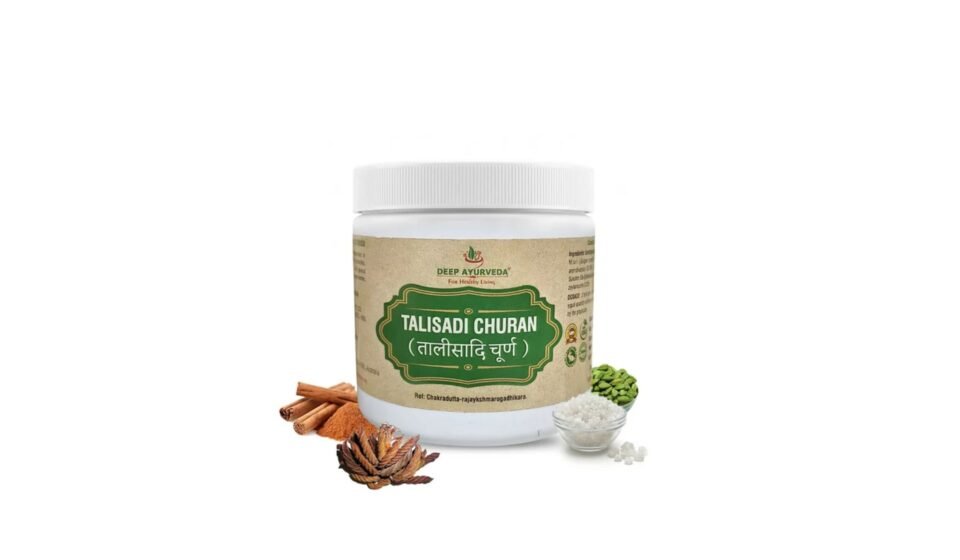

Talisadi Churna is a classical Ayurvedic herbal powder traditionally used in the management of Kasa (cough), Pratishyaya (rhinitis/catarrhal conditions), reduced appetite, indigestion and other Kapha- or respiratory-dominant complaints. It is a multi-ingredient formulation rather than a single herb, and its traditional use depends on the nature of symptoms, digestive strength, dosha involvement and the anupana (vehicle) used with it.
The formulation commonly contains Talisapatra, Pippali, Maricha, Shunthi, Vamshalochana, Ela, Tvak and Sharkara. Ayurvedic references describe Talishadi Curna with specific dosage and anupana combinations, although formulations and product instructions can vary.
This guide explains what Talisadi Churna is, its ingredients, Ayurvedic properties, traditional uses, benefits, dosage, anupana, precautions, and the situations in which professional medical advice is more appropriate.
Important: The uses described in this article are based primarily on traditional Ayurvedic knowledge. Traditional use should not be interpreted as proof that Talisadi Churna can diagnose, treat or cure a modern medical disease.
What Is Talisadi Churna?
Talisadi Churna (Talishadi Churna) is a classical Ayurvedic powdered formulation prepared from a combination of aromatic, pungent and warming herbs along with Vamshalochana and Sharkara.
The name is associated with Talisapatra, traditionally identified with Abies webbiana. Unlike a single-herb preparation, Talisadi Churna combines several ingredients with complementary Ayurvedic properties.
This distinction is important.
For example, Pippali, Shunthi and Maricha are individually familiar Ayurvedic herbs. When used together with Talisapatra, Ela, Tvak, Vamshalochana and Sharkara, however, the formulation has a different composition and traditional therapeutic rationale.
Classical and Ayurvedic reference databases associate Talishadi Curna particularly with Kasa (cough), Pratishyaya and Kapha-dominant respiratory presentations, while also describing digestive and appetite-related applications.
Talisadi Churna Ingredients
The commonly described formulation contains eight principal ingredients:
| Ingredient | Common name | Botanical name | Traditional Ayurvedic role |
|---|---|---|---|
| Talisapatra | Talis leaf | Abies webbiana | Traditionally used in respiratory formulations |
| Pippali | Long pepper | Piper longum | Deepana-Pachana and respiratory support |
| Maricha | Black pepper | Piper nigrum | Traditionally associated with Kapha and digestive balance |
| Shunthi | Dry ginger | Zingiber officinale | Traditionally used for Agni and Kapha-related complaints |
| Vamshalochana | Bamboo silica/manna | Source-dependent | Traditionally included in respiratory formulations |
| Ela | Cardamom | Elettaria cardamomum | Aromatic digestive support |
| Tvak | Cinnamon | Cinnamomum spp. | Warming and aromatic ingredient |
| Sharkara | Sugar | — | Traditionally used as part of the formulation |
The exact formulation, ingredient identity, processing and proportions can differ according to the classical reference, manufacturer and pharmacopoeial standard. Therefore, the label of the specific product should always be checked before use.
How Do the Ingredients of Talisadi Churna Work Together in Ayurveda?
One of the most useful ways to understand Talisadi Churna is to look beyond its ingredient list.
Its traditional formulation brings together herbs with Katu (pungent), aromatic and warming characteristics, along with sweet Sharkara. This creates a formulation intended not merely to stop a cough, but to address several Ayurvedic aspects that may accompany respiratory complaints.
Talisapatra
Talisapatra is considered the principal ingredient from which the formulation gets its name. It is traditionally used in Ayurvedic respiratory preparations and is associated with Kasa and related Kapha presentations.
Pippali, Maricha and Shunthi
These three herbs form the well-known Trikatu combination.
In Ayurveda, Trikatu is traditionally valued for Deepana and Pachana properties and is frequently used when Kapha accumulation and impaired digestion are considered relevant to a person’s symptoms.
This is one reason Talisadi Churna should not be thought of simply as a cough powder. Its traditional rationale also involves Agni and digestion.
Vamshalochana
Vamshalochana is traditionally included in several Ayurvedic respiratory formulations. Its exact botanical/source description can vary across references, so it is preferable to identify it according to the formulation standard or product documentation being used.
Ela and Tvak
Cardamom and cinnamon add aromatic and warming characteristics to the formulation. In Ayurvedic practice, aromatic spices are commonly used in formulations where digestive and Kapha-related considerations are important.
Sharkara
Sharkara is an important part of the traditional formulation and should not be overlooked when considering suitability.
This also creates an important practical point: Talisadi Churna should not automatically be assumed to be sugar-free.
Ayurvedic Properties of Talisadi Churna
The Ayurvedic understanding of Talisadi Churna is based on the combined properties of its ingredients rather than on one isolated herb.
The formulation is traditionally understood in relation to:
- Kapha
- Vata
- Agni
- Ama
- Kasa
- Pratishyaya
- Digestive strength
The presence of pungent and warming ingredients gives the formulation a traditionally Kapha-reducing and Agni-supportive orientation, while its suitability depends on the individual and the specific symptom pattern.
This is why Ayurvedic assessment matters.
A person with a Kapha-dominant presentation may be considered differently from someone with marked dryness, burning sensation or strong Pitta aggravation.
Traditional Ayurvedic Uses of Talisadi Churna
Talisadi Churna has traditionally been used in several Ayurvedic contexts.
The most commonly discussed include:
1. Kasa (Cough)
Talisadi Churna is traditionally associated with Kasa, making cough one of its primary Ayurvedic applications.
However, Ayurveda does not necessarily treat every cough in exactly the same way. The nature of the cough, associated mucus, dryness, digestive status and dosha involvement can influence formulation selection.
2. Kapha-Dominant Respiratory Complaints
The warming and pungent nature of several ingredients makes Talisadi Churna traditionally relevant when Kapha predominance is considered.
3. Pratishyaya
Classical Ayurvedic references also associate Talishadi Curna with Pratishyaya, an Ayurvedic term broadly associated with nasal/catarrhal complaints.
4. Reduced Appetite
Because several ingredients are traditionally described as Deepana, Talisadi Churna may be selected in Ayurvedic practice when poor appetite accompanies the broader symptom picture.
5. Indigestion
The Trikatu component is traditionally associated with supporting Agni and digestion, making digestive weakness another important aspect of the formulation.
6. Aruchi
Aruchi, broadly understood as reduced interest or desire for food, is another traditional digestive indication associated with formulations containing pungent and aromatic herbs.
Talisadi Churna Benefits: What Does Ayurveda Traditionally Say?
Rather than describing Talisadi Churna as a cure-all, its traditional benefits can be understood through the actions of its ingredients.
Supports traditional management of cough
Talisadi Churna is traditionally used in Kasa and related respiratory presentations.
Supports Kapha-related symptom patterns
Its pungent and warming ingredients are traditionally considered useful where excess Kapha is thought to contribute to symptoms.
Supports digestive fire
Pippali, Maricha and Shunthi are traditionally regarded as Deepana-Pachana herbs and form the Trikatu component.
Supports appetite
The formulation may traditionally be considered when reduced appetite occurs alongside digestive sluggishness.
Traditionally used for certain throat and respiratory complaints
The aromatic and warming ingredients have made Talisadi Churna a commonly discussed formulation within Ayurvedic respiratory care.
Combines respiratory and digestive considerations
This is one of its most interesting features.
Talisadi Churna is not built exclusively around respiratory herbs. Its formulation also contains ingredients traditionally associated with Agni and digestion, reflecting the Ayurvedic view that digestion can be relevant when managing Kapha-associated complaints.
Talisadi Churna for Cough: When Is It Traditionally Considered?
This is where a more nuanced Ayurvedic approach becomes important.
A cough is not a single Ayurvedic presentation.
Depending on the individual, cough may be associated with different combinations of Vata, Pitta and Kapha, along with differences in dryness, mucus, appetite and digestion.
Talisadi Churna for a Kapha-Dominant Cough
When cough is associated with features traditionally interpreted as Kapha predominance, such as heaviness and mucus, a warming and pungent formulation may be considered in Ayurvedic practice.
Talisadi Churna fits this traditional formulation logic.
Talisadi Churna for Dry Cough
A dry cough should not automatically be assumed to require Talisadi Churna.
If significant dryness, irritation or Vata predominance is present, an Ayurvedic practitioner may assess whether a different formulation or anupana would be more appropriate.
Therefore, Talisadi Churna is good for every dry cough is an overly broad claim.
Cough With Digestive Weakness
This is an interesting traditional consideration.
If cough occurs together with poor appetite, sluggish digestion or other signs of weak Agni, the Trikatu component may be one reason Talisadi Churna is traditionally considered.
Talisadi Churna for Digestion
The digestive role of Talisadi Churna is sometimes overlooked because most online articles focus almost entirely on cough.
Its formulation contains Pippali, Maricha and Shunthi, collectively known as Trikatu.
In Ayurveda, these ingredients are traditionally associated with:
- Deepana — supporting digestive fire
- Pachana — supporting digestion of improperly processed material
- Kapha management
- Appetite support
Consequently, Talisadi Churna may traditionally be selected when respiratory symptoms coexist with digestive sluggishness.
However, this does not mean that it should be used as a universal treatment for conditions such as GERD, ulcers, IBS or other diagnosed gastrointestinal disorders.
How to Take Talisadi Churna?
The appropriate method depends on the formulation, individual constitution, symptoms and the anupana selected.
Ayurvedic references describe Talisadi Churna with different administration vehicles, including honey and ghee/honey combinations.
Commonly discussed options include:
- Honey (Madhu)
- Ghee (Ghrita)
- Honey with ghee
- Other vehicles according to Ayurvedic indication
Why does the Anupana matter?
In Ayurveda, Anupana is not simply something used to swallow a powder.
The vehicle is traditionally selected to complement the formulation and the individual’s condition.
For example, the choice of anupana may differ depending on whether the focus is on Kapha, Vata, digestion or the nature of the respiratory complaint.
Therefore, rather than giving everyone the same instruction, it is more responsible to consider the specific formulation and individual context.
Talisadi Churna Dosage
There is no single dosage that is appropriate for every person.
Several Ayurvedic references describe approximately 1–3 g as a traditional dosage range, but dosage and frequency can vary according to the source, age, condition, formulation and anupana.
For this reason:
Adults: Follow the product label or advice from a qualified Ayurvedic practitioner.
Children: Do not automatically use an adult dosage. Pediatric use should be guided by a qualified healthcare professional.
Older adults: Existing medicines and health conditions should be considered.
Pregnancy or breastfeeding: Professional advice is recommended before use.
The dosage printed on the specific product label should take priority over a generalized internet dosage.
Can Talisadi Churna Be Taken Daily?
This depends on why it is being taken, the dose, the formulation and the individual.
Natural does not automatically mean that a formulation should be taken indefinitely.
A short course recommended by an Ayurvedic practitioner is different from taking a concentrated herbal formulation continuously without a clear indication.
If symptoms persist or repeatedly return, the priority should be finding the underlying cause rather than continuously increasing or extending self-treatment.
Talisadi Churna Side Effects and Safety
Talisadi Churna is traditionally used in Ayurveda, but it should still be used thoughtfully.
Because the formulation contains pungent and warming ingredients, excessive or inappropriate use may not be suitable for everyone.
Potential concerns include:
- Gastric irritation or burning in sensitive individuals
- Discomfort when taken in excessive amounts
- Unsuitability in certain Pitta-dominant presentations
- Sensitivity or allergy to individual ingredients
- Concerns related to sugar-containing formulations
The exact risk profile also depends on the specific product and the individual’s health status.
Does Talisadi Churna Contain Sugar?
Traditional Talisadi Churna formulations commonly contain Sharkara.
This is an important point that is frequently overlooked in general discussions of the formulation.
Therefore, someone managing blood glucose should not assume that Talisadi Churna is sugar-free simply because it is an Ayurvedic herbal product.
Check the product label for the actual composition and seek professional advice if you have diabetes or are following a medically supervised glucose-management plan.
Who Should Use Talisadi Churna Only After Medical Advice?
Professional guidance is particularly important for:
- Children
- Pregnant women
- Breastfeeding women
- People with diabetes
- People taking multiple medicines
- People with significant gastric sensitivity
- People with chronic respiratory disease
- People with recurrent or unexplained cough
- People with persistent fever
- Anyone experiencing worsening breathing difficulty
The goal is not to discourage Ayurvedic care, but to make sure that traditional medicine is used appropriately and does not delay necessary diagnosis or treatment.
Talisadi Churna vs Sitopaladi Churna
Talisadi Churna and Sitopaladi Churna are both well-known Ayurvedic formulations discussed in relation to respiratory and digestive complaints, but they are not interchangeable formulations.
| Feature | Talisadi Churna | Sitopaladi Churna |
|---|---|---|
| Formulation | Multi-ingredient classical formulation | Multi-ingredient classical formulation |
| Key identity | Talisapatra-based formulation | Sitopala-based formulation |
| Trikatu | Present | Present in traditional formulation |
| Traditional respiratory use | Yes | Yes |
| Digestive considerations | Important | Important |
| Sweetening component | Sharkara commonly included | Sugar component commonly included |
| Selection | Depends on symptom pattern | Depends on symptom pattern |
Which one is better?
There is no universally better formulation.
The appropriate choice depends on the individual’s symptoms, Ayurvedic assessment, constitution, digestive status and formulation suitability.
Talisadi Churna vs Trikatu Churna
This is another useful distinction.
Although Talisadi Churna contains the three herbs that make up Trikatu—Pippali, Maricha and Shunthi—Talisadi Churna is not the same thing as Trikatu Churna.
Trikatu is a three-herb combination.
Talisadi Churna incorporates Trikatu into a larger multi-ingredient formulation containing Talisapatra, Vamshalochana, Ela, Tvak and Sharkara.
Therefore, the two should not automatically be substituted for one another.
How Is Talisadi Churna Different From a Single-Herb Remedy?
This is perhaps the easiest way to understand the formulation.
Pippali alone ≠ Talisadi Churna
Shunthi alone ≠ Talisadi Churna
Black pepper alone ≠ Talisadi Churna
The traditional Ayurvedic rationale of Talisadi Churna comes from the combination of ingredients and their collective properties, not simply from one herb.
This is why copying the main herb and assuming it will produce the same effect is not an appropriate way to understand classical formulations.
What Does Modern Research Say About Talisadi Churna?
This distinction is important for responsible health writing.
Ayurvedic texts and traditional references provide a historical and clinical framework for the use of Talishadi Curna in conditions such as Kasa and Pratishyaya.
However, evidence for a complete classical formulation is not necessarily equivalent to evidence for each individual ingredient.
Research on individual herbs such as ginger, black pepper or long pepper may provide interesting pharmacological information, but those findings should not automatically be presented as clinical proof that Talisadi Churna treats a particular disease.
Therefore, the most accurate conclusion is:
Talisadi Churna has a well-established traditional Ayurvedic rationale and history of use, while modern clinical evidence for the complete formulation should be interpreted separately and more cautiously.
This distinction prevents traditional knowledge from being overstated as modern clinical evidence.
When Should You See a Doctor Instead of Self-Treating a Cough?
Not every cough should be managed with an herbal formulation alone.
Seek appropriate medical evaluation if you experience:
- Difficulty breathing
- Chest pain
- Coughing up blood
- Severe or persistent fever
- Significant wheezing
- Rapidly worsening symptoms
- Unexplained persistent cough
- Repeated episodes of cough
- Severe weakness or dehydration
- Respiratory symptoms in a very young child
Talisadi Churna should not be used as a substitute for diagnosis when symptoms may indicate a significant underlying condition.
Final Ayurvedic Perspective
Talisadi Churna is a classical Ayurvedic formulation traditionally used for Kasa (cough), Kapha-related respiratory complaints and digestive weakness. Its combination of Talisapatra, Trikatu and other herbs gives it a broader traditional role than a single-herb remedy. However, its suitability, dosage and anupana should be based on individual needs. For persistent, severe or unexplained symptoms, consult a qualified healthcare professional rather than relying on self-treatment.
Frequently Asked Questions About Talisadi Churna
What is Talisadi Churna used for?
Traditionally, Talisadi Churna is used in Ayurveda for Kasa (cough), Pratishyaya and selected Kapha- or digestion-related complaints. Its suitability depends on the individual’s symptom pattern.
Is Talisadi Churna good for cough?
It is traditionally used for Kasa, or cough. However, different types of cough may have different underlying causes, so the formulation should not be treated as appropriate for every cough.
Can Talisadi Churna be taken for dry cough?
It may be considered in some traditional contexts, but a dry cough can have different causes and Ayurvedic patterns. Individual assessment is preferable, especially when symptoms are persistent.
What is the usual dosage of Talisadi Churna?
Traditional references commonly describe around 1–3 g, but the appropriate dose depends on age, indication, formulation, anupana and individual circumstances.
Can Talisadi Churna be taken with honey?
Honey is described as an anupana for Talishadi Curna in Ayurvedic references. However, the appropriate vehicle and dose should depend on the individual and the specific formulation.
Does Talisadi Churna contain sugar?
Traditional formulations commonly contain Sharkara. Always check the label of the particular product, especially if you are managing blood glucose.
Is Talisadi Churna the same as Sitopaladi Churna?
No. They are different Ayurvedic formulations with different compositions, although both are traditionally associated with respiratory and digestive applications.