
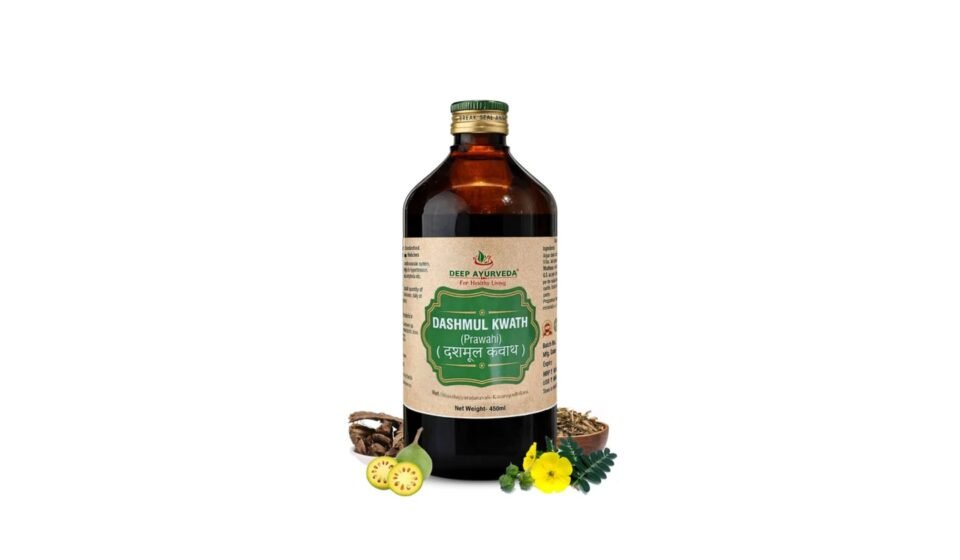
Dashmool Kwath: Complete Guide to Uses, Benefits, Dosage, Side Effects, and Safety

In Ayurveda, not every herbal formulation is meant to be used simply because it contains beneficial herbs. The real value of a formulation lies in understanding why those herbs are combined, which health pattern they are traditionally suited for, and how they should be prepared and used. Dashmool Kwath is a good example of this Ayurvedic approach.
Dashmool Kwath, also known as Dashamoola Kwatha, is a traditional Ayurvedic decoction prepared from a combination of ten medicinal roots. The name itself reflects its composition: Dash means ten, Moola means roots, and Kwath refers to a decoction prepared by processing herbs with water.
Traditionally, Dashamoola is particularly associated with Vata-related disorders, musculoskeletal discomfort, stiffness, certain inflammatory presentations, respiratory complaints, and selected conditions involving weakness or disturbed movement of Vata. However, this does not mean that Dashmool Kwath is appropriate for every person experiencing pain, swelling, cough, or body ache.
From an Ayurvedic perspective, the same symptom can have different causes. For example, joint discomfort associated with dryness and stiffness may be approached differently from pain accompanied by marked swelling, heat, or another underlying condition. Therefore, the person’s Prakriti, current imbalance (Vikriti), digestion, age, symptoms, and overall health can all influence whether Dashmool Kwath is appropriate.
This is also where a common misconception needs to be addressed: Dashmool Kwath is not simply an Ayurvedic pain-relief drink. It is a traditional multi-herb formulation whose use depends on the clinical context.
In this complete guide, we will explore what Dashmool Kwath is, its ten ingredients, traditional Ayurvedic uses and benefits, preparation method, dosage considerations, possible side effects, precautions, interactions, modern research, and practical mistakes to avoid. We will also discuss an important question that is often overlooked: when should you avoid self-using Dashmool Kwath and consult an Ayurvedic or medical professional instead?
Important: This article provides educational information about Dashmool Kwath and should not be considered a substitute for individual medical advice. Dosage and suitability can vary according to the formulation, health condition, age, medications, and individual needs.
What Is Dashmool Kwath?
Dashmool Kwath, also written as Dashamool Kwath or Dashamoola Kwatha, is a traditional Ayurvedic herbal decoction prepared from a group of ten medicinal roots. In Ayurveda, these ten herbs are collectively known as Dashamoola, a classical combination traditionally used in formulations addressing Vata-related imbalances and selected inflammatory, musculoskeletal, respiratory, and other health conditions.
The word Dashamoola has a simple meaning:
- Dash = ten
- Moola = roots
- Kwath/Kwatha = decoction
So, in simple terms, Dashmool Kwath is a decoction prepared from the ten-root Dashamoola group.
But there is an important distinction that is often missed in online articles. Dashamoola refers to the herbal combination, whereas Dashmool Kwath refers to a preparation made from that combination. The exact form available in the market may vary, including coarse herbal material used for preparing a decoction, powdered Kwath formulation, or ready-to-use liquid preparations.
Why Are Ten Roots Combined in Dashmool?
Ayurveda traditionally uses herbs in combinations rather than always relying on a single plant. The purpose is to create a formulation in which different herbs contribute complementary properties.
Dashamoola is traditionally divided into two groups:
Brihat Panchamoola – the five larger roots:
- Bilva
- Agnimantha
- Shyonaka
- Patala
- Gambhari
Laghu Panchamoola – the five smaller roots:
- Shalaparni
- Prishniparni
- Brihati
- Kantakari
- Gokshura
Together, these ten herbs form the classical Dashamoola group.
Dashmool Kwath From an Ayurvedic Perspective
From an Ayurvedic physician’s perspective, it is better to understand Dashmool Kwath through the concepts of Dosha, Dushya, Agni, and the nature of the complaint, rather than simply calling it a remedy for pain.
Dashamoola is traditionally associated particularly with Vata management. Vata governs movement and is closely related in Ayurveda to the nervous system, movement of the joints, circulation of impulses, and various physiological activities. When Vata becomes aggravated, symptoms such as stiffness, discomfort, dryness, restricted movement, and body ache may occur depending on the underlying condition.
Dashmool Kwath has therefore traditionally been included in Ayurvedic approaches where Vata aggravation is considered relevant. Its traditional applications also extend beyond musculoskeletal complaints and may include selected respiratory, inflammatory, fever-associated, and postpartum contexts.
However, a symptom alone is not enough to decide whether Dashmool Kwath is suitable. Two people can experience joint pain, for example, while having very different Ayurvedic presentations and different underlying medical causes.
Is Dashmool Kwath the Same as Dashamoola?
The terms are closely related but should not always be treated as identical.
Dashamoola is the name of the ten-herb combination.
Dashmool Kwath is a decoction prepared from the Dashamoola group.
This distinction becomes particularly important when discussing dosage. A person cannot automatically use the same quantity for a Kwath churna, a freshly prepared decoction, and a concentrated or ready-to-use liquid product. The concentration and preparation method can differ.
Why the Preparation Method Matters
A traditional Kwath is not simply herbal powder mixed into a glass of warm water. A decoction involves extracting constituents from the herbal material through controlled boiling and reduction of water.
This means the quantity of herbs, particle size, water volume, boiling process, reduction, filtration, and final concentration can influence the resulting preparation.
For this reason, when purchasing Dashmool Kwath, readers should follow the manufacturer’s preparation and dosage instructions rather than assuming that every Dashmool product has the same strength.
The 10 Ingredients of Dashmool Kwath
The traditional Dashmool formulation is built around ten medicinal plants, divided into two groups of five: Brihat Panchamoola and Laghu Panchamoola. This classification is an important part of understanding Dashmool Kwath because the formulation is designed as a combination rather than as ten unrelated herbs.
From an Ayurvedic perspective, the value of Dashamoola lies not only in the properties of individual herbs but also in their combined therapeutic profile. Each ingredient contributes its own Rasa, Guna, Virya, Vipaka, and traditional actions, while the complete combination is used according to the patient’s condition.
Brihat Panchamoola — The Five Larger Roots
The first group is known as Brihat Panchamoola, traditionally comprising five plants.
| Ayurvedic Name | Common/Botanical Name |
|---|---|
| Bilva | Aegle marmelos |
| Agnimantha | Premna integrifolia |
| Shyonaka | Oroxylum indicum |
| Patala | Stereospermum suaveolens |
| Gambhari | Gmelina arborea |
1. Bilva (Aegle marmelos)
Bilva is one of the well-known plants of Ayurveda and is traditionally valued for its influence on digestion and Vata-related conditions. Its inclusion in Dashamoola contributes to the broader balancing profile of the formulation.
Bilva is also used in several other classical Ayurvedic preparations, particularly where digestive and Vata-related considerations are important.
2. Agnimantha (Premna integrifolia)
Agnimantha is traditionally associated with Vata-Kapha balancing properties and is an important member of Dashamoola.
In Ayurvedic practice, it is traditionally used in formulations addressing conditions involving pain, stiffness, swelling, and impaired movement. Its presence supports the overall Vata-oriented character of Dashmool.
3. Shyonaka (Oroxylum indicum)
Shyonaka is another important Dashamoola ingredient traditionally used in Ayurvedic formulations.
Modern experimental research has also investigated Shyonaka and Dashamoola preparations for their potential anti-inflammatory activity. However, laboratory findings should not be interpreted as proof that the herb treats or cures a specific disease in humans.
This distinction is important when reading online herbal claims: traditional use, laboratory research, animal studies, and proven clinical efficacy are different levels of evidence.
4. Patala (Stereospermum suaveolens)
Patala is traditionally included among the five larger roots of Dashamoola. Ayurvedic literature associates it with formulations used for Vata-related and inflammatory presentations.
Rather than considering Patala as an isolated pain-relieving herb, it is more appropriate to understand its role as part of the complete Dashamoola combination.
5. Gambhari (Gmelina arborea)
Gambhari is traditionally regarded as an important medicinal plant in Ayurveda and is included in several classical formulations.
Its traditional properties complement the other members of Brihat Panchamoola and contribute to the overall formulation used in selected Vata-related conditions.
Laghu Panchamoola — The Five Smaller Roots
The second group is called Laghu Panchamoola. It contains another five medicinal plants:
| Ayurvedic Name | Common/Botanical Name |
|---|---|
| Shalaparni | Desmodium gangeticum |
| Prishniparni | Uraria picta |
| Brihati | Solanum indicum |
| Kantakari | Solanum xanthocarpum |
| Gokshura | Tribulus terrestris |
6. Shalaparni (Desmodium gangeticum)
Shalaparni is traditionally used in Ayurveda in formulations associated with weakness, Vata imbalance, and recovery from certain illnesses.
It is one of the herbs that helps give Dashamoola its broader restorative and Vata-oriented character.
7. Prishniparni (Uraria picta)
Prishniparni is traditionally considered a member of the Dashamoola group and is used in Ayurvedic formulations involving Vata-related conditions.
Its traditional role is better understood as part of the collective action of Dashamoola rather than as an isolated treatment for one particular symptom.
8. Brihati (Solanum indicum)
Brihati belongs to the Solanaceae family and is traditionally included among the Laghu Panchamoola.
Ayurvedic applications of Brihati include formulations used in respiratory and Vata-Kapha-related conditions. Its inclusion helps broaden the traditional applications of Dashamoola beyond purely musculoskeletal complaints.
9. Kantakari (Solanum xanthocarpum)
Kantakari is another important member of the Laghu Panchamoola group.
It is traditionally associated particularly with Kapha and respiratory presentations, and is found in several classical Ayurvedic respiratory formulations.
This is one reason Dashmool should not be viewed solely as a formulation for joints or body pain.
10. Gokshura (Tribulus terrestris)
Gokshura is perhaps one of the more familiar Ayurvedic herbs in this group.
It is traditionally associated with the urinary system, Mutravaha Srotas, and Vata-related conditions. Its presence adds a different dimension to Dashamoola’s traditional profile.
Why Are These 10 Herbs Combined?
This is perhaps the most interesting part of Dashmool Kwath.
If Dashamoola were simply intended to provide ten herbs for pain, there would be little reason to maintain such a specific classical combination.
Instead, Ayurveda uses the formulation as a multi-herb therapeutic system.
The ten ingredients collectively bring different properties and traditional actions to the preparation. Some have stronger associations with Vata, some with Kapha-related respiratory presentations, while others are traditionally connected with digestion, urinary function, inflammation, or general strength.
Therefore, the traditional logic of Dashmool Kwath is better understood as:
individual herbal properties + complementary actions + appropriate Ayurvedic assessment = formulation-specific use
This is also why replacing one ingredient with another simply because both are described online as anti-inflammatory does not necessarily produce an equivalent formulation.
How Does Dashmool Kwath Work According to Ayurveda?
To understand Dashmool Kwath properly, it helps to move beyond the question, What does it treat? Ayurveda generally approaches a health complaint by looking at the underlying imbalance, the affected tissues and channels, digestive capacity, and the individual’s overall constitution.
Dashmool is traditionally considered particularly relevant to Vata-dominant conditions, while its ten herbs collectively provide a broader therapeutic profile. This is why the same formulation may be considered in different clinical situations—but not necessarily for every person with the same symptom.
Dashmool and Vata Dosha
In Ayurveda, Vata Dosha governs movement and is associated with functions such as bodily movement, nerve activity, circulation, respiration, and elimination.
When Vata becomes aggravated, traditional Ayurvedic descriptions may include symptoms such as:
- stiffness
- dryness
- discomfort or pain
- restricted movement
- weakness
- disturbed sleep
- a feeling of heaviness or irregularity in certain bodily functions
The traditional properties of Dashamoola make it particularly relevant to formulations used for selected Vata-related presentations.
However, it would be incorrect to conclude that every type of pain is caused by Vata or that every painful condition should automatically be treated with Dashmool Kwath.
For example, a person experiencing discomfort with pronounced heat and swelling may require a different Ayurvedic assessment from someone whose primary complaints are dryness, stiffness, cracking joints, and restricted movement.
The symptom is only one part of the diagnosis.
Dashmool and Shotha — The Ayurvedic View of Swelling
Shotha is an Ayurvedic term broadly associated with swelling or inflammatory-type presentations.
Dashamoola has traditionally been included in Ayurvedic approaches where Shotha and Vata involvement are considered relevant. Modern experimental research has also investigated Dashamoola preparations for anti-inflammatory activity, providing an area of scientific interest.
But there is an important difference between these two statements:
Traditional Ayurvedic use: Dashamoola is used in selected conditions involving Shotha and Vata.
Scientific evidence: Experimental studies have investigated its anti-inflammatory potential.
The second statement does not automatically prove that Dashmool Kwath can treat every inflammatory disease in humans.
This distinction is especially important for health content because swelling can have many causes. It may occur following an injury, infection, autoimmune condition, allergic reaction, vascular problem, or another medical issue. Persistent or unexplained swelling therefore deserves proper assessment rather than prolonged self-treatment.
What About Vata-Kapha Conditions?
Dashmool is interesting because its traditional applications are not restricted to purely Vata presentations.
Some of its ingredients, particularly members of Laghu Panchamoola such as Brihati and Kantakari, have traditional associations with Kapha-related and respiratory conditions.
This gives Dashamoola a broader traditional profile.
For instance, a person may have a combination of:
- stiffness or body discomfort
- heaviness
- congestion
- reduced appetite
- respiratory discomfort
From an Ayurvedic perspective, the practitioner would consider the combination of symptoms rather than treating each complaint separately.
This is one reason classical Ayurvedic formulations are often selected according to the overall pattern of imbalance, rather than according to a single symptom.
The Role of Agni in Ayurvedic Assessment
Another concept that should not be overlooked is Agni, or digestive and metabolic capacity.
Ayurveda considers digestion important when deciding how a person may respond to a formulation.
A person with good digestive capacity may tolerate a preparation differently from someone experiencing:
- poor appetite
- indigestion
- abdominal heaviness
- excessive gas
- irregular bowel movements
Therefore, simply asking, What is the recommended Dashmool Kwath dosage? may not provide the complete answer from an Ayurvedic perspective.
The formulation, preparation, dose, timing, diet, digestive capacity, and individual’s condition may all influence how it is used.
Why Dashmool Kwath Is Not a Universal Pain Remedy
This is one of the most important points for anyone considering Dashmool Kwath.
Suppose three people visit an Ayurvedic practitioner complaining of back pain.
The first may have stiffness and dryness with a Vata-dominant presentation.
The second may have acute pain following an injury.
The third may have severe pain associated with another underlying medical condition.
Although all three use the same words—I have back pain—their clinical situations are not necessarily the same.
An Ayurvedic practitioner therefore does not ideally prescribe a formulation simply by matching a product to a symptom.
Instead, the assessment considers factors such as:
Prakriti → Vikriti → Dosha → Agni → affected tissues → disease stage → strength of the person → suitability of the formulation
This approach is much closer to the traditional Ayurvedic principle of individualized care.
Dashmool and the Concept of Srotas
Ayurveda also describes the body through Srotas, or functional channels through which different substances and physiological processes are understood to operate.
Depending on the clinical situation, Ayurvedic practitioners may consider different Srotas when evaluating a patient’s symptoms.
For example, a presentation involving:
- movement and musculoskeletal function,
- respiratory function,
- urinary function,
- or digestive disturbances
may require a different assessment even if Dashmool is being considered.
This broader perspective helps explain why Dashmoola appears in different traditional contexts rather than having one narrowly defined use.
What Modern Science Can—and Cannot—Tell Us
Modern research has investigated Dashamoola and some of its individual ingredients for properties such as anti-inflammatory and antioxidant activity.
Experimental studies provide useful scientific leads, but they should be interpreted carefully.
A laboratory or animal study can help researchers understand potential biological activity. It does not automatically establish that the same effect will occur in humans at the same dose or that Dashmool Kwath can replace established medical treatment.
Therefore, a responsible interpretation is:
Traditional Ayurvedic use provides the historical and clinical context for Dashmool, while modern research helps investigate possible biological mechanisms. Neither should be exaggerated beyond the evidence available.
This balanced approach is particularly important when discussing Ayurvedic medicines online.
Dashmool Kwath Benefits: What Is It Traditionally Used For?
Dashmool Kwath has been used in Ayurvedic practice as a multi-herb decoction for selected Vata-related and inflammatory presentations. Its traditional applications are broader than simply managing pain, which is why reducing Dashmool to a natural painkiller does not fully explain its place in Ayurveda.
The ten herbs of Dashamoola are traditionally selected for their complementary properties. Depending on the individual’s condition, Ayurvedic practitioners may consider Dashmool in situations involving musculoskeletal discomfort, stiffness, swelling, respiratory complaints, fever-associated body discomfort, and selected postpartum conditions.
However, these are traditional Ayurvedic uses, not a guarantee that the formulation will treat or cure a particular disease. The appropriate use depends on the person’s symptoms, constitution, digestive capacity, age, other medicines, and underlying health condition.
1. May Support Joint Comfort and Mobility
Joint discomfort accompanied by stiffness and restricted movement is one of the areas in which Dashmool is traditionally considered.
From an Ayurvedic perspective, Vata has a close relationship with movement and the musculoskeletal system. When Vata becomes aggravated, dryness, stiffness and discomfort may become prominent.
Dashmool may therefore be included in an Ayurvedic treatment plan when the overall symptom pattern suggests Vata involvement.
It should not, however, be assumed that every type of arthritis or joint pain requires Dashmool Kwath. Persistent joint pain, significant swelling, redness, trauma, or loss of function should be properly evaluated to identify the underlying cause.
2. Traditionally Used for Vata-Related Musculoskeletal Complaints
The traditional identity of Dashamoola is strongly connected with Vata management.
Ayurvedic practitioners may consider it in selected presentations involving:
- body stiffness
- muscular discomfort
- restricted movement
- Vata-associated aches
- discomfort associated with certain musculoskeletal conditions
The important word here is selected.
Ayurveda does not classify all musculoskeletal pain as one condition. The nature of the pain, associated symptoms, digestion, strength, age and Dosha involvement can influence the treatment approach.
3. May Support Comfort in Selected Swelling-Associated Conditions
Dashamoola has traditionally been used in Ayurvedic approaches involving Shotha, a term broadly associated with swelling.
Modern experimental research has also investigated Dashamoola for anti-inflammatory activity. This makes the formulation scientifically interesting, but experimental findings should not be interpreted as proof that Dashmool Kwath treats inflammatory diseases in humans.
If swelling is sudden, severe, unexplained, associated with fever, injury, breathing difficulty, chest pain, or significant redness and warmth, self-treatment is not appropriate.
4. Traditionally Used in Certain Respiratory Presentations
Dashmool is sometimes discussed only in relation to joints and pain, but its traditional applications also extend into selected Vata-Kapha and respiratory presentations.
Ingredients within the Laghu Panchamoola group, particularly Brihati and Kantakari, have traditional associations with respiratory health.
Depending on the Ayurvedic assessment, Dashamoola may therefore be considered in formulations or treatment plans where respiratory symptoms occur alongside an appropriate Dosha pattern.
This does not mean Dashmool Kwath should replace prescribed treatment for asthma, pneumonia, serious respiratory infections, or breathing emergencies.
5. May Be Considered for Body Ache Associated With Certain Conditions
Generalised body ache can occur for many reasons, including physical exertion, inadequate rest, infections, nutritional issues, stress, or an underlying medical condition.
In Ayurveda, body ache may sometimes be interpreted through the lens of aggravated Vata, particularly when associated with stiffness, dryness or restricted movement.
Dashmool may traditionally be used in such situations when the overall presentation is considered appropriate.
But unexplained or persistent body pain should not automatically be attributed to Vata. Finding the underlying cause remains important.
6. Traditionally Included in Selected Fever-Related Ayurvedic Approaches
Dashamoola has a longstanding place in classical Ayurvedic formulations and therapeutic approaches involving certain fever-related presentations.
Its traditional use in this context should not be confused with the idea that Dashmool Kwath independently treats the cause of every fever.
Fever can result from infections and numerous other conditions. A high, persistent, recurrent, or unexplained fever requires appropriate medical evaluation rather than relying solely on an herbal decoction.
7. May Support Urinary Health in Appropriate Ayurvedic Contexts
Gokshura, one of the ten Dashamoola herbs, has a strong traditional association with the urinary system and Mutravaha Srotas.
Because Gokshura forms part of Dashamoola, urinary health is another area in which the formulation may appear in traditional Ayurvedic practice.
However, this should not be interpreted as a claim that Dashmool Kwath treats urinary tract infections, kidney stones, or other urinary diseases.
Symptoms such as burning urination, blood in urine, fever with urinary symptoms, severe flank pain, or difficulty passing urine require proper evaluation.
8. Traditionally Considered in Selected Postpartum Conditions
Dashamoola has also been used traditionally in certain postpartum Ayurvedic approaches, particularly in contexts where Vata is considered aggravated after childbirth.
The postpartum period is physiologically important, and treatment should be individualized. Factors such as type of delivery, bleeding, digestion, lactation, medications, surgical recovery, and overall strength can influence whether a particular formulation is appropriate.
Therefore, new mothers should not begin Dashmool Kwath simply because it is described online as a postpartum recovery medicine.
9. May Have Potential Anti-Inflammatory Activity
One of the areas attracting scientific interest is the potential anti-inflammatory activity of Dashamoola.
Experimental research has investigated Dashamoola preparations and individual ingredients for biological effects associated with inflammation. Such findings may help researchers understand how traditional formulations could interact with biological pathways.
But there is an important evidence boundary:
Potential biological activity ≠ proven clinical treatment.
More high-quality human research is needed before broad therapeutic claims can be made for specific inflammatory diseases.
10. Its Traditional Value Comes From the Complete Formulation
Perhaps the most important benefit of understanding Dashmool Kwath is recognising that it is a compound formulation.
Its traditional applications cannot be explained adequately by saying:
Herb A is for pain, Herb B is for inflammation, and Herb C is for digestion.
Ayurveda considers the combined qualities of the formulation and its suitability for the individual’s condition.
That is why Dashmool Kwath should be viewed as a context-dependent Ayurvedic preparation, rather than a universal remedy for every complaint listed on an online product page.
What These Benefits Really Mean
When an Ayurvedic source says that Dashmool Kwath is traditionally used for a particular condition, it does not necessarily mean that modern clinical trials have conclusively demonstrated that it cures that condition.
For health information, it is useful to separate three categories:
Traditional Ayurvedic use: Based on classical knowledge and clinical tradition.
Scientific research: Studies investigating possible biological effects or mechanisms.
Clinically established treatment: Supported by appropriate human evidence and accepted medical practice.
Dashmool currently has an interesting research profile, but these categories should not be mixed together.
As an Ayurvedic physician, I consider this distinction important because it allows patients to appreciate traditional medicine without creating unrealistic expectations.
How to Prepare Dashmool Kwath Traditionally
The word Kwath refers to a decoction prepared by extracting the soluble constituents of herbs into water through controlled heating and reduction. Therefore, preparing Dashmool Kwath traditionally involves more than simply adding herbal powder to hot water.
The quality of the final decoction can depend on factors such as the form of the herbal material, quantity used, water volume, particle size, heating time, reduction, filtration, and storage.
Traditional Dashmool Kwath Preparation
For a classical-style preparation, Dashmool is generally used in a coarse form rather than an extremely fine powder.
The basic process involves:
- Measure the appropriate quantity of Dashmool coarse herbal material.
- Add the recommended quantity of water.
- Allow the mixture to boil gently.
- Continue heating so that the water gradually reduces and extracts constituents from the herbs.
- Reduce it to the volume specified by the applicable preparation method.
- Filter the decoction carefully to remove the herbal residue.
- Use the prepared Kwath according to the practitioner’s or product’s directions.
The exact proportions and reduction method can vary according to the classical reference, formulation and purpose. For this reason, it is better not to assume that one household preparation method applies to every commercially available Dashmool product.
Why Is Dashmool Boiled Instead of Simply Soaked?
This is an important distinction between a decoction and a simple herbal infusion.
Harder plant materials such as roots and barks generally require a more extensive extraction process than delicate leaves or flowers. Since Dashmool contains multiple root-based ingredients, controlled boiling and reduction are traditionally used to prepare the Kwath.
Simply pouring hot water over Dashmool powder may therefore produce a preparation that is different from a traditionally prepared decoction.
Can Dashmool Kwath Be Made From Fine Powder?
This depends on the product and its intended method of use.
A product labelled Dashmool Kwath Churna may be supplied specifically for preparing a decoction, while another product may already be a concentrated or ready-to-use liquid.
These forms should not automatically be treated as interchangeable.
Kwath churna → material used to prepare the decoction
Prepared Kwath → the resulting liquid decoction
Ready-to-use liquid → commercially manufactured preparation with its own concentration and dosage instructions
This distinction becomes particularly important when calculating dosage.
Should Dashmool Kwath Be Prepared Fresh?
Traditionally prepared herbal decoctions are generally intended for appropriate use after preparation rather than being stored casually for extended periods.
A freshly prepared decoction can also be vulnerable to contamination if it is kept improperly.
If you are using a commercially manufactured liquid Dashmool preparation, follow the manufacturer’s storage instructions instead. A commercially prepared product may contain specific preservation, packaging, and stability considerations that do not apply to a homemade decoction.
Can I Prepare Dashmool Kwath at Home?
Yes, a person may prepare a decoction at home when they have an appropriately identified product and clear preparation instructions.
However, the most common problem with home preparation is inconsistency.
For example, two people may use the same number of spoonfuls of powder but:
- use different amounts of water,
- boil for different lengths of time,
- reduce the liquid to different volumes,
- use different particle sizes,
- or store the final decoction differently.
The resulting preparations may therefore differ in concentration.
This is one reason professionally prepared Ayurvedic products can be more convenient when consistent dosing and standardized manufacturing are important.
A Common Mistake: Confusing Dashmool Powder With Dashmool Kwath
This deserves special attention.
If a label says Dashmool Kwath Churna, it does not necessarily mean that the powder should be swallowed directly in the same quantity as a liquid Kwath.
Likewise, a ready-made liquid labelled Dashmool Kwath should not automatically be diluted or boiled again unless the product instructions specifically say so.
Always follow the preparation instructions provided for the exact formulation you are using.
Does Preparation Affect the Strength of Dashmool Kwath?
Yes, the final concentration can be influenced by the preparation process.
Imagine two preparations made from the same starting herbs. If one is reduced substantially and another contains much more remaining water, the amount of extracted material per millilitre will not necessarily be the same.
Therefore, comparing products simply by saying:
Both contain Dashmool, so 10 ml of each must be equivalent
would be an unsafe assumption.
The concentration, manufacturing process, ingredients, extract ratio, and recommended serving can differ between products.
Dashmool Kwath Dosage: How Much Should You Take?
There is no single universal dose of Dashmool Kwath that is appropriate for everyone. The amount depends on the form of the preparation, its concentration, the person’s age and health status, the condition being addressed, digestive capacity, and whether it has been prescribed as part of a broader Ayurvedic treatment plan.
This is particularly important because Dashmool Kwath Churna, freshly prepared Dashmool decoction, and ready-to-use liquid preparations are different dosage forms.
Dashmool Kwath Churna
Dashmool Kwath Churna is generally intended to be processed into a decoction according to the instructions provided with the formulation.
The quantity of powder used to prepare the decoction should therefore not automatically be interpreted as the quantity of liquid that should be consumed.
Different manufacturers may also provide different preparation instructions depending on the composition, processing method and intended use.
Freshly Prepared Dashmool Kwath
For a freshly prepared decoction, the final dose depends on how the Kwath was prepared and how concentrated the resulting liquid is.
A decoction made by reducing a measured quantity of herbs substantially will not necessarily have the same concentration as a preparation containing a larger volume of water.
For this reason, the dose should be based on the specific preparation method rather than an arbitrary number of millilitres copied from another product.
Ready-to-Use Dashmool Liquid Preparations
Commercial liquid Dashmool preparations can differ significantly in concentration and manufacturing method.
Therefore, if a product is already prepared and bottled, use the dosage printed on that particular product’s label or the dose recommended by your qualified practitioner.
Do not assume that the recommended dose of one manufacturer’s Dashmool liquid applies to another manufacturer’s product.
Why a Universal Dosage Is Not Ideal
Several factors can influence how an Ayurvedic practitioner approaches dosage, including:
- age
- body strength
- digestive capacity (Agni)
- constitution (Prakriti)
- current Dosha imbalance
- severity and nature of the complaint
- other medicines being taken
- pregnancy or breastfeeding
- other medical conditions
- the specific Dashmool preparation
This is why two people with apparently similar symptoms may not necessarily receive exactly the same Ayurvedic prescription.
How Often Should Dashmool Kwath Be Taken?
The frequency depends on the specific preparation and therapeutic purpose.
Some commercially available products may recommend once- or twice-daily use, while an Ayurvedic practitioner may prescribe a different schedule based on the individual’s condition.
Therefore, rather than following a generic internet dosage, check:
1. The product label
2. The preparation instructions
3. Your Ayurvedic practitioner’s prescription, if applicable
How Long Can You Take Dashmool Kwath?
The duration should not be determined solely by how many benefits are listed online.
Short-term use and longer-term use can have different considerations. If symptoms continue despite using the formulation, repeatedly increasing the dose or continuing it indefinitely is not a good approach.
Persistent pain, swelling, recurrent fever, unexplained weakness, or other ongoing symptoms may indicate an underlying condition that needs evaluation.
From an Ayurvedic perspective, treatment duration can depend on the disease stage, Dosha involvement, strength of the patient, Agni, and response to treatment.
Should Dashmool Kwath Be Taken Before or After Food?
There is no single timing that applies to every Dashmool preparation.
The appropriate timing can depend on the formulation and the reason for its use. Some preparations may be directed around meals, while an Ayurvedic practitioner may prescribe a specific timing according to the treatment plan.
If you experience digestive discomfort when taking an herbal preparation on an empty stomach, do not simply increase the dose or ignore the symptoms. Check the product directions and seek professional advice when necessary.
What Can Dashmool Kwath Be Taken With?
The liquid may be taken with the Anupana or accompanying substance specifically recommended for the formulation.
Warm water may be used with some preparations, but the appropriate Anupana can vary according to the formulation and therapeutic objective.
This is another area where copying instructions from a different Ayurvedic product can lead to inappropriate use.
Can You Take a Higher Dose for Faster Results?
No.
Taking more does not necessarily mean faster or better results.
An Ayurvedic formulation should be used according to an appropriate dose and treatment plan. Increasing the quantity without professional guidance can increase the possibility of intolerance or unwanted effects while failing to address the underlying cause of the symptoms.
This is especially important when someone is already taking several medicines or herbal formulations.
What If You Miss a Dose?
If Dashmool Kwath has been prescribed as part of a treatment plan and you miss a dose, do not automatically double the next dose.
Follow the product instructions or ask your healthcare professional how to proceed.
When Is the Best Time to Take Dashmool Kwath?
The best time to take Dashmool Kwath depends on the formulation, digestive capacity (Agni), health concern, and individual Ayurvedic assessment. There is no universal rule that Dashmool Kwath must always be taken on an empty stomach or after meals. In Ayurveda, the timing of a medicine is often selected according to the condition being addressed and how well the person tolerates it.
For some people, taking a preparation at a particular time may be comfortable, while others may experience digestive discomfort if it is taken without food. Therefore, the product label and advice of a qualified Ayurvedic practitioner should take priority over generalized timing advice found online.
Should Dashmool Kwath Be Taken Before or After Food?
This is one of the most common questions I receive about Ayurvedic decoctions. The answer depends on the specific preparation.
If you are using Dashmool Kwath Churna to prepare a traditional decoction, the timing may be different from that of a ready-to-use liquid formulation. Similarly, the appropriate schedule can vary depending on whether the preparation is being used traditionally for Vata-related discomfort, respiratory concerns, recovery support, or another purpose.
Rather than choosing a timing simply because it is commonly recommended online, consider these factors:
- The exact form of Dashmool being used
- The quantity and concentration of the preparation
- Your digestive strength
- The purpose for which it is being taken
- Other medicines or Ayurvedic formulations being used
- Whether you experience acidity, nausea, bloating, or digestive sensitivity
If a practitioner has prescribed a specific schedule, follow that schedule rather than changing the timing yourself.
What Is Anupana, and Why Does It Matter?
In Ayurveda, Anupana refers to the substance taken along with or after a medicine to support its administration. Depending on the formulation and individual requirement, different Anupanas may be considered.
However, Anupana should not be selected casually. The appropriate vehicle can vary according to the person’s Dosha, Agni, season, age, digestive tolerance, and therapeutic objective.
For Dashmool Kwath, it is therefore better to avoid assuming that one Anupana is suitable for everyone.
A Practical Ayurvedic Approach
When I assess an Ayurvedic formulation for a person, I do not look at the medicine alone. I also consider when it is taken, how it is prepared, what it is taken with, and whether the person’s current condition is suitable for it.
This is particularly important with traditional decoctions because their concentration and method of preparation can influence how they are used.
What If Dashmool Kwath Causes Digestive Discomfort?
If you notice symptoms such as:
- Stomach discomfort
- Nausea
- Loose stools
- Unusual abdominal irritation
- Increased acidity or burning
do not simply increase or decrease the dose on your own. Review the preparation method and timing, and discuss continued use with a qualified healthcare professional or Ayurvedic practitioner.
Dashmool Kwath Side Effects: Is It Safe?
Dashmool Kwath is a traditional Ayurvedic herbal decoction, but natural does not automatically mean that it is suitable for everyone or that it can be taken in unlimited quantities. Its safety depends on the ingredients, preparation, dose, duration of use, individual constitution, digestive capacity, existing health conditions, and other medicines being taken.
When used appropriately and in a suitable person, Dashmool Kwath is traditionally used in Ayurveda for several Vata- and inflammation-related contexts. However, self-prescribing large quantities or taking it for a prolonged period without professional guidance is not recommended.
Possible Side Effects of Dashmool Kwath
Some people may experience digestive or other discomfort, particularly if the preparation is too concentrated, the dose is unsuitable, or the person does not tolerate one or more ingredients.
Possible unwanted effects may include:
- Stomach discomfort or heaviness
- Nausea
- Loose stools or changes in bowel habits
- Acidity or digestive irritation in sensitive individuals
- An unpleasant taste or difficulty tolerating the decoction
- Allergic reactions in people sensitive to one of its botanical ingredients
These effects are not inevitable, and they should not be assumed to occur in everyone taking Dashmool Kwath.
What Should You Do If You Experience Side Effects?
If you develop a mild but persistent digestive problem after starting Dashmool Kwath, pause and review the preparation, dose, and timing with a qualified Ayurvedic practitioner or healthcare professional.
If you experience signs of a serious allergic reaction—such as difficulty breathing, swelling of the face or throat, widespread hives, or severe dizziness—seek urgent medical attention.
It is also important not to increase the dose simply because the expected benefit has not appeared quickly. Traditional herbal preparations generally require an individualized approach rather than a more is better strategy.
Who Should Use Dashmool Kwath With Extra Caution?
Certain groups should not start Dashmool Kwath casually without professional advice.
1. Pregnant Women
Pregnancy requires particular caution with herbal medicines because safety can depend on the individual ingredients, dose, formulation, and stage of pregnancy. Do not start Dashmool Kwath during pregnancy unless its use has been specifically assessed by an appropriately qualified healthcare professional.
2. Breastfeeding Women
If you are breastfeeding, discuss Dashmool Kwath with a qualified practitioner before use. The fact that a preparation is traditionally used does not establish that every formulation or dose is appropriate during lactation.
3. People Taking Prescription Medicines
If you regularly take prescription or over-the-counter medicines, inform your doctor or Ayurvedic practitioner before adding Dashmool Kwath. This is especially important when you are being treated for a chronic condition or taking several medicines at the same time.
4. People With Sensitive Digestion
Individuals who frequently experience acidity, loose stools, nausea, or other digestive problems may require a more individualized approach to herbal decoctions.
5. Children and Older Adults
Dosage should not simply be copied from an adult product label for children or older adults. Age, body strength, digestion, existing medicines, and health status should be considered.
Can You Take Dashmool Kwath Every Day?
Daily use should not automatically be considered appropriate simply because Dashmool Kwath is an Ayurvedic formulation.
The correct duration depends on why it is being used, the form of preparation, the dose, and the individual’s response. Short-term use under appropriate guidance is different from taking a concentrated decoction continuously for months without reassessment.
From an Ayurvedic perspective, I would also ask an important question before recommending continued use: Is the formulation still appropriate for the person’s current Vikriti (present imbalance)?
A medicine that may be appropriate during one phase of a condition may not necessarily remain appropriate indefinitely.
Important Safety Principle
Dashmool Kwath should be viewed as a traditional Ayurvedic medicinal preparation, not as a universal remedy for every type of pain, inflammation, fever, respiratory complaint, or weakness.
If symptoms are severe, persistent, unexplained, or worsening, proper medical evaluation should not be delayed in favor of self-treatment with an herbal preparation.
Who Should Avoid Dashmool Kwath Without Professional Guidance?
Dashmool Kwath has a long history of traditional Ayurvedic use, but that does not mean it should be self-prescribed in every situation. The suitability of an Ayurvedic formulation depends on the person’s Prakriti, current Vikriti, Agni, age, strength, symptoms, medications, and the exact preparation being used.
As an Ayurvedic doctor, I would therefore look beyond the name Dashmool Kwath before recommending it. Two people with similar-looking symptoms may require completely different approaches.
Pregnancy and Breastfeeding
Pregnancy and breastfeeding are situations where herbal medicines should be used particularly carefully. Do not begin Dashmool Kwath during pregnancy or lactation simply because it is described online as a natural or traditional remedy.
If its use is being considered, consult a qualified Ayurvedic practitioner and your healthcare professional so that the specific formulation, dose, duration, and individual circumstances can be assessed.
Children
Adult dosage information should never be automatically applied to children. Their body size, digestive capacity, and response to medicines can differ considerably.
For children, Dashmool Kwath should be used only when an appropriately qualified practitioner has assessed the need and determined a suitable preparation and dose.
People Taking Regular Medicines
If you take prescription medicines regularly, inform your doctor or Ayurvedic practitioner before adding Dashmool Kwath to your routine.
This is particularly important for people managing long-term health conditions or taking multiple medicines. Herbal preparations can contain several active plant constituents, so it is sensible to review the complete medication and supplement list rather than considering each product independently.
People With Digestive Sensitivity
A traditional decoction may not be equally comfortable for every digestive system. If you frequently experience acidity, loose stools, nausea, abdominal discomfort, or significant digestive irregularity, professional guidance can help determine whether the preparation and method of administration are appropriate.
People With Unexplained or Severe Symptoms
Dashmool Kwath should not be used to postpone proper medical assessment when symptoms may indicate a serious underlying problem.
Seek medical attention promptly for symptoms such as:
- Severe or sudden pain
- Difficulty breathing
- Chest pain or pressure
- Persistent high fever
- Fainting or severe weakness
- Sudden swelling
- New neurological symptoms
- Blood in urine, stool, or vomit
- Rapidly worsening symptoms
An Ayurvedic formulation may have a role within an individualized healthcare plan, but it should not replace urgent evaluation when warning signs are present.
Can Dashmool Kwath Be Taken With Other Medicines?
If you are already taking medicines, supplements, or other Ayurvedic formulations, it is sensible to discuss Dashmool Kwath with a qualified healthcare professional before adding it to your routine. The main concern is not that Dashmool Kwath will necessarily interact with every medicine, but that the safety of combining multiple preparations depends on their ingredients, doses, timing, and the person’s health condition.
This becomes particularly important when someone is taking several products at the same time.
Dashmool Kwath With Prescription Medicines
There is not enough evidence to assume that Dashmool Kwath is automatically compatible with every prescription medicine. Therefore, avoid making a blanket assumption that an Ayurvedic decoction can be combined with medicines simply because it is plant-based.
If you take regular medication for a chronic health condition, tell your doctor or Ayurvedic practitioner about all the products you use, including:
- Prescription medicines
- Over-the-counter medicines
- Herbal supplements
- Ayurvedic formulations
- Vitamins and minerals
- Other concentrated herbal extracts
Keeping a complete list makes it easier for a healthcare professional to assess your overall regimen.
Dashmool Kwath With Other Ayurvedic Medicines
Ayurveda frequently uses combinations of formulations, but combinations should be based on a clear therapeutic rationale rather than simply adding several products with similar claimed benefits.
For example, taking multiple formulations marketed for joint discomfort or inflammation does not necessarily mean that the results will be better. It may instead make it difficult to understand which preparation is helping or causing an unwanted reaction.
From a clinical perspective, I prefer to consider the overall formulation, dose, Anupana, timing, and duration rather than looking at Dashmool Kwath in isolation.
Should You Take Dashmool Kwath and Another Herbal Product Together?
Not necessarily.
Two herbal products can contain overlapping herbs or botanicals with similar physiological effects. Some may also have ingredients that are not obvious from the product’s marketing name.
Before combining products, check:
- The complete ingredient list
- The amount of each ingredient
- The recommended dosage
- The intended duration of use
- Whether both products are addressing the same therapeutic objective
- Any existing medical conditions or regular medicines
If you are uncertain, professional guidance is preferable to experimenting with multiple formulations simultaneously.
What About Spacing Dashmool Kwath From Other Medicines?
Simply separating two products by a few hours should not automatically be considered a guarantee of safety. Whether spacing is useful depends on the specific medicines and ingredients involved.
Therefore, if your doctor or pharmacist has provided a particular timing instruction, follow it. If you are using multiple Ayurvedic formulations, ask your practitioner whether they should be taken together or at separate times.
A Common Mistake to Avoid
One common mistake is to think:
If one Ayurvedic formulation is good for me, adding two or three more must be better.
Ayurvedic practice does not work on this principle. The objective is to choose an appropriate formulation and use it thoughtfully according to the individual’s needs.
When Should You Ask a Healthcare Professional?
Before combining Dashmool Kwath with other medicines, seek professional advice if you:
- Take several prescription medicines
- Have a long-term health condition
- Are pregnant or breastfeeding
- Are considering it for a child
- Have experienced an allergic reaction to herbal products
- Are already using several Ayurvedic formulations
- Are unsure about the correct dose or duration
Dashmool Kwath vs Dashmoolarishta vs Dashmool Taila
The word Dashmool appears in several Ayurvedic formulations, but they are not interchangeable. Dashmool Kwath, Dashmoolarishta, and Dashmool Taila differ in their form, preparation method, route of administration, and traditional application.
This distinction is important because many people search for Dashmool assuming that every Dashmool formulation provides the same action. In practice, the formulation makes a significant difference.
Dashmool Kwath
Dashmool Kwath is a decoction-based preparation traditionally made by processing Dashamoola herbs with water.
It is generally considered when an internal decoction is indicated according to an individual’s Ayurvedic assessment. Its traditional use is particularly associated with Vata-related conditions, Shotha (swelling/inflammatory presentations), musculoskeletal discomfort, and certain respiratory or recovery-related contexts.
Because the preparation involves water extraction, its method of preparation and concentration matter.
Key point: Dashmool Kwath is primarily an internally administered decoction when appropriately indicated.
Dashmoolarishta
Dashmoolarishta belongs to the Asava-Arishta category of Ayurvedic fermented preparations. Unlike a freshly prepared water decoction, an Arishta undergoes a controlled fermentation process and has a different composition and administration profile.
It should therefore not be treated as simply a stronger or long-lasting version of Dashmool Kwath.
The presence of naturally generated alcohol in fermented Ayurvedic preparations is another reason why dosage, suitability, and product-specific instructions matter.
Key point: Dashmoolarishta and Dashmool Kwath are different formulations and should not be substituted for one another without appropriate guidance.
Dashmool Taila
Dashmool Taila is an oil-based Ayurvedic preparation intended primarily for external application, depending on the specific formulation.
It may be used traditionally for applications such as massage or localized care in Vata-related musculoskeletal discomfort. Because it is used externally, its purpose and method are very different from an oral Dashmool decoction.
Which Dashmool Form Is Better?
There is no universally best Dashmool formulation.
The appropriate choice depends on the person’s condition, Dosha involvement, Agni, strength, age, formulation quality, and therapeutic objective.
For example, someone looking for an internal decoction should not automatically choose Dashmool Taila simply because both contain Dashmool. Likewise, someone using an external oil should not assume that taking an internal decoction will produce the same result.
What Does Modern Research Say About Dashmool Kwath?
Dashmool has attracted scientific interest because its constituent herbs contain a variety of naturally occurring phytochemicals. Researchers have investigated Dashamoola and related preparations for properties such as anti-inflammatory, antioxidant, analgesic, and other biological activities.
However, it is important to interpret this evidence carefully. Laboratory findings and animal studies cannot automatically be translated into proven clinical benefits in humans. Research on Dashmool is still developing, and the evidence quality can vary considerably depending on the preparation, study design, and condition being investigated.
Research on Anti-Inflammatory Activity
One area of scientific interest is the potential anti-inflammatory activity of Dashamoola preparations.
Experimental research has investigated Dashamoola formulations in animal models of inflammation and reported measurable anti-inflammatory effects. Such findings provide a scientific reason for further investigation, but they do not establish that Dashmool Kwath can replace clinically proven anti-inflammatory treatment in humans.
This distinction is particularly important when writing about Ayurvedic medicines. Traditional use can provide valuable therapeutic knowledge, while modern research helps investigate possible mechanisms—but the two should not be presented as identical forms of evidence.
Research on Pain and Musculoskeletal Concerns
Because Dashamoola has traditionally been associated with Vata-related musculoskeletal complaints, researchers have also explored its potential role in pain and inflammation-related conditions.
Some early clinical and experimental findings are encouraging, but studies differ in the formulation used, dosage, duration, and patient population. Therefore, it would be inappropriate to conclude that Dashmool Kwath universally treats arthritis, back pain, joint disease, or other chronic pain conditions.
From an Ayurvedic perspective, the clinical question is more individualized:
What is causing the pain, which Dosha is involved, and is Dashmool actually the appropriate formulation for that person?
That assessment remains more meaningful than treating every painful condition as a Dashmool indication.
What About Postpartum Use?
Dashamoola has a traditional place in certain Ayurvedic approaches to postpartum care. Modern researchers have also investigated Dashamoola preparations in postpartum settings.
Some clinical research has reported improvements in pain-related outcomes after childbirth. However, individual studies may have limitations such as small sample sizes, specific participant selection, or lack of a suitable comparison group.
Therefore, such findings should be viewed as preliminary evidence rather than definitive proof that Dashmool Kwath is required or beneficial for every woman after childbirth.
Postpartum care should always consider the type of delivery, bleeding, breastfeeding, medications, recovery status, and any complications.
Why Standardization Matters
One of the less-discussed issues with traditional herbal medicines is standardization.
Dashmool is a combination of multiple botanicals. The final preparation can potentially vary according to:
- Correct botanical identification
- Plant part used
- Harvesting conditions
- Processing method
- Storage
- Extraction procedure
- Proportion of individual ingredients
- Quality-control practices
This means that two products carrying a similar Dashmool name should not automatically be assumed to be chemically or therapeutically identical.
For consumers, this makes reliable sourcing and clear ingredient information particularly important.
Traditional Knowledge and Modern Science: How Should You Read the Evidence?
A balanced way to understand Dashmool Kwath is to place the available information into three categories:
| Evidence level | What it tells us |
|---|---|
| Traditional Ayurvedic use | Explains how Dashmoola has historically been selected and used within Ayurvedic principles |
| Laboratory and animal research | Helps investigate possible biological activities and mechanisms |
| Human clinical research | Provides more direct evidence about effects in people, but quality and applicability still need assessment |
This distinction prevents two common mistakes: dismissing traditional knowledge simply because modern research is limited, or treating preliminary research as if it were definitive clinical proof.
What We Still Need to Know
More high-quality human research is needed to clarify the effectiveness, optimal dosage, long-term safety, and appropriate clinical applications of specific Dashmool preparations.
Future studies would be particularly useful if they clearly define:
- The exact Dashmool formulation used
- Botanical identity and plant parts
- Preparation and concentration
- Dose and treatment duration
- Participant characteristics
- Comparison treatment or placebo
- Clinically meaningful outcomes
- Adverse effects and safety monitoring
How to Choose a Good-Quality Dashmool Kwath
Choosing Dashmool Kwath is not simply about finding the product with the longest list of benefits. Since Dashmool is a combination of ten medicinal plants, the quality and correct identification of the ingredients are important.
A well-prepared formulation should have clear information about its ingredients, dosage, method of use, manufacturer, batch details, and storage requirements. This becomes even more important when purchasing herbal products online, where appearance alone cannot tell you whether the raw materials have been correctly identified or processed.
1. Check the Complete Ingredient List
A quality Dashmool preparation should clearly disclose the ingredients used.
Look for the botanical names or sufficiently clear ingredient identification, particularly because several Ayurvedic herbs can have regional names or different commonly used names.
Do not rely solely on the word Dashmool on the front of the package.
2. Check Which Plant Parts Are Used
The plant part used in an Ayurvedic formulation matters.
Roots, bark, stems, leaves, fruits, and other plant parts can have different characteristics. Therefore, a product should provide sufficient information about the ingredients and formulation rather than leaving the consumer to assume that every Dashmool product uses identical plant material.
3. Look for Manufacturing and Batch Information
When purchasing a packaged Dashmool product, check for basic product information such as:
- Manufacturer details
- Batch or lot number
- Manufacturing date
- Expiry or best-before information
- Net quantity
- Directions for use
- Storage instructions
- Appropriate regulatory or licensing information applicable to the product
These details help with product traceability and responsible use.
4. Avoid Products With Unclear Claims
Be cautious with products that promise that Dashmool Kwath will cure multiple unrelated diseases, provide instant pain relief, or replace prescribed medical treatment.
Ayurvedic formulations can have traditional therapeutic applications, but responsible health information should distinguish between traditional use and clinically proven treatment.
A trustworthy product description should explain how the formulation is traditionally used without making unrealistic guarantees.
5. Pay Attention to Preparation Instructions
Dashmool Kwath may be available as a coarse herbal powder for preparing a decoction or as a ready-to-use liquid preparation.
These are not automatically equivalent.
If you are purchasing Dashmool Kwath Churna, check whether the package provides clear instructions for preparing the decoction. If it is a liquid product, follow the manufacturer’s stated dosage and storage instructions.
Never assume that the quantity of powder and quantity of ready-made liquid can be converted directly.
6. Check Storage Conditions
Herbal preparations should be stored according to the manufacturer’s instructions.
Exposure to excessive heat, moisture, sunlight, or contamination may affect product quality. After opening a liquid preparation, follow the stated storage requirements and observe any instructions regarding refrigeration or recommended use after opening.
7. Buy From a Reliable Source
When possible, purchase Ayurvedic medicines from a reputable manufacturer or authorized seller rather than choosing an unidentified product solely because it is cheaper.
Reliable sourcing gives you better access to ingredient information, manufacturing details, batch traceability, and customer support if you have questions about the product.
5 Common Mistakes to Avoid When Taking Dashmool Kwath
Dashmool Kwath is a traditional Ayurvedic formulation, but the way it is prepared and used can make a significant difference. In practice, many problems arise not because the formulation itself is unsuitable, but because people choose the wrong preparation, use an arbitrary dose, or continue it without reassessing their condition.
Here are five common mistakes worth avoiding.
1. Assuming More Dashmool Means Better Results
Taking a larger quantity does not necessarily make an Ayurvedic formulation more effective.
A higher dose may instead increase the likelihood of digestive discomfort or other unwanted effects. The appropriate amount depends on the preparation, concentration, individual factors, and reason for use.
Better approach: Follow the product instructions or individualized recommendation from a qualified practitioner rather than increasing the dose yourself.
2. Confusing Dashmool Churna With Ready-Made Kwath
This is one of the most important practical mistakes.
Dashmool Kwath Churna is generally used as the raw material for preparing a decoction, whereas a ready-to-use liquid formulation has already undergone its preparation process.
The quantity of powder should therefore not be directly compared with the millilitres of a ready-made liquid.
Better approach: Identify the exact dosage form before deciding how much to take.
3. Preparing the Decoction Without Following Proper Instructions
Traditional decoctions require appropriate preparation. Simply mixing a spoonful of powder into hot water and assuming it is equivalent to a properly prepared Kwath may produce a different concentration.
Water quantity, boiling, reduction, filtration, and the amount of starting material can all influence the final preparation.
Better approach: Follow the preparation instructions supplied with the specific product or obtain guidance from a qualified Ayurvedic practitioner.
4. Taking Dashmool for Every Type of Pain
Because Dashmool is frequently associated with Vata-related musculoskeletal discomfort, some people assume that it is appropriate for any joint, muscle, back, or body pain.
That is not a sound approach.
Pain can have many causes, including injury, infection, nerve involvement, inflammatory disorders, nutritional problems, and other medical conditions. Ayurveda also evaluates the underlying pattern rather than treating every symptom identically.
Better approach: If pain is severe, persistent, recurrent, or unexplained, get the underlying cause assessed instead of relying only on a herbal decoction.
5. Continuing It Indefinitely Without Reassessment
Another common mistake is treating Dashmool Kwath like a daily wellness drink simply because it is herbal.
Traditional medicinal preparations should have a purpose and an appropriate duration. If symptoms are not improving, are worsening, or have changed, continuing the same formulation indefinitely may not be the best strategy.
Better approach: Reassess the condition and discuss continued use with a qualified practitioner, particularly when long-term use is being considered.
When Is Dashmool Kwath Appropriate—and When Should You See a Doctor?
Dashmool Kwath is traditionally selected in Ayurveda according to the individual’s symptoms, Dosha involvement, digestive capacity, strength, and overall health status. It may have a place in an individualized Ayurvedic approach, particularly where Vata-related patterns and Shotha (swelling/inflammatory presentations) are considered relevant.
However, not every symptom that sounds like a traditional Dashmool indication should be managed at home with a decoction.
A useful approach is to distinguish between supportive Ayurvedic care and situations that require proper medical assessment.
Situations Where Ayurvedic Guidance May Be Helpful
A qualified Ayurvedic practitioner may consider Dashmool Kwath when assessing concerns such as:
- Vata-associated musculoskeletal discomfort
- Certain patterns of stiffness and body discomfort
- Swelling or inflammatory presentations where Dashamoola is traditionally indicated
- Selected respiratory or Vata-Kapha presentations
- Specific recovery-related situations where an individualized Ayurvedic plan is appropriate
The important word is individualized. The presence of one symptom alone does not automatically make Dashmool Kwath the correct formulation.
When You Should Not Rely on Dashmool Kwath Alone
Some symptoms require investigation because the underlying cause may be more significant than the symptom itself.
For example, persistent or severe pain may result from an injury, infection, nerve problem, autoimmune condition, or another medical disorder. Similarly, breathing difficulty should not be assumed to be a simple Vata-Kapha imbalance without appropriate assessment.
Seek medical evaluation if you experience:
- Severe or rapidly worsening pain
- Chest pain or pressure
- Significant difficulty breathing
- Persistent or unusually high fever
- Sudden weakness, confusion, or fainting
- New numbness or loss of movement
- Severe swelling
- Unexplained weight loss
- Blood in vomit, stool, or urine
- Symptoms following a significant injury
These warning signs should not be managed solely through self-treatment.
Can Dashmool Kwath Replace Prescription Medicine?
Dashmool Kwath should not automatically be used as a replacement for prescribed medication.
If you have been diagnosed with a medical condition and are receiving treatment, speak with your doctor before stopping, reducing, or replacing your medication with an Ayurvedic preparation.
Ayurvedic care and modern medical care can sometimes be used alongside one another, but this should be coordinated thoughtfully—particularly when prescription medicines are involved.
What If Your Symptoms Do Not Improve?
This is another important point that is often missed in online Ayurvedic content.
If you have been using Dashmool Kwath appropriately but your symptoms are not improving, the answer is not necessarily to increase the dose.
Instead, reconsider:
- Whether the formulation is appropriate
- Whether the preparation is being made correctly
- Whether the dose is suitable
- Whether the original assessment was accurate
- Whether another underlying condition needs investigation
- Whether a different therapeutic approach is required
From an Ayurvedic perspective, lack of improvement can be a reason to reassess the Samprapti—the underlying disease process—rather than simply increasing the medicine.
How to Prepare and Store Dashmool Kwath Properly
The preparation method is an important part of understanding Dashmool Kwath. A traditional Kwath (decoction) is not simply herbal powder mixed with water. The herbs are processed with water in a particular manner so that the final preparation has the intended consistency.
The exact method and proportions can vary according to the classical formulation, product instructions, and the form of Dashmool being used. Therefore, the instructions supplied with a specific product should always take priority.
Traditional Preparation of Dashmool Kwath
When Dashmool is supplied as a coarse herbal powder intended for decoction preparation, the general process involves:
- Measure the recommended quantity of Dashmool Kwath Churna.
- Add the herbs to the recommended amount of water.
- Allow the mixture to undergo gentle heating or boiling according to the prescribed method.
- Continue the process until the preparation reaches the required reduction.
- Filter the decoction to remove the coarse herbal material.
- Allow it to cool to a suitable temperature before administration.
- Use the prepared quantity according to the recommended dosage.
The exact water-to-herb ratio and reduction should not be guessed. Different formulations and products can have different preparation instructions.
Why Correct Reduction Matters
One of the most overlooked aspects of a traditional decoction is concentration.
If too much water remains, the final preparation may be more dilute than intended. If the mixture is excessively reduced, the resulting decoction may be much more concentrated.
This is why simply boiling the herbs until the water looks right is not a reliable way to reproduce a standardized preparation.
For this reason, following the formulation-specific preparation instructions is preferable to relying on an approximate kitchen method.
Can Dashmool Kwath Be Prepared in Advance?
Freshly prepared decoctions and commercially prepared liquid formulations should not be treated as identical.
If you prepare Dashmool Kwath at home, follow the storage and consumption instructions provided by the manufacturer or practitioner. Avoid keeping a homemade herbal decoction for unnecessarily long periods, particularly if there are no specific instructions regarding storage.
A ready-to-use commercial liquid preparation may have a different shelf life because of its manufacturing and packaging process. Always follow the product label.
How Should Dashmool Kwath Be Stored?
Storage depends on the formulation.
For a packaged product:
- Keep it in the conditions specified on the label.
- Protect it from excessive heat and moisture.
- Keep the container properly closed.
- Use a clean measuring device when required.
- Check the expiry or best-before date.
- Follow any instructions regarding refrigeration after opening.
For a freshly prepared decoction, use the storage guidance provided by your practitioner or product manufacturer rather than assuming that it can be safely stored for several days.
What If the Decoction Tastes Very Strong?
Dashmool Kwath can have a distinctly herbal and sometimes bitter or astringent taste. A strong taste does not necessarily mean that the preparation is more powerful.
Similarly, diluting it significantly just to make it easier to drink may alter the intended concentration.
If the taste is difficult to tolerate, ask a qualified Ayurvedic practitioner whether an appropriate Anupana or administration method can be used rather than modifying the formulation randomly.
How to Select the Right Dashmool Kwath
Not every product labelled Dashmool Kwath will necessarily be identical. The form of preparation, ingredients, plant parts, concentration, manufacturing process, and quality-control practices can all influence the final product.
If you are purchasing Dashmool Kwath for personal use, especially online, it is worth spending a few minutes checking the product details rather than choosing only on the basis of price or a long list of claimed benefits.
1. Check the Exact Dosage Form
First determine whether you are purchasing:
- Dashmool Kwath Churna for preparing a decoction
- A ready-to-use Dashmool liquid
- Another Dashmool-based formulation
These preparations should not automatically be considered interchangeable.
The dosage and method of administration can differ significantly between them.
2. Look for a Clearly Listed Ingredient Profile
A reliable product should provide clear information about its ingredients.
Because Dashmoola is traditionally composed of ten herbs, the product information should make it possible to understand what is actually included in the formulation.
Ideally, consumers should also be able to identify the relevant botanical ingredients or their accepted Ayurvedic names.
3. Check Manufacturing Details
Before purchasing, look for basic information such as:
- Manufacturer’s name and address
- Batch or lot number
- Manufacturing date
- Expiry or best-before date
- Net quantity
- Dosage instructions
- Storage requirements
- Applicable manufacturing or regulatory information
Clear product information makes the preparation easier to trace and use responsibly.
4. Don’t Choose Based Only on More Benefits
A product description containing dozens of disease claims is not necessarily a sign of better quality.
Be cautious when a Dashmool product is marketed as a guaranteed solution for numerous unrelated conditions or as a replacement for medical treatment.
A more responsible product description should explain its traditional Ayurvedic uses and appropriate method of administration without promising guaranteed results.
5. Consider the Source
Buy Ayurvedic medicines from a reputable manufacturer, authorized seller, or established pharmacy whenever possible.
Avoid products with unclear origins, incomplete labels, damaged packaging, or missing batch and expiry information.
This is especially important for herbal formulations containing multiple botanical ingredients.
How Dashmool Kwath Fits Into an Ayurvedic Treatment Plan
One of the biggest misunderstandings about Ayurvedic medicines is that a single formulation should be able to address every aspect of a health problem. Ayurveda generally takes a broader view. The formulation is selected according to the Dosha, affected tissues (Dhatu), digestive strength (Agni), presence of Ama, stage of the condition, and the person’s overall strength.
Dashmool Kwath can therefore be useful in an Ayurvedic treatment plan when its traditional properties and formulation are appropriate for the individual’s presentation. It is not necessarily intended to be used alone.
Dashmool Kwath and Vata Assessment
Dashmoola is traditionally associated particularly with Vata-related patterns.
However, simply having pain, stiffness, weakness, or body discomfort does not automatically mean that Vata is the only factor involved.
An Ayurvedic practitioner may consider whether the presentation includes features such as:
- Dryness
- Stiffness
- Variable or migrating discomfort
- Reduced mobility
- Cold sensitivity
- Irregular digestion
- Disturbed sleep
- Other characteristic Vata features
The complete pattern matters more than one isolated symptom.
The Role of Agni
Ayurveda places considerable importance on Agni, or digestive and metabolic capacity.
If digestion is poor, simply adding another formulation may not address the underlying issue. In some cases, dietary changes and appropriate digestive support may need to be considered as part of the overall plan.
This is one reason why Ayurvedic treatment is individualized rather than based solely on a diagnosis or symptom name.
Dashmool Kwath May Be Combined With Other Approaches
Depending on the individual assessment, an Ayurvedic practitioner may use dietary guidance, lifestyle measures, external therapies, exercise or movement recommendations, and other formulations alongside Dashmool Kwath.
However, combining several medicines should not be done simply because they are all marketed for similar benefits.
Every additional formulation should have a clear purpose.
Example of Individualized Thinking
Consider two people who both complain of lower-back discomfort.
The first person may have a predominantly Vata-associated pattern with stiffness and dryness. The second may have pain following an acute injury or another underlying medical problem.
Although the symptom name is similar, the appropriate approach may be completely different.
This illustrates an important Ayurvedic principle:
The symptom is not always the whole disease process.
Don’t Treat Dashmool Kwath as a Daily Detox Drink
Another modern misconception is to use Dashmool Kwath routinely as a general detoxification beverage.
Dashmool Kwath is a medicinal Ayurvedic preparation, not simply a herbal tea intended for unlimited daily consumption.
If there is no clear reason for taking it, routine long-term use should not be assumed to be necessary.
What I Look for as an Ayurvedic Practitioner
Before including Dashmool Kwath in a treatment plan, I would consider:
1. The person’s current symptoms
What exactly is happening, and how long has it been present?
2. Dosha involvement
Does the overall presentation actually support its traditional indication?
3. Agni and digestion
Will the person tolerate the preparation comfortably?
4. The form of Dashmool
Is it a decoction, Churna, liquid preparation, or another formulation?
5. Dose and duration
How much is appropriate, and for how long?
6. Other medicines
Could the overall regimen become unnecessarily complicated?
7. Response to treatment
Is the person improving, unchanged, or developing new symptoms?
This final point is especially important. Ayurvedic treatment should involve observation and reassessment, rather than taking the same formulation indefinitely without checking whether it remains appropriate.
Dashmool Kwath Is One Part of the Bigger Picture
The most useful way to understand Dashmool Kwath is not as a miracle remedy, but as one traditional formulation that may have a role when appropriately selected.
Its value depends not only on the herbs inside the formulation but also on the person receiving it, the preparation being used, the dose, the timing, and the therapeutic objective.
That is what makes an individualized Ayurvedic approach different from simply following a generic list of Dashmool Kwath benefits found online.
How to Use Dashmool Kwath Correctly
Using Dashmool Kwath correctly involves more than knowing its dosage. The formulation, preparation, timing, storage, duration, and individual suitability all matter. A common mistake is to focus only on how many millilitres or grams to take while overlooking these other factors.
If you are using Dashmool Kwath as part of an Ayurvedic regimen, follow the instructions provided for your specific preparation or the recommendation of a qualified Ayurvedic practitioner.
Step 1: Identify the Formulation
Before taking Dashmool, confirm exactly what you have purchased.
It may be:
- Dashmool Kwath Churna
- A freshly prepared Dashmool decoction
- A ready-to-use liquid preparation
- Another Dashmool-based formulation
Never assume that dosage instructions for one form apply to another.
Step 2: Follow the Recommended Preparation
If you are using Kwath Churna, prepare the decoction according to the instructions supplied with the product or provided by your practitioner.
Avoid changing the amount of herbs or water simply to make the preparation stronger or weaker.
The concentration of a decoction can change when the preparation method changes.
Step 3: Measure the Dose Carefully
Use an appropriate measuring device for liquid preparations rather than estimating the quantity by eye.
For powdered formulations, use the recommended measuring method and do not assume that a larger quantity will produce faster results.
More is not necessarily better.
Step 4: Follow the Recommended Timing
Take Dashmool Kwath at the time recommended for your particular preparation and individual needs.
There is no single timing rule that should be applied to everyone. If your practitioner has advised you to take it at a specific time, follow that instruction.
Step 5: Pay Attention to Your Body’s Response
After starting an Ayurvedic formulation, observe how your body responds.
Pay attention to:
- Digestive comfort
- Changes in bowel habits
- Nausea or stomach irritation
- Changes in the original symptoms
- Any unusual reaction
If significant or persistent unwanted effects develop, stop self-adjusting the dose and seek appropriate professional advice.
Step 6: Don’t Combine Multiple Formulations Without a Reason
Taking several Ayurvedic medicines at the same time can make your regimen unnecessarily complicated.
If you are already taking other herbal preparations, supplements, or prescription medicines, discuss the complete list with your healthcare professional or Ayurvedic practitioner.
This helps avoid unnecessary duplication and allows the overall regimen to be reviewed properly.
Step 7: Use It for a Defined Purpose
Before beginning Dashmool Kwath, be clear about why you are taking it.
A traditional medicinal formulation should not automatically become a permanent part of your daily routine simply because it is herbal.
If the original symptoms improve, worsen, or change substantially, the need for continued use should be reassessed.
What Should You Avoid While Using Dashmool Kwath?
Avoid these common practices:
❌ Increasing the dose because results are slow
❌ Using someone else’s prescription or dosage
❌ Mixing several Dashmool products together
❌ Assuming all Dashmool formulations are interchangeable
❌ Continuing indefinitely without reassessment
❌ Replacing prescribed medicines without medical advice
❌ Ignoring severe or persistent symptoms
These practices can turn a potentially useful traditional formulation into an inappropriate self-treatment strategy.
Diet and Lifestyle While Taking Dashmool Kwath
Dashmool Kwath should not be viewed in isolation from the rest of a person’s routine. In Ayurveda, Ahara (diet) and Vihara (lifestyle) are important parts of maintaining balance and supporting recovery.
However, there is no single Dashmool diet that everyone needs to follow. Dietary recommendations should be based on the individual’s constitution, digestive capacity, symptoms, season, and overall health.
Focus on Easy-to-Digest Foods
If Dashmool Kwath is being used as part of an Ayurvedic plan, maintaining comfortable digestion is generally more useful than following unnecessarily restrictive dietary rules.
Depending on individual tolerance, meals may include:
- Freshly prepared, simple foods
- Warm cooked vegetables
- Rice or other easily tolerated grains
- Light soups or preparations
- Adequate fluids
- Foods appropriate for the person’s digestive capacity
The goal is not to eat as little as possible, but to support comfortable digestion and regular nourishment.
Avoid Unnecessary Dietary Extremes
You do not necessarily need to eliminate entire food groups simply because you are taking Dashmool Kwath.
Online articles sometimes recommend very restrictive Ayurvedic detox diets alongside herbal formulations. Such approaches are not appropriate for everyone and may unnecessarily reduce nutritional intake.
A balanced diet that suits your individual needs is generally a more sensible approach.
What About Very Heavy or Highly Processed Foods?
If your digestion is already uncomfortable, frequently consuming very heavy, excessively oily, or highly processed meals may make it harder to determine whether digestive symptoms are related to your diet, the herbal preparation, or another factor.
Rather than following a rigid prohibition list, pay attention to foods that consistently cause discomfort and discuss persistent digestive issues with a healthcare professional.
Lifestyle Also Matters
If Dashmool Kwath is being considered for Vata-related musculoskeletal discomfort, lifestyle factors can be particularly relevant.
Depending on your condition and physical capacity, consider:
- Maintaining a regular sleep schedule
- Avoiding prolonged inactivity
- Taking gentle movement breaks during sedentary work
- Using appropriate stretching or mobility exercises
- Protecting yourself from excessive cold exposure if it aggravates your symptoms
- Maintaining adequate hydration
- Avoiding sudden increases in strenuous physical activity
Exercise recommendations should always be adapted to the person’s condition. Severe pain or an acute injury is not the time to push through intense exercise.
Sleep and Recovery
Good-quality sleep is an often-overlooked part of recovery.
Irregular sleep schedules, excessive screen exposure late at night, and inadequate rest can affect energy, stress levels, and the perception of discomfort.
Taking an Ayurvedic formulation while consistently neglecting sleep, nutrition, and recovery is unlikely to be a balanced approach to health.
Should You Completely Avoid Cold Foods?
This is another area where online Ayurvedic advice can become unnecessarily rigid.
Some people may notice that cold environments or certain foods aggravate their symptoms, particularly when their presentation has strong Vata characteristics. Others may tolerate them without difficulty.
Therefore, rather than following a universal no cold foods rule, observe your individual response and discuss persistent symptoms with a qualified practitioner.
A Practical Ayurvedic Routine
A simple routine may be more sustainable than a long list of restrictions:
Morning:
Start the day with adequate hydration and a suitable breakfast according to your digestive capacity.
During the day:
Maintain regular meals, avoid prolonged inactivity, and take movement breaks if you work at a desk.
Evening:
Choose a comfortable, appropriately timed meal and allow adequate time for rest.
Night:
Prioritize consistent sleep and recovery.
The exact routine should be adjusted according to age, occupation, health status, season, and individual Ayurvedic assessment.
I generally encourage patients to avoid thinking of an Ayurvedic medicine as a standalone solution.
If the goal is to support musculoskeletal comfort or another Vata-associated concern, the formulation is only one part of the picture. Appropriate movement, rest, nutrition, digestion, stress management, and treatment of the underlying cause can all matter.
The most useful approach is therefore not:
What foods must I stop eating because I am taking Dashmool Kwath?
Instead, ask:
What diet and lifestyle help my digestion, recovery, and overall condition?
That question leads to a much more individualized and sustainable Ayurvedic approach.
How Long Can You Take Dashmool Kwath?
There is no single duration that is appropriate for everyone taking Dashmool Kwath. The length of use depends on the purpose of administration, formulation, dose, individual response, digestive tolerance, age, health status, and the advice of a qualified practitioner.
Dashmool Kwath is traditionally considered a medicinal preparation, so it should not automatically be treated like an everyday herbal beverage that can be consumed indefinitely.
Short-Term Use vs Long-Term Use
Short-term use under appropriate guidance is different from taking a concentrated decoction continuously for several months.
For a temporary complaint, the practitioner may recommend a limited period followed by reassessment. In a chronic or recurring condition, the overall treatment plan may require periodic review rather than simply continuing the same formulation indefinitely.
The important question is not only:
How many days should I take Dashmool Kwath?
It is also:
Is Dashmool Kwath still appropriate for my current condition?
What Determines the Duration?
An Ayurvedic practitioner may consider several factors before deciding how long a formulation should be continued.
1. The Reason for Use
The duration may differ depending on whether the preparation is being considered for a short-term Vata-related complaint, recovery support, or a longer-standing health concern.
2. Your Response
If the original symptoms are improving, the treatment plan may need to be reassessed rather than automatically continued at the same dose.
Likewise, if there is no meaningful improvement, simply extending the duration may not be the correct solution.
3. Digestive Tolerance
Changes in digestion, bowel habits, appetite, acidity, or abdominal comfort should be taken seriously.
Persistent digestive problems are a reason to review the formulation and its administration.
4. Other Medicines and Health Conditions
People with chronic illnesses or those taking regular medicines may require more careful supervision, particularly when prolonged use is being considered.
5. The Exact Preparation
Dashmool Kwath Churna used to prepare a decoction is not identical to every ready-to-use liquid preparation or other Dashmool formulation. Therefore, duration recommendations should not be copied from one product to another.
Should You Stop Dashmool Kwath Once You Feel Better?
Do not make abrupt changes to a treatment plan without understanding why it was recommended.
If you have been taking Dashmool Kwath under professional guidance, discuss whether it should be stopped, reduced, or continued when your symptoms improve.
If you started it yourself and your symptoms have resolved, there may be no reason to continue taking a medicinal formulation indefinitely. However, the decision should also consider why the symptoms occurred in the first place.
What If There Is No Improvement?
If your symptoms remain unchanged after an appropriate period, reconsidering the approach is often more useful than simply increasing the dose or extending the duration.
Persistent symptoms may indicate:
- The formulation is not suitable
- The preparation or dosage is inappropriate
- The underlying cause has not been identified
- Additional treatment is required
- Medical evaluation is needed
This is particularly important when symptoms are severe, recurrent, or progressively worsening.
Avoid the More Days = More Benefits Mindset
A common misconception is that herbal medicines become increasingly effective simply because they are taken for a longer period.
That is not a safe assumption.
The objective of Ayurvedic treatment is to use an appropriate intervention for an appropriate purpose and reassess the person’s response over time.
Longer use should have a reason—not simply become a habit.
When Should You Reassess Dashmool Kwath?
Consider professional reassessment if:
- Your symptoms are not improving
- Your symptoms become worse
- New symptoms appear
- You develop persistent digestive discomfort
- You begin taking a new prescription medicine
- You are considering long-term use
- Your health circumstances change
- You are unsure whether the formulation is still necessary
Dashmool Kwath for Joint Pain and Inflammation
Joint discomfort is one of the traditional areas where Dashmool Kwath may be considered in Ayurveda, particularly when Vata aggravation, stiffness, heaviness, or inflammatory features are involved. However, it is important to understand that Ayurveda does not view every type of joint pain in the same way. The cause, Dosha involvement, digestion, strength, age, and associated symptoms all influence the choice of treatment.
Dashmool is traditionally regarded as having Vata-balancing and Shothahara (supportive for reducing inflammatory swelling) properties. This is one reason Dashmool-based preparations have been used traditionally in Ayurvedic approaches to musculoskeletal discomfort.
How May Dashmool Kwath Support Joint Health?
From an Ayurvedic perspective, joint discomfort can develop through different patterns. For example, excessive Vata may be associated with dryness, stiffness, cracking sensations, variable pain, and reduced mobility. When Kapha or Ama is involved, a person may instead experience heaviness, sluggishness, swelling, or a feeling of congestion around the affected area.
Dashmool Kwath may be considered when its traditional properties match the individual’s presentation.
Its traditional role may include:
- Supporting comfortable joint movement
- Helping manage stiffness associated with Vata imbalance
- Supporting the body’s natural response to inflammatory processes
- Supporting musculoskeletal comfort
- Helping maintain mobility when used as part of an appropriate Ayurvedic plan
These should be understood as traditional Ayurvedic uses, not as a guarantee that Dashmool Kwath will treat or cure arthritis, autoimmune disease, injury, or another diagnosed joint condition.
Dashmool Kwath for Different Types of Joint Discomfort
Not every joint problem should be approached with the same herbal preparation.
For Vata-dominant discomfort, symptoms such as dryness, stiffness, variable pain, sensitivity to cold, or reduced flexibility may be considered when assessing whether Dashmool is appropriate.
When discomfort is accompanied by swelling, heaviness, or signs of Ama, an Ayurvedic practitioner may first assess digestion and metabolic factors rather than simply recommending a stronger dose of Dashmool.
For acute injury, severe swelling, suspected fracture, ligament damage, or sudden unexplained pain, professional medical assessment should come before relying on an Ayurvedic decoction.
This individualized approach is an important difference between traditional Ayurvedic clinical reasoning and simply taking an herbal product because it is marketed for joint pain.
Can Dashmool Kwath Reduce Inflammation?
Dashmool has been investigated experimentally for anti-inflammatory activity, and research on Dashamoola preparations provides some scientific interest in this traditional use. However, laboratory and animal findings cannot automatically be interpreted as proof that Dashmool Kwath will produce the same therapeutic effect in humans.
Therefore, it is more accurate to say that Dashmool has traditional and preliminary research support for its role in inflammatory and musculoskeletal contexts, while stronger human clinical evidence is still needed to establish specific therapeutic effects.
Dashmool Kwath Is Not a Replacement for Joint-Pain Diagnosis
Persistent joint pain can have many causes, including osteoarthritis, gout, injury, infection, inflammatory arthritis, nerve-related problems, and other medical conditions. Treating the symptom without identifying the underlying cause may delay appropriate care.
Seek medical evaluation if joint pain is:
- Severe or rapidly worsening
- Associated with significant swelling or redness
- Accompanied by fever
- Following a major injury or fall
- Associated with weakness, numbness, or loss of movement
- Persistent despite appropriate self-care
- Affecting normal walking or daily activities
Dashmool Kwath: What to Check Before Starting
Dashmool Kwath is a traditional Ayurvedic preparation, but being herbal does not automatically mean it is suitable for everyone. Before starting it, the most important step is to understand why you want to take it, which form you are using, how it should be prepared, and whether your current health condition or medicines require additional caution.
A practical checklist can help:
- Identify the exact formulation: Dashmool Kwath Churna, freshly prepared decoction, and ready-to-use liquid are not necessarily used in the same way.
- Check the ingredients: Confirm that the product clearly lists its botanical ingredients and plant parts.
- Follow the product or practitioner’s directions: Do not assume that a dose mentioned for one preparation applies to another.
- Consider your health status: Pregnancy, breastfeeding, chronic illnesses, recent surgery, or ongoing treatment may require professional guidance.
- Review your medicines: Tell your healthcare professional about all prescription medicines, OTC products, and supplements you use.
- Monitor your response: Digestive discomfort, allergy symptoms, or unexpected worsening should not be ignored.
- Avoid indefinite self-use: If you are taking it for a specific ongoing complaint, reassess whether the problem is actually improving.
The most useful principle is simple: choose Dashmool Kwath according to the person and the purpose, not simply according to the popularity of the herb.
Final Thoughts
Dashmool Kwath is much more than a traditional herbal decoction made from ten roots. In Ayurveda, its relevance comes from the combined properties of its ingredients and how those properties fit an individual’s Dosha, Agni, strength, symptoms, and overall health condition.
Frequently Asked Questions About Dashmool Kwath
1. What is Dashmool Kwath used for?
Dashmool Kwath is traditionally used in Ayurveda mainly for Vata-related conditions and may be considered for musculoskeletal discomfort, stiffness, certain respiratory patterns, and selected postpartum recovery protocols. Its suitability depends on individual assessment.
2. What are the main benefits of Dashmool Kwath?
Traditionally, Dashmool Kwath is valued for supporting Vata balance, musculoskeletal comfort, mobility, and certain inflammatory or Vata-Kapha patterns. These are traditional uses and should not be considered guaranteed treatments for specific diseases.
3. How much Dashmool Kwath should I take?
There is no single universal dosage for every Dashmool preparation. The appropriate amount depends on whether you are using Kwath Churna, a freshly prepared decoction, or a ready-to-use liquid. Follow the product instructions or a qualified practitioner’s recommendation.
4. When is the best time to take Dashmool Kwath?
The timing depends on the formulation, purpose of use, digestion, and individual Ayurvedic assessment. It is better to follow the specific instructions provided for your preparation rather than assuming that one timing rule applies to everyone.
5. Does Dashmool Kwath help with joint pain?
Dashmool has a traditional role in Ayurvedic approaches to Vata-related musculoskeletal discomfort, including stiffness and reduced mobility. However, persistent or severe joint pain should be properly evaluated because the underlying cause may require specific medical treatment.
6. Can Dashmool Kwath be taken after childbirth?
Dashmool has traditionally been included in some Ayurvedic postpartum protocols, particularly in approaches focused on Vata balance and recovery. However, postpartum women should seek professional guidance, especially after C-section delivery or while breastfeeding.
7. Can I take Dashmool Kwath with other medicines?
Do not assume that Dashmool Kwath is automatically compatible with every medicine. If you regularly take prescription drugs, have a chronic condition, are pregnant or breastfeeding, or are recovering from surgery, discuss its use with a qualified healthcare professional before starting it.