
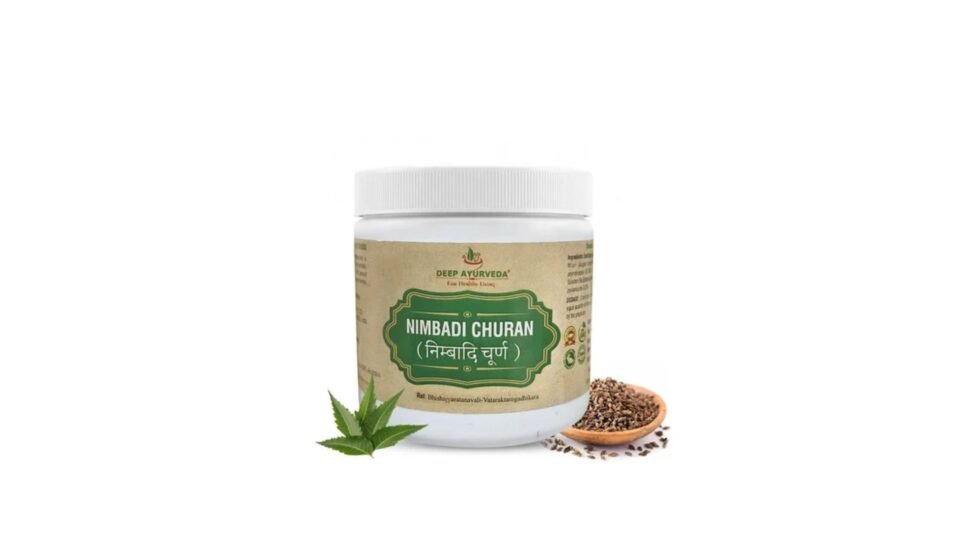

Nimbadi Churna is a classical Ayurvedic polyherbal formulation traditionally used in the management of certain skin disorders and Vatarakta, an Ayurvedic condition commonly correlated with gout in modern clinical discussions. Unlike plain Neem powder, Nimbadi Churna contains a combination of several herbs, each selected according to the therapeutic principles of Ayurveda.
One important point often missed in online articles is that Nimbadi Churna does not always mean an identical composition across every commercial product. Classical references describe a specific formulation, while products sold by different manufacturers may have different ingredient combinations or proportions. Therefore, the exact product label and its reference should always be checked before discussing its dosage or method of use.
This article explains Nimbadi Churna from an Ayurvedic perspective, including its ingredients, traditional uses, potential benefits, dosage, precautions, and what recent research tells us about the formulation.
What Is Nimbadi Churna?
Nimbadi Churna is a powdered Ayurvedic formulation in which Nimba (Neem) is one of the principal ingredients. The classical formulation described in Ayurvedic references combines Nimba with herbs such as Guduchi, Haritaki, Amalaki, Bakuchi, Shunthi, Vidanga, Pippali, Haridra, Daruharidra, Khadira and several other medicinal substances.
The word Nimbadi essentially indicates a formulation beginning with Nimba, while Churna refers to a properly prepared powdered herbal formulation.
From an Ayurvedic perspective, it is more useful to understand Nimbadi Churna as a formulation rather than simply a Neem-based powder. Its therapeutic rationale comes from the combined properties of its ingredients and their intended action on the dosha, dushya and affected srotas.
Nimbadi Churna vs Neem Churna: Are They the Same?
No. Neem Churna and Nimbadi Churna should not be considered interchangeable.
Neem Churna is primarily the powdered form of Neem, whereas Nimbadi Churna is a multi-ingredient formulation. The additional herbs alter the overall Ayurvedic profile of the preparation.
This distinction is particularly important when selecting a product. A person looking for Nimbadi Churna should not assume that any powder containing Neem is the classical Nimbadi formulation.
Nimbadi Churna Ingredients
The classical formulation described in Ayurvedic references contains five principal ingredients in larger quantities and a group of supporting ingredients in smaller quantities. One reference lists Nimba, Guduchi, Haritaki, Amalaki and Bakuchi at 48 g each, while the remaining ingredients are listed at 12 g each.
Classical Nimbadi Churna Composition
| Ayurvedic Name | Common Name | Botanical Name | Quantity* |
|---|---|---|---|
| Nimba | Neem | Azadirachta indica | 48 g |
| Guduchi / Amrita | Giloy | Tinospora cordifolia | 48 g |
| Haritaki / Abhaya | Haritaki | Terminalia chebula | 48 g |
| Amalaki / Dhatri | Amla | Emblica officinalis / Phyllanthus emblica | 48 g |
| Bakuchi / Somaraji | Bakuchi | Psoralea corylifolia | 48 g |
| Shunthi | Dry Ginger | Zingiber officinale | 12 g |
| Vidanga | Vidanga | Embelia ribes | 12 g |
| Chakramarda | Chakramarda | Cassia tora | 12 g |
| Pippali | Long Pepper | Piper longum | 12 g |
| Yavani | Ajwain | Trachyspermum ammi | 12 g |
| Vacha | Vacha | Acorus calamus | 12 g |
| Jiraka | Cumin | Cuminum cyminum | 12 g |
| Katuka / Kutki | Kutki | Picrorhiza kurroa | 12 g |
| Khadira | Khair | Acacia catechu | 12 g |
| Saindhava Lavana | Rock Salt | — | 12 g |
| Yavakshara | Yava Kshara | — | 12 g |
| Haridra | Turmeric | Curcuma longa | 12 g |
| Daruharidra | Daruharidra | Berberis aristata | 12 g |
| Mustaka | Nagarmotha | Cyperus rotundus | 12 g |
| Devadaru | Himalayan Cedar | Cedrus deodara | 12 g |
| Kushtha | Kushta | Saussurea costus | 12 g |
Quantities shown above correspond to the classical composition cited in the referenced sources; commercial preparations may differ.
Why Does Nimbadi Churna Contain So Many Ingredients?
This is where simply copying an ingredient list misses the real Ayurvedic concept.
Ayurveda traditionally formulates medicines according to the combined action of multiple dravyas, rather than assuming that one herb has to perform every therapeutic function. In Nimbadi Churna, different ingredients contribute different properties to the overall formulation.
For example, Nimba is traditionally associated with Tikta (bitter) and Kashaya (astringent) characteristics, while ingredients such as Pippali and Shunthi bring distinctly different properties to the formulation. Guduchi, Haritaki and Amalaki also have their own Ayurvedic profiles.
Therefore, the formulation should be understood as a synergistic Ayurvedic combination, rather than as 21 herbs with 21 separate benefits.
Ayurvedic Understanding of Nimbadi Churna
From an Ayurvedic perspective, the usefulness of a formulation cannot be determined only by asking whether an individual ingredient is anti-inflammatory, antibacterial, or antioxidant.
Ayurveda evaluates a drug through concepts such as:
- Rasa – taste
- Guna – qualities
- Virya – potency
- Vipaka – post-digestive effect
- Dosha karma – influence on Vata, Pitta and Kapha
- Dushya – tissues involved
- Srotas – channels involved
- Agni and Ama – digestive/metabolic considerations
This is particularly relevant for a multi-herbal formulation such as Nimbadi Churna.
Nimbadi Churna and Skin Health
Traditional Ayurvedic sources associate Nimbadi Churna with the management of several skin-related conditions. References describing the formulation mention conditions under the broader Ayurvedic category of Kushta, as well as skin eruptions and other related presentations.
However, it is important not to interpret the traditional term Kushta as automatically meaning one specific modern diagnosis such as psoriasis, eczema or fungal infection. Ayurvedic disease categories and modern dermatological diagnoses are not always one-to-one equivalents.
That distinction makes the content more medically responsible and prevents a common mistake in online Ayurveda articles: directly translating every classical disease name into a modern disease without considering the diagnostic context.
Nimbadi Churna Benefits
The traditional benefits of Nimbadi Churna are best discussed in relation to its classical indications and Ayurvedic therapeutic rationale, rather than promising that it will cure a particular disease.
1. Traditionally Used for Certain Skin Disorders
Nimbadi Churna is traditionally associated with the management of skin disorders under the Ayurvedic concept of Kushta. Classical descriptions and secondary Ayurvedic references also mention skin eruptions and related conditions.
Its multi-herbal composition includes Nimba, Khadira, Haridra, Daruharidra and other botanicals traditionally used in Ayurvedic approaches to skin health.
2. Traditionally Used in Vatarakta
One of the more interesting aspects of Nimbadi Churna is its association with Vatarakta.
Vatarakta is an Ayurvedic condition in which vitiated Vata and Rakta are described as playing an important role. Modern literature commonly discusses Vatarakta in relation to gout because of similarities in clinical presentation.
A randomized comparative clinical study involving 60 patients evaluated Nimbadi Churna and another Ayurvedic formulation for Vatarakta over 28 days. The Nimbadi Churna group received 3 g twice daily in that study. The findings reported improvement in assessed symptoms and serum uric acid, but the study should be interpreted within its design and limitations rather than treated as proof that Nimbadi Churna replaces established gout treatment.
3. Provides a Multi-Herbal Ayurvedic Approach
The formulation combines herbs traditionally associated with different Ayurvedic actions. This makes it different from taking Neem alone.
Rather than assigning a single benefit to the entire formulation based on one herb, the Ayurvedic approach considers how the ingredients collectively fit a particular clinical presentation.
4. Traditionally Used When Skin and Digestive Factors Are Considered Together
Some traditional descriptions include both skin-related and abdominal indications.
This is an important Ayurvedic perspective because Ayurveda does not always treat skin health as an isolated surface problem. Assessment may also consider Agni, Ama, bowel habits, diet, dosha involvement and the patient’s overall presentation.
That does not mean every person with a skin complaint should take Nimbadi Churna. The appropriate formulation and treatment depend on the individual’s condition.
A New Perspective: How Do You Know If Nimbadi Churna Is a Good-Quality Formulation?
This is one area where modern research adds an interesting dimension to the traditional discussion.
A 2025 research study focused specifically on developing quality-control standards for Nimbadi Churna. Researchers evaluated phytochemical, microbial, aflatoxin and elemental parameters and used analytical techniques including HPTLC, HPLC and GC-MS to identify and quantify chemical markers in the formulation.
The study identified markers including piperlongumine, gallic acid, piperine, curcumin and thymol through HPTLC analysis and quantified several markers using HPLC. The researchers proposed that these analytical parameters could support quality checks for Nimbadi Churna.
For a consumer, the practical lesson is simple:
A good Ayurvedic formulation is not judged only by how many ingredients appear on the label. Authentication, raw-material quality, appropriate processing, microbial safety and consistent manufacturing also matter.
This is especially relevant for polyherbal formulations because the final product depends on the identity and quality of multiple raw materials.
Nimbadi Churna Dosage
The dosage of Nimbadi Churna should not be treated as a universal number for every person or every product.
A classical/reference source gives a range of approximately 1–3 g twice daily, with the formulation traditionally administered with an appropriate vehicle such as Guduchi decoction or honey, depending on the context.
In contrast, the clinical study on Vatarakta used 3 g twice daily for 28 days. That study dosage should not automatically be interpreted as a general prescription for everyone.
What Determines the Appropriate Dose?
An Ayurvedic physician may consider:
- the patient’s age
- digestive capacity (Agni)
- constitution (Prakriti)
- disease presentation
- strength of the patient
- associated symptoms
- other medicines being taken
- whether the formulation is intended for internal or external use
Therefore, follow the dosage specified for the exact formulation you are using and seek professional Ayurvedic guidance when taking it for a medical condition.
Nimbadi Churna Uses in Ayurveda
The traditional use of Nimbadi Churna is broader than simply using Neem for skin. Its classical application is understood in the context of the patient’s dosha, dushya, Agni and clinical presentation. Classical descriptions associate the formulation particularly with certain skin disorders and Vatarakta, while individual product formulations may have different indications and methods of use.
It is therefore important to distinguish between classical use of a specific Nimbadi Churna formulation and claims made for commercially available products with the same or similar name.
Nimbadi Churna for Skin Problems
In Ayurveda, several skin conditions are considered under the broader concept of Kushta, with assessment based on factors such as dosha involvement, affected tissues, symptoms and chronicity.
Nimbadi Churna contains Nimba and other traditionally used Ayurvedic herbs such as Khadira, Haridra, Daruharidra and Bakuchi. These ingredients have long-standing use in Ayurvedic practice for different skin-related presentations.
However, a modern skin diagnosis should not automatically be equated with an Ayurvedic disease category. For example, Kushta is not synonymous with psoriasis, eczema or a fungal infection. The appropriate treatment depends on the actual diagnosis and individual presentation.
Nimbadi Churna for Itching
Kandu (itching) is an important symptom considered in Ayurvedic assessment of many skin disorders.
Nimbadi Churna is traditionally associated with formulations used in skin conditions where itching and related symptoms are present. Its use should, however, be based on the underlying cause rather than treating itching as an isolated symptom.
Persistent, severe or unexplained itching may require medical evaluation because it can occur with dermatological, allergic, systemic or infectious conditions.
Nimbadi Churna for Acne and Skin Eruptions
Some Ayurvedic references and commercial descriptions associate Nimbadi Churna with skin eruptions and acne-like complaints.
From an Ayurvedic perspective, the management of such complaints may involve assessment of Pitta, Kapha, Rakta, Agni and diet, rather than relying only on a single herbal powder.
If the product is intended for internal use, the dose and anupana should be determined according to the particular formulation. If it is intended for external application, the manufacturer’s directions should be followed.
Nimbadi Churna for Vatarakta
One of the more distinctive traditional applications of Nimbadi Churna is Vatarakta.
In Ayurvedic literature, Vatarakta describes a disorder involving interaction between aggravated Vata and Rakta, with symptoms that can include pain, tenderness, burning, redness and swelling, particularly around the extremities.
Modern Ayurvedic clinical literature frequently discusses Vatarakta in relation to gout, although the two concepts should not be assumed to be exact equivalents.
This makes Vatarakta an important topic to discuss separately rather than simply placing gout in a list of Nimbadi Churna benefits.
Nimbadi Churna and Vatarakta: What Does the Research Say?
The traditional indication of Nimbadi Churna for Vatarakta has also been examined clinically.
A randomized comparative clinical study involving 60 patients with Vatarakta evaluated Nimbadi Churna alongside another Ayurvedic formulation. In the study, the Nimbadi Churna group received 3 g twice daily after meals with lukewarm water for 28 days. Researchers assessed changes in symptoms and serum uric acid levels. The study reported improvement in several assessed parameters in the Nimbadi Churna group.
These findings are interesting because they provide some clinical data around a classical indication. At the same time, the study was relatively small and short in duration. Therefore, it would be inappropriate to conclude from this research alone that Nimbadi Churna is a proven replacement for standard gout treatment.
Can Nimbadi Churna Replace Gout Medicine?
No, it should not be assumed to replace prescribed gout treatment.
A person with elevated uric acid or recurrent gout attacks should have the condition properly assessed. Ayurvedic treatment, if chosen, should be individualized and coordinated appropriately with ongoing medical care.
This distinction is particularly important because untreated or poorly controlled gout can lead to recurrent attacks, tophi and joint damage.
How to Take Nimbadi Churna?
The correct method of taking Nimbadi Churna depends on the exact formulation, indication and intended route of administration.
A reference source describes a classical dosage in the approximate range of 1–3 g twice daily, while the clinical Vatarakta study used 3 g twice daily for its participants. These numbers should not be interpreted as a universal prescription for every Nimbadi Churna product or every individual.
What Is the Anupana of Nimbadi Churna?
In Ayurveda, Anupana refers to the vehicle or accompanying substance used with a medicine. The appropriate anupana can influence how a formulation is administered and is selected according to the medicine and clinical situation.
For Nimbadi Churna, traditional sources describe administration with vehicles such as Guduchi decoction or honey in specific contexts. The appropriate choice should therefore not be generalized to every patient.
For a commercially manufactured product, the product label and physician’s recommendation should take priority over a generic internet dosage.
Internal or External Use: Which One Is Correct?
This is an important point because Nimbadi Churna products available in the Indian market do not necessarily have identical formulations or directions for use.
Some preparations are described for internal administration, while certain products sold as Nimbadi Choornam are intended for external application.
Therefore:
Do not assume that every product labelled Nimbadi Churna can be taken orally.
Before using it, check:
- The complete ingredient list
- The manufacturer’s directions
- Whether it is labelled for internal or external use
- Recommended dosage or application method
- Any contraindications or warnings on the label
This simple check can prevent one of the most common mistakes associated with herbal products: assuming that products with similar names have the same composition and route of administration.
Nimbadi Churna Side Effects
Nimbadi Churna is a multi-ingredient formulation, so its tolerability can depend on the ingredients, dose, preparation quality and individual patient.
Possible problems can include digestive discomfort or intolerance to one or more ingredients. External application may also cause irritation or an allergic reaction in sensitive individuals.
The important point is that there is no scientifically justified universal statement that every Nimbadi Churna product is completely free from side effects. Different manufacturers may use different compositions.
If unusual symptoms develop after taking or applying the formulation, discontinue use and consult a qualified healthcare professional.
Who Should Avoid Nimbadi Churna?
Nimbadi Churna should not be self-prescribed indiscriminately, particularly when the person has an existing medical condition.
Extra caution is appropriate for:
- Pregnant or breastfeeding women
- Children
- Older adults taking multiple medicines
- People with known allergies to any ingredient
- People with chronic liver or kidney conditions
- People taking long-term prescription medicines
- Individuals with an undiagnosed skin condition
- People experiencing severe or recurrent joint pain or swelling
For these groups, an Ayurvedic physician can determine whether the formulation is appropriate and, if so, which dose and anupana are suitable.
Nimbadi Churna With Other Medicines
Natural does not automatically mean interaction-free.
Because Nimbadi Churna can contain multiple botanicals and mineral-derived substances depending on the formulation, people taking regular medication should disclose all medicines and supplements to their healthcare professional.
This is particularly relevant when someone is already receiving treatment for a chronic condition. Do not stop a prescribed medicine simply because you have started an Ayurvedic formulation.
How to Choose a Good-Quality Nimbadi Churna
When choosing an Ayurvedic formulation, the question should not be only:
Does this product contain Neem?
A better question is:
Does this product have a clearly identified formulation, authenticated ingredients and appropriate quality controls?
This becomes even more relevant for a polyherbal formulation.
A 2025 study on Nimbadi Churna investigated quality-control parameters using techniques including HPTLC, HPLC and GC-MS, along with assessment of parameters such as microbial load, aflatoxins and elemental content. The research also examined chemical markers associated with the formulation.
What Should You Check on the Pack?
Before purchasing, look for:
- Clearly mentioned ingredients
- Botanical identification where provided
- Manufacturer details
- Batch number
- Manufacturing and expiry dates
- Directions for use
- Appropriate storage instructions
- Clearly stated internal/external use
- Relevant quality or testing information
Most importantly, compare the ingredient list with the formulation you actually intend to use. Two products carrying similar Nimbadi names may not necessarily have the same composition.
Nimbadi Churna vs Neem Churna
| Feature | Nimbadi Churna | Neem Churna |
|---|---|---|
| Formulation | Polyherbal | Single-herb powder |
| Main ingredient | Nimba along with other ingredients | Neem |
| Composition | Depends on the specific formulation | Primarily Neem |
| Ayurvedic action | Considered at formulation level | Considered mainly from Neem’s properties |
| Dosage | Formulation-specific | Neem powder-specific |
| Should they be substituted? | Not automatically | Not automatically |
The key takeaway is simple: Nimbadi Churna is not merely another name for Neem Churna.
Nimbadi Churna vs Nimbadi Choornam
The terms Churna, Choorna and Choornam are commonly used to describe powdered Ayurvedic preparations, but the name alone does not establish that two products have identical compositions.
Commercial products carrying the name Nimbadi Choornam can have compositions that differ substantially from the classical formulation described in other references.
For this reason, always verify the actual ingredient list and intended use rather than selecting a product based only on its name.
Final Thoughts
Nimbadi Churna is a traditional Ayurvedic polyherbal formulation, not simply Neem powder. Its benefits and appropriate dosage depend on the specific formulation, individual health condition and Ayurvedic assessment.
Since products with the Nimbadi name can have different compositions, always check the ingredients and usage instructions before taking them. Used appropriately and under professional guidance, Nimbadi Churna may have a valuable role in traditional Ayurvedic care.
Frequently Asked Questions About Nimbadi Churna
What is Nimbadi Churna used for?
Nimbadi Churna is a multi-herbal Ayurvedic formulation traditionally associated with the management of certain skin disorders and Vatarakta. The exact uses depend on the specific formulation and the patient’s clinical presentation.
What are the main ingredients of Nimbadi Churna?
A classical formulation includes Nimba, Guduchi, Haritaki, Amalaki, Bakuchi and several supporting ingredients such as Shunthi, Pippali, Haridra, Daruharidra, Khadira and others. Commercial formulations may differ, so the product label should always be checked.
Is Nimbadi Churna good for skin problems?
It is traditionally used in Ayurveda for certain skin-related conditions. However, the suitability of the formulation depends on the Ayurvedic assessment and the actual cause of the skin complaint.
Can Nimbadi Churna be taken every day?
Daily use should not be assumed to be appropriate for everyone. The duration and dosage depend on the specific formulation, indication and individual patient.
What is the dosage of Nimbadi Churna?
A classical reference describes approximately 1–3 g twice daily, while one clinical study used 3 g twice daily for 28 days. This should not be treated as a universal dosage for all products or individuals.
Is Nimbadi Churna the same as Neem Churna?
No. Neem Churna is primarily Neem powder, whereas Nimbadi Churna is a multi-ingredient Ayurvedic formulation.
Can Nimbadi Churna be applied to the skin?
That depends on the particular product. Some Nimbadi preparations are intended for external use, while others are described for internal administration. Always check the manufacturer’s instructions.
Is Nimbadi Churna safe during pregnancy?
Pregnant women should not self-medicate with Nimbadi Churna. Because formulations and ingredients can vary, use during pregnancy should only be considered after consultation with an appropriately qualified healthcare professional.