

For generations, Mulethi has been a familiar ingredient in Indian homes. Many people know it as the sweet-tasting root used traditionally for throat discomfort, while in Ayurveda it is known as Yashtimadhu or Madhuyashti.
But there is more to Yashtimadhu than its familiar use as a household herb.
In Ayurveda, Yashtimadhu has a long history of traditional use in areas including the throat, voice, respiratory system and digestive health. At the same time, modern research has investigated licorice root for several specific uses, although the quality and strength of evidence vary considerably by condition.
There is also an important side of Mulethi that is often overlooked: natural does not automatically mean suitable for everyone. Yashtimadhu contains glycyrrhizin, a compound that can cause problems such as increased blood pressure and low potassium when consumed in excessive amounts or for prolonged periods.
So, what exactly is Yashtimadhu? What does Ayurveda say about it? What benefits are traditionally associated with it, and what does modern research actually tell us?
Let’s take a closer look.
Yashtimadhu at a Glance
| Detail | Information |
|---|---|
| Ayurvedic name | Yashtimadhu / Madhuyashti |
| Common Indian name | Mulethi / Mulathi |
| English name | Licorice / Liquorice |
| Botanical name | Glycyrrhiza glabra |
| Family | Fabaceae |
| Part commonly used | Root and stolon |
| Characteristic taste | Naturally sweet |
| Important constituent | Glycyrrhizin |
| Traditional system | Ayurveda and other traditional medical systems |
The Ministry of AYUSH’s E-Charak database identifies Glycyrrhiza glabra as Mulathi and lists the root as the part used. The Ayurvedic Pharmacopoeia of India also identifies Glycyrrhiza glabra as the botanical source of Yaṣṭī Mūla.
What Is Yashtimadhu (Mulethi)?
Yashtimadhu is the Ayurvedic name commonly used for Mulethi, the root of Glycyrrhiza glabra. It is also known internationally as licorice or liquorice root.
The root has a naturally sweet taste, which is one reason Mulethi has traditionally been used in preparations where a pleasant taste is desirable.
In Indian traditional medicine, Mulethi is not simply viewed as a sweetening ingredient. It has been used in different formulations and preparations for a range of traditional applications.
The official Ayurvedic Pharmacopoeia of India lists Yaṣṭī Mūla as Glycyrrhiza glabra stolon and root, establishing its identity as an Ayurvedic raw drug.
Why Is Yashtimadhu Called Mulethi?
You may come across several names for the same herb:
Yashtimadhu → Mulethi → Licorice → Glycyrrhiza glabra
Different Indian languages also have their own names for the herb. An official pharmacopoeial monograph lists names such as Mulethi, Yashtimadhu, Jethimadhu and related regional names.
The word Yashtimadhu is traditionally understood in relation to the sweet nature of the herb, while the English name licorice is used internationally for plants of the Glycyrrhiza genus.
One useful distinction is worth remembering:
Mulethi is the common Indian name; Yashtimadhu is its familiar Ayurvedic name; and Glycyrrhiza glabra is the botanical identity.
This distinction becomes particularly useful when buying powders, capsules, extracts or other herbal products because different products can contain different forms or concentrations of licorice.
Yashtimadhu in Ayurveda
Yashtimadhu has an established place in Ayurvedic medicine.
The Ministry of AYUSH’s list of essential Ayurvedic medicines includes Yashtimadhu/Madhuyashti/Yashti Churna and associates it traditionally with applications including Rasayana, Kasa, Shvasa, Vranaropana, Kshaya and Svarabheda. The same government document also gives precautions relating to obesity, hypertension, oedema and long-term use.
Ayurvedic properties of Yashtimadhu
Traditional Ayurvedic descriptions generally discuss herbs through concepts such as:
- Rasa – taste
- Guna – qualities
- Virya – energetic potency
- Vipaka – post-digestive effect
- Dosha effects
For Yashtimadhu, these properties help explain why the herb has traditionally been incorporated into preparations intended for different systems of the body.
However, it is important not to reduce Ayurveda to a list of isolated benefits. The way an Ayurvedic practitioner selects an herb can depend on the individual’s prakriti, vikriti, symptoms, digestion, age, diet, other medicines and the formulation being used.
That is one reason why the same herb should not automatically be used in the same quantity or for the same duration by everyone.
Traditional Uses of Yashtimadhu
Yashtimadhu has traditionally been used in several areas of Ayurveda. These traditional applications should not be confused with modern clinical proof of effectiveness.
Yashtimadhu for Throat and Voice
Mulethi is perhaps best known in India for its traditional association with the throat.
Ayurvedic preparations containing Yashtimadhu have traditionally been used in situations involving throat discomfort and changes in voice.
Modern research has also investigated licorice preparations for specific throat-related applications. For example, NCCIH notes that licorice gargles or lozenges may help reduce sore throat following intubation in some surgical settings, although this does not mean that ordinary Mulethi should be considered a universal treatment for sore throat.
If throat pain is persistent, severe or accompanied by symptoms such as difficulty swallowing or breathing, medical evaluation is more appropriate than relying only on an herbal remedy.
Yashtimadhu for Cough and Respiratory Comfort
Traditional Ayurveda includes Yashtimadhu among herbs used in respiratory-related formulations.
The Ministry of AYUSH’s essential medicines document lists Kasa and Shvasa among the traditional indications associated with Yashtimadhu Churna.
However, it is important to understand the difference between traditional use and treatment of a diagnosed respiratory disease.
Mulethi should not be presented as a replacement for medical treatment for asthma, pneumonia, persistent bronchitis, tuberculosis or other respiratory conditions.
Yashtimadhu and Digestive Health
Another commonly discussed traditional application of Mulethi is digestive comfort.
Licorice has been investigated for various digestive complaints, but according to NCCIH, it remains unclear whether licorice products used alone have meaningful effects on digestive symptoms.
Therefore, a responsible explanation would be:
Yashtimadhu has a history of traditional digestive use, but modern evidence is not strong enough to describe it as a proven treatment for every digestive complaint.
This distinction matters, particularly for people experiencing recurring acidity, abdominal pain, reflux or other persistent symptoms.
Yashtimadhu and Skin
Licorice-derived preparations have also attracted interest in topical skin applications.
Preliminary research has investigated topical licorice preparations for conditions such as eczema symptoms and wound or burn healing, but NCCIH notes that more research is needed to establish effectiveness and safety.
This is why it is better to say has been studied for rather than making broad claims such as Yashtimadhu cures skin problems.
What Does Modern Research Say About Yashtimadhu?
This is where traditional knowledge and modern scientific evidence need to be considered separately.
Licorice root has been studied in human research, but NCCIH concludes that there is not enough high-quality evidence to clearly support licorice for any specific health condition overall. Some individual applications have shown promising or preliminary results, but the evidence varies.
For example:
| Area studied | What current evidence suggests |
|---|---|
| Postoperative sore throat | Some evidence suggests gargles/lozenges may help in specific surgical settings |
| Recurrent mouth ulcers | Some studies suggest potential benefit from licorice preparations |
| Certain skin applications | Preliminary evidence exists, but more research is needed |
| Digestive symptoms | Evidence remains unclear |
| General wellness claims | Not enough high-quality evidence to make broad treatment claims |
The important takeaway is that research on a specific licorice preparation does not automatically prove that every Mulethi powder, tea or capsule will produce the same result.
Preparation, concentration, dose and duration can all matter.
Yashtimadhu Benefits: What Can You Realistically Expect?
When people search for Yashtimadhu benefits, they often expect a simple list.
A more useful way to understand the herb is to separate traditional benefits from scientifically established effects.
1. Traditionally used to soothe the throat
Yashtimadhu has a long-standing traditional association with the throat and voice.
2. Traditionally used in respiratory formulations
Ayurvedic formulations containing Yashtimadhu have traditionally been used for respiratory complaints such as Kasa and Shvasa.
3. Traditionally used for digestive comfort
Mulethi has a history of traditional digestive use, although modern evidence for licorice alone remains inconclusive.
4. Studied for certain oral-health applications
Some clinical studies have examined licorice-containing preparations for recurrent mouth ulcers and oral health. Results are promising in some contexts but should not be generalized to every licorice product.
5. Studied in topical preparations
Licorice extracts have been investigated for some skin applications, but evidence remains preliminary.
What about immunity boosting?
This is a claim frequently attached to herbal products online.
It is better not to describe Yashtimadhu as a proven general immunity booster without specifying the particular preparation and evidence behind the claim.
Traditional use can be discussed, but it should not be presented as equivalent to clinical proof.
How to Use Yashtimadhu
Yashtimadhu can be found in different forms, and these forms are not necessarily interchangeable.
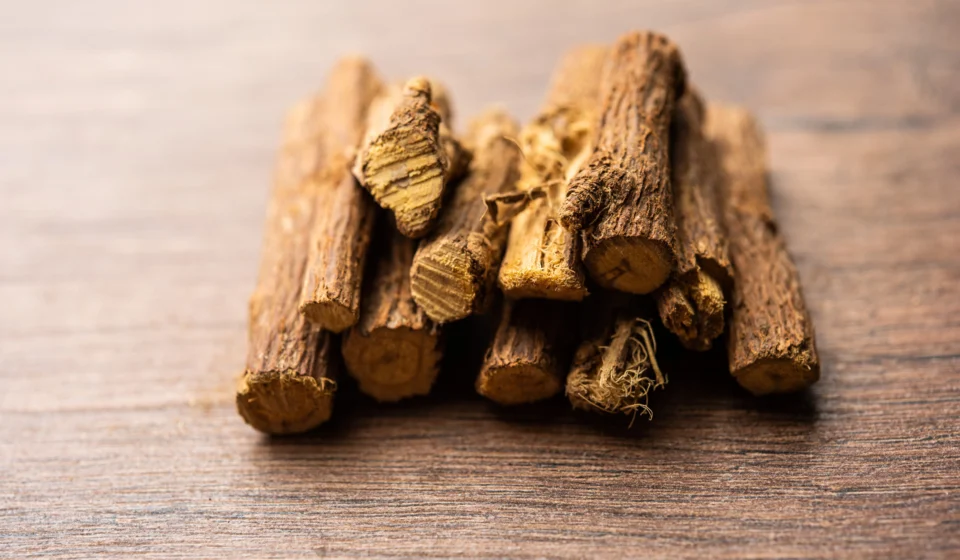
Yashtimadhu Root
The dried root or stolon is the traditional raw herbal material.
It may be used as an ingredient in traditional preparations, but the amount and method of preparation matter.
Yashtimadhu Powder
Yashtimadhu Churna is a commonly encountered Ayurvedic form.
The Ministry of AYUSH lists Yashtimadhu/Madhuyashti/Yashti Churna as an essential Ayurvedic medicine and gives a dose context of up to 12 g, while simultaneously listing obesity, hypertension, oedema and long-term use as precautions.
That is an important reason not to copy a single dosage number and present it as suitable for every person.
Yashtimadhu Tea or Infusion
Some people prepare Mulethi as a beverage or infusion.
The concentration can vary significantly depending on the quantity of root used and the preparation method, so a homemade preparation should not automatically be equated with a standardized extract.
Yashtimadhu Extracts and Capsules
Extracts and capsules may contain more concentrated amounts of constituents than the raw root.
Always check:
- ingredient list
- serving size
- extract ratio or standardization, if provided
- glycyrrhizin information
- manufacturer details
- recommended duration of use
Yashtimadhu Dosage: How Much Should You Take?
There is no single dose that is automatically appropriate for every person or every Yashtimadhu product.
Dosage can depend on:
- the form being used
- the concentration
- the reason for use
- age
- health conditions
- duration of use
- other medicines or supplements
The official AYUSH document lists up to 12 g for Yashtimadhu Churna, but also lists important precautions including hypertension, oedema, obesity and long-term use.
Therefore, this figure should not be interpreted as a recommendation for everyone to consume 12 g daily.
For concentrated extracts or supplements, follow the manufacturer’s labelled serving and seek professional guidance where appropriate.
Can You Take Yashtimadhu Every Day?
This is one of the most important questions about Mulethi.
Regular long-term consumption should not be assumed to be safe simply because Yashtimadhu is an Ayurvedic herb.
The concern is particularly relevant to products containing glycyrrhizin.
NCCIH reports that high amounts or prolonged consumption of glycyrrhizin-containing licorice can cause serious adverse effects, including abnormal heart rhythms. It also notes that even smaller amounts can be problematic in some people, including those with hypertension or heart and kidney conditions.
The Indian Ministry of AYUSH essential medicines document also specifically lists long-term use among the precautions for Yashtimadhu Churna.
So the better question isn’t simply:
Can everyone take Mulethi every day?
It is:
Which preparation, at what amount, for how long, and for whom?
Yashtimadhu Side Effects and Safety
The safety profile of Yashtimadhu deserves as much attention as its traditional uses.
Can Yashtimadhu increase blood pressure?
Yes. Glycyrrhizin-containing licorice can raise blood pressure in some people.
NCCIH specifically identifies licorice as an herb that may raise blood pressure and advises caution, particularly in people with hypertension.
Can Yashtimadhu affect potassium?
Excessive glycyrrhizin exposure can contribute to low potassium levels.
This can become clinically important because potassium plays a major role in normal muscle and heart function.
Can it cause water retention?
Yes. Licorice-related effects can include fluid retention, which is one reason people with certain cardiovascular or kidney conditions need particular caution.
What happens with excessive or prolonged intake?
Serious effects can occur with high amounts or long-term use. NCCIH reports possible irregular heartbeat and, in severe cases, cardiac arrest associated with excessive glycyrrhizin exposure.
This is why the idea that herbal products cannot cause side effects should never be applied to Yashtimadhu.
Who Should Be Careful With Yashtimadhu?
Extra caution is appropriate for people who:
- have high blood pressure
- have heart disease
- have kidney disease
- have problems with potassium levels
- have significant fluid retention/oedema
- consume a high-salt diet
- take certain prescription medicines
- are pregnant or breastfeeding
- are considering long-term or high-dose use
NCCIH also reports potential interactions between licorice and corticosteroids and recommends discussing herbal products with a healthcare professional when medicines are being taken.
Yashtimadhu and Medicines: What Should You Know?
Herbs can interact with medicines, and licorice is no exception.
Particular caution is warranted with medicines or conditions involving:
- blood pressure
- potassium balance
- fluid retention
- corticosteroids
- cardiovascular health
If you take prescription medication regularly, do not assume that a concentrated Yashtimadhu supplement is automatically compatible with it.
Discuss the specific product with your doctor or pharmacist before using it regularly. NCCIH specifically advises people taking medicines to discuss licorice and other herbal products with their healthcare provider because herb–drug interactions can occur.
Yashtimadhu vs DGL Licorice: What’s the Difference?
You may have seen the term DGL on some licorice products.
DGL stands for deglycyrrhizinated licorice.
The important difference is that DGL products are processed to remove most of the glycyrrhizin.
Why does that matter?
Because many of the safety concerns associated with whole licorice are linked to glycyrrhizin.
NCCIH notes that oral licorice products without glycyrrhizin may have a different safety profile, although safety still depends on the product and circumstances.
So:
Yashtimadhu/Mulethi ≠ automatically the same thing as DGL.
When buying a product, check the label rather than assuming all licorice products contain the same ingredients.
Yashtimadhu Root vs Powder vs Extract vs Capsule
| Form | What to consider |
|---|---|
| Root/stick | Traditional raw form; preparation determines concentration |
| Powder/Churna | Convenient but quantity and duration matter |
| Extract | May be more concentrated; check standardization |
| Capsule/tablet | Convenient; formulation and ingredient amounts vary |
| DGL | Glycyrrhizin is removed/reduced; different from ordinary licorice |
This distinction is particularly useful when comparing products online.
Two products can both say Mulethi on the front label while providing very different amounts and forms of licorice.
How to Choose Good-Quality Yashtimadhu
If you are buying Yashtimadhu powder, capsules or another supplement, don’t judge quality only by the front-label claims.
Look for:
1. Correct botanical identity
The label should clearly identify the ingredient. Glycyrrhiza glabra is the botanical species associated with Yashtimadhu/Mulethi in the Indian official sources cited above.
2. Clearly mentioned plant part
For traditional Yashtimadhu, the root/stolon is the relevant plant material.
3. Transparent ingredient information
Look for the actual ingredients rather than relying only on phrases such as Ayurvedic wellness formula.
4. Batch and expiry information
A reputable product should provide basic traceability information.
5. Understand whether it is whole licorice or DGL
This can be particularly relevant from a safety perspective.
6. Don’t confuse natural with risk-free
The quality of the raw material matters, but so do dosage, duration and your individual health circumstances.
Common Questions About Yashtimadhu
Is Yashtimadhu and Mulethi the same?
Yes. Yashtimadhu is a commonly used Ayurvedic name for Mulethi, which is associated with Glycyrrhiza glabra. Official Indian sources identify Glycyrrhiza glabra with names including Mulathi/Mulethi and Yashtimadhu-related regional names.
What is Yashtimadhu traditionally used for?
In Ayurveda, Yashtimadhu has traditional applications associated with areas such as the throat, voice, respiratory complaints and certain digestive contexts. The Ministry of AYUSH lists Kasa, Shvasa, Svarbheda and other traditional indications for Yashtimadhu Churna.
Can Yashtimadhu be taken every day?
Not necessarily. Long-term use can present safety concerns, particularly with glycyrrhizin-containing preparations. The appropriate duration depends on the preparation, amount and individual health circumstances.
Does Yashtimadhu increase blood pressure?
It can. Glycyrrhizin-containing licorice may raise blood pressure, making caution especially important for people who already have hypertension.
Is Yashtimadhu useful for the throat?
It has a long history of traditional use for the throat and voice, and some licorice preparations have been studied for specific sore-throat applications. However, this should not be interpreted as proof that every Mulethi preparation treats every cause of throat pain.
Is Yashtimadhu safe during pregnancy?
High amounts of oral licorice can be unsafe during pregnancy. Anyone who is pregnant or planning pregnancy should discuss use with an appropriate healthcare professional rather than self-medicating with concentrated licorice products.
What is the difference between Yashtimadhu and DGL?
Yashtimadhu/Mulethi generally refers to licorice, while DGL means deglycyrrhizinated licorice, in which most glycyrrhizin has been removed. They should not be treated as identical products.
The Bottom Line
Yashtimadhu (Mulethi) is a well-known Ayurvedic herb traditionally used for the throat, voice, respiratory and digestive health. While some modern research shows promising results for specific uses, more evidence is needed for many health claims.
Most importantly, Mulethi is not risk-free. Because it contains glycyrrhizin, excessive or prolonged use may affect blood pressure and potassium levels. Use it appropriately, and seek professional advice if you have an existing health condition or take regular medicines.
Sources
- Ministry of AYUSH / E-Charak — medicinal plant information for Glycyrrhiza glabra.
- The Ayurvedic Pharmacopoeia of India — Glycyrrhiza glabra / Yaṣṭī Mūla.
- Ministry of AYUSH — List of Essential Ayurvedic Medicines, including Yashtimadhu Churna.
- NCCIH — Licorice Root: usefulness, evidence, side effects and interactions.
- NCCIH — Licorice and hypertension safety considerations.