
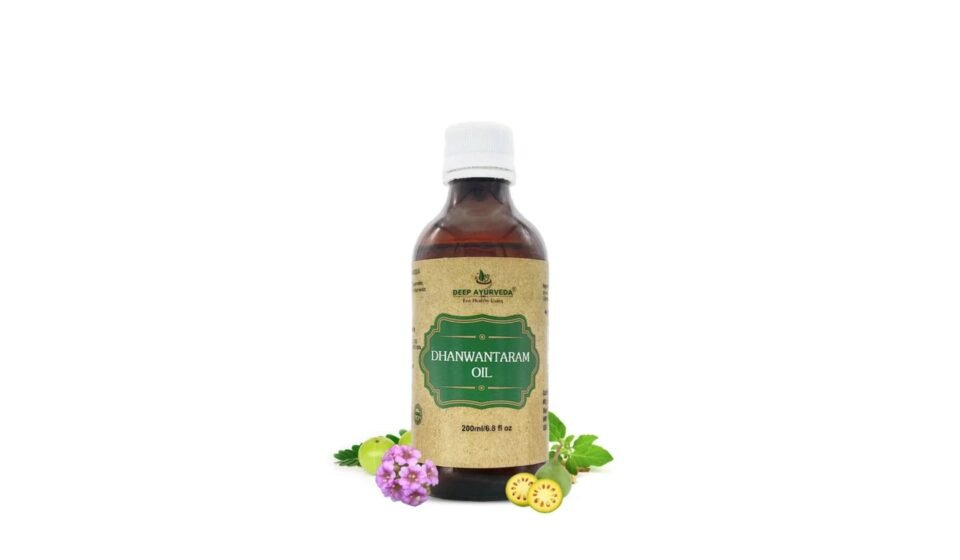

Ayurveda has a long tradition of using medicated oils as part of external therapies such as Abhyanga (oil massage) and other therapeutic procedures. Among these formulations, Dhanwantharam Oil, also known as Dhanwantharam Taila or Dhanwantharam Thailam, is a well-known classical Ayurvedic oil traditionally associated with Vata-oriented care.
What makes Dhanwantharam Oil different from an ordinary massage oil is its formulation. It is prepared using a combination of herbs, a sesame-oil base, milk, and herbal decoctions rather than relying on a single plant ingredient. Classical references describe Dhanwantharam Taila in the context of Ayurvedic therapeutic applications, while modern research has begun examining its chemical composition as well.
However, there is an important distinction to keep in mind: traditional Ayurvedic use and modern clinical evidence are not the same thing. Some uses of Dhanwantharam Oil are rooted in classical Ayurvedic practice, while modern scientific research on the finished formulation is still developing.
This guide explains what Dhanwantharam Oil is, why it has an important place in traditional Ayurveda, what its formulation contains, how it is traditionally used, what modern research has found so far, and what precautions should be considered before using it.
What Is Dhanwantharam Oil?
Dhanwantharam Oil is a classical Ayurvedic medicated oil traditionally used for Abhyanga and selected Ayurvedic therapeutic procedures, particularly in approaches associated with Vata.
Unlike a simple single-herb oil, Dhanwantharam Taila is a multi-ingredient preparation. Classical descriptions include ingredients such as Bala, Yava, Kola, Kulattha, Dashamoola and several other herbs, processed with sesame oil and other components. Published descriptions of the classical formulation show that the preparation involves multiple stages of decoction and processing rather than simply mixing herbs into oil.
In Ayurvedic terminology, Dhanwantharam Taila is generally discussed in relation to Vata, particularly where qualities such as dryness, stiffness and restricted movement are considered within the Ayurvedic framework.
It is important not to translate Vata-related directly into a modern medical diagnosis. Vata is an Ayurvedic concept and is not equivalent to a specific disease or condition recognized by modern medicine.
Dhanwantharam Oil vs Dhanwantharam Taila vs Dhanwantharam Thailam
You may see several spellings of the same formulation online:
- Dhanwantharam Oil
- Dhanwantharam Taila
- Dhanwantharam Thailam
- Dhanvantaram Tailam
- Dhanwantaram Taila
The words Taila and Thailam are commonly used in Ayurveda to refer to oil-based preparations. Therefore, differences in spelling do not necessarily mean that the products are different.
However, consumers should not assume that every commercial product carrying the name Dhanwantharam Oil has exactly the same composition. The formulation, manufacturing process, concentration, intended route of use and product specifications should always be checked on the manufacturer’s label.
Why Is Dhanwantharam Oil Important in Ayurveda?
To understand Dhanwantharam Oil properly, it helps to look beyond the modern question, What are its benefits?
In Ayurveda, medicated oils are selected according to the properties of the formulation, the individual’s condition, the intended therapy and the Ayurvedic assessment of the person.
Dhanwantharam Taila is traditionally associated with Vatahara and Brimhana concepts in Ayurvedic literature. A recent review of Ayurvedic formulations used in maternal and related care also lists Dhanwantaram Tailam from Ashtanga Hridaya in the context of Vata-oriented and nourishing approaches.
This traditional context helps explain why Dhanwantharam Oil is frequently encountered in discussions of:
- Ayurvedic oil massage
- stiffness and restricted movement
- Vata-oriented care
- selected postpartum practices
- certain Ayurvedic therapeutic procedures
These traditional applications should not be interpreted as proof that the oil independently treats or cures a modern medical disease.
What Does Dhanwantharam Mean?
The name Dhanwantharam is associated with Dhanvantari, a revered figure in the Ayurvedic tradition.
The significance of the name is primarily traditional and cultural. It should not be interpreted as evidence that the formulation can automatically treat every condition associated with Ayurveda or modern medicine.
For a modern reader, the more useful question is therefore not simply Why is it called Dhanwantharam? but:
What is actually in the formulation, how has Ayurveda traditionally used it, and what does current research tell us about it?
That is where the formulation itself becomes important.
What Is Dhanwantharam Oil Made Of?
Dhanwantharam Taila is a complex polyherbal formulation rather than a single-herb oil.
Published descriptions of the formulation include Bala (Sida cordifolia) as a major component along with ingredients such as Yava (barley), Kola, Kulattha and Dashamoola. The Dashamoola group itself consists of ten roots used traditionally in Ayurveda. The preparation also includes sesame oil and milk as part of the classical processing method.
Some important ingredients traditionally associated with the formulation include:
| Ingredient | Botanical/common identity | Traditional relevance |
|---|
| Bala | Sida cordifolia | Traditionally associated with strength and Vata-oriented formulations |
| Yava | Barley | Included as part of the classical formulation |
| Kola | Ziziphus species | Traditional component of the formulation |
| Kulattha | Horse gram | Used traditionally in Ayurvedic formulations |
| Dashamoola | Group of ten roots | Important classical Ayurvedic group |
| Gokshura | Tribulus terrestris | Classical ingredient |
| Ashwagandha | Withania somnifera | Traditionally associated with nourishing and strengthening approaches |
| Shatavari | Asparagus racemosus | Traditionally used in nourishing Ayurvedic formulations |
| Yashtimadhu | Glycyrrhiza glabra | Classical herbal ingredient |
| Sesame oil | Sesamum indicum | Traditional oil base |
The exact ingredient list and quantities can vary according to the specific preparation and manufacturer, so the product label should remain the primary source for the composition of a particular commercial product.
Why Does Dhanwantharam Oil Contain So Many Herbs?
This is one of the most interesting aspects of the formulation.
A common mistake is to look at a classical Ayurvedic oil and ask:
Which single ingredient gives all the benefits?
That is not how a multi-herbal formulation is traditionally conceptualized.
Dhanwantharam Taila combines numerous herbs with different Ayurvedic properties and processes them together with an oil base. The purpose is to create a finished formulation with a particular therapeutic profile, rather than simply adding several independent herbal ingredients together.
The classical preparation described in published literature involves separate decoction and paste components that are eventually processed with sesame oil.
This also explains why simply making a home mixture of two or three ingredients should not automatically be considered equivalent to classical Dhanwantharam Taila.
The Role of Sesame Oil in Dhanwantharam Taila
Sesame oil (Sesamum indicum) is traditionally used as the oil base for Dhanwantharam Taila.
In Ayurveda, sesame oil has an established place in Sneha therapies and Abhyanga. The medicated-oil preparation process allows selected herbal components to be incorporated into the oil medium.
Modern research has also examined the chemical composition of Dhanwantharam Thailam itself. A 2024 GC-MS study identified several compounds in a tested sample, including oleic acid and dodecanoic-acid-related compounds. However, this was a chemical profiling study, not a large clinical trial demonstrating that Dhanwantharam Oil treats a particular disease.
That distinction matters.
Finding a chemical compound in an oil can help researchers understand its composition, but it does not by itself establish the effectiveness or safety of the complete formulation for a specific medical condition.
What Does Ayurveda Traditionally Use Dhanwantharam Oil For?
Traditionally, Dhanwantharam Taila is used in several Ayurvedic settings, particularly those involving Vata-oriented care and external oleation therapies.
Its traditional applications include:
1. Abhyanga — Ayurvedic Oil Massage
Abhyanga is one of the best-known external applications of Ayurvedic oils.
The oil is applied to the body and massaged according to the individual’s needs and the purpose of the therapy. Dhanwantharam Taila is traditionally used in this context because of its Ayurvedic properties and its association with Vata-oriented care.
The aim of Abhyanga is not simply to massage away pain. In Ayurveda, the therapy is viewed more broadly in relation to Snehana, nourishment, lubrication and support of the body’s functional balance.
2. Traditional Care for Stiffness and Restricted Movement
Dhanwantharam Taila is commonly discussed in Ayurvedic practice in relation to stiffness, muscular discomfort and restricted movement.
However, it is important to distinguish between:
Traditional Ayurvedic use:
The formulation may be selected as part of an Ayurvedic approach based on the individual’s presentation.
Modern medical treatment:
A persistent or severe joint, muscle, nerve or back problem may require proper diagnosis and evidence-based medical management.
Therefore, Dhanwantharam Oil should not be presented as a universal treatment for arthritis, paralysis, nerve disorders or other serious conditions.
3. Selected Postpartum Ayurvedic Practices
Dhanwantharam Taila is also associated with traditional postpartum oil-massage practices.
This is an area where individualized guidance is particularly important. The appropriate timing, technique, amount of oil and areas of application can vary according to the mother’s health, delivery circumstances, recovery and the Ayurvedic practitioner’s assessment.
Pregnancy and postpartum care should therefore not be reduced to a generic instruction such as use the oil daily.
4. Use in Certain Ayurvedic Procedures
Classical and contemporary Ayurvedic literature describes Dhanwantharam Taila in connection with therapeutic procedures beyond ordinary massage, including procedures such as Dhara and Basti in appropriate clinical settings.
These procedures are not equivalent to applying oil at home and should be performed according to appropriate Ayurvedic clinical guidance.
What Does Modern Research Say About Dhanwantharam Oil?
Modern research on Dhanwantharam Taila is still much more limited than the volume of traditional and commercial information available online.
A 2024 study examined a Dhanwantharam Thailam sample using gas chromatography-mass spectrometry (GC-MS) and identified several chemical constituents, including oleic acid and other compounds. The researchers suggested that the findings could contribute to understanding the formulation’s chemical profile and its traditionally described activities.
But there is an important scientific limitation:
Chemical profiling is not the same as a clinical efficacy trial.
A GC-MS study can tell researchers what compounds were detected in a tested sample. It cannot, by itself, establish that Dhanwantharam Oil cures arthritis, repairs nerves, eliminates inflammation or produces a particular clinical outcome in humans.
This distinction is particularly important when evaluating Ayurvedic health information online, where traditional claims are sometimes presented as though they were established clinical facts.
What We Know — and What We Still Need to Know
Current literature provides useful information about:
- the traditional identity of the formulation
- its multi-herbal composition
- its use within Ayurvedic therapies
- its chemical profile in at least one studied sample
However, more high-quality human research would be useful to establish:
- condition-specific effectiveness
- optimal dosing and application protocols
- comparative effectiveness against other oils or treatments
- long-term safety
- consistency between different commercial preparations
Until stronger clinical evidence is available, the most accurate way to describe Dhanwantharam Oil is to clearly separate classical Ayurvedic use from modern clinical evidence.
Traditional Benefits of Dhanwantharam Oil
Dhanwantharam Oil is traditionally valued in Ayurveda because of its association with Snehana (oleation), Abhyanga and Vata-oriented therapeutic approaches. Rather than thinking of it as an oil that provides one single benefit, Ayurveda considers the formulation, the person’s condition, the method of application and the therapeutic objective together.
Some commonly described traditional applications are discussed below.
1. Supports Ayurvedic Oil Massage and Abhyanga
One of the most familiar uses of Dhanwantharam Oil is Abhyanga, the Ayurvedic practice of applying oil to the body with massage.
In this context, the purpose is broader than simply rubbing oil over the skin. Abhyanga is traditionally considered a form of external oleation and is used as part of Ayurvedic routines intended to support nourishment, lubrication and comfortable movement.
The choice of oil depends on factors such as the person’s constitution, symptoms and therapeutic requirements. In a prospective Ayurvedic massage study involving post-stroke rehabilitation, Dhanwantharam oil was selected for participants assessed as having Vata-predominant Prakriti, illustrating how the oil may be selected within an individualized Ayurvedic protocol rather than used identically for everyone.
2. Traditionally Used in Vata-Oriented Care
In Ayurveda, Dhanwantharam Taila is commonly associated with Vata and its related qualities.
Vata is an Ayurvedic concept associated with movement and qualities such as dryness, lightness and mobility. Therefore, traditional Vata-oriented use of an oil formulation is not the same as saying that the oil treats a particular modern medical diagnosis.
This distinction is important because terms such as Vata imbalance and arthritis, neuropathy, or sciatica should not automatically be treated as interchangeable.
The traditional Ayurvedic approach generally considers the complete presentation of the individual before selecting a medicated oil or procedure.
3. Traditionally Used for Stiffness and Restricted Movement
Dhanwantharam Oil is frequently used in Ayurvedic massage and therapeutic settings where stiffness, muscular discomfort or reduced ease of movement are part of the person’s presentation.
The oil may be incorporated into a broader Ayurvedic treatment plan rather than used as a standalone intervention.
For example, Dhanwantara Taila has been included as the local oil in a research protocol involving Janu Basti for people with knee osteoarthritis. However, that protocol also included other interventions, so it should not be interpreted as evidence that Dhanwantharam Oil alone treats osteoarthritis.
This is an important point when reading online claims: evidence about an Ayurvedic treatment protocol containing an oil is not necessarily evidence about the oil alone.
4. Used Traditionally in Selected Neuromuscular and Rehabilitation Settings
Dhanwantharam Oil also appears in Ayurvedic therapeutic protocols involving neurological and musculoskeletal conditions.
A prospective study of Ayurvedic massage in post-stroke patients, for example, used Dhanwantharam oil for participants categorized as Vata-predominant, alongside rehabilitation exercises and other therapies.
Such studies can provide useful information about how the oil is used within Ayurveda, but they should not be interpreted as proof that Dhanwantharam Oil independently reverses neurological damage or cures paralysis.
For someone experiencing sudden weakness, numbness, loss of balance, facial drooping, speech difficulty or other acute neurological symptoms, medical evaluation should take priority over self-treatment with massage oil.
5. Traditionally Included in Certain Therapeutic Procedures
Dhanwantharam Taila is not limited to ordinary body massage.
Ayurvedic clinical literature describes its use in selected procedures such as Abhyanga, Sirovasti and other therapeutic applications, depending on the clinical context and the practitioner’s assessment.
These procedures require more knowledge than simply applying oil at home. Their method, duration, temperature, quantity and anatomical application can vary according to the procedure.
Therefore, a description of Dhanwantharam Oil’s classical use in a procedure should not be interpreted as a recommendation to perform that procedure without professional supervision.
Dhanwantharam Oil for Massage: How Is It Traditionally Used?
For ordinary external massage, Dhanwantharam Oil can be incorporated into an Abhyanga routine.
The exact quantity and duration do not need to be identical for every person. They can depend on the area being massaged, skin type, age, season, purpose of the massage and the specific product being used.
A simple external massage approach
Step 1: Check the product
Before applying the oil, read the manufacturer’s directions and confirm that the product is intended for external use.
Step 2: Use a suitable amount
Apply enough oil to spread comfortably over the intended area without excessive rubbing.
Step 3: Warm only if appropriate
If the product instructions and your practitioner permit warming, make the oil comfortably lukewarm rather than very hot.
The objective is comfort—not maximum heat.
Step 4: Apply gently
Spread the oil over the skin and massage using comfortable pressure.
There is no need to use force to obtain a supposed therapeutic effect.
Step 5: Allow a suitable resting period
Depending on the routine, the oil may be left on the skin for a period before bathing. There is no universal requirement that everyone leave Dhanwantharam Oil on the skin for a fixed number of hours.
Step 6: Bathe according to your routine
After the massage, bathe as appropriate for the individual’s routine and the practitioner’s instructions.
Should Dhanwantharam Oil be heated?
Dhanwantharam Oil is often used warm during Ayurvedic massage, but warm does not mean hot.
Excessive heat can irritate or burn the skin. Before applying warmed oil over a large area, check its temperature carefully.
People with reduced sensation, very sensitive skin, children and older adults may require additional caution because they may not accurately perceive excessive heat.
How Often Can Dhanwantharam Oil Be Used?
There is no single frequency that is appropriate for everyone.
For general massage, some people may incorporate oil massage into their regular Ayurvedic routine, while therapeutic use may follow a specific schedule prescribed by an Ayurvedic practitioner.
Frequency can depend on:
- the purpose of the application
- the person’s age and health
- skin tolerance
- the formulation being used
- the area of application
- the Ayurvedic treatment plan
More frequent application does not automatically mean greater benefit.
If repeated application produces itching, redness, burning, swelling or a rash, stop using the product and seek appropriate medical advice.
Dhanwantharam Oil for Postpartum Massage
Dhanwantharam Oil is frequently discussed in connection with traditional postpartum Abhyanga.
Ayurvedic postpartum care may involve oil massage as part of a broader routine intended to support recovery, comfort and nourishment. However, postpartum care is highly individual.
The appropriate timing and technique can depend on:
- vaginal or cesarean delivery
- healing of wounds or surgical incisions
- bleeding and recovery
- skin sensitivity
- breastfeeding-related considerations
- general health and complications
Therefore, postpartum massage should not be reduced to a universal instruction such as apply Dhanwantharam Oil every day after delivery.
Can Dhanwantharam Oil be used after a C-section?
Extra caution is appropriate after cesarean delivery.
Oil should not be applied directly over a surgical incision unless the treating healthcare professional has confirmed that it is appropriate. A healing wound, redness, discharge, increasing pain or fever requires medical assessment rather than massage.
Can Dhanwantharam Oil Be Used During Pregnancy?
Pregnancy requires individualized advice.
Although Dhanwantharam Oil appears in Ayurvedic discussions and clinical contexts involving maternal care, that does not mean every pregnant person should independently use the product.
During pregnancy, the suitability of an oil, massage technique, body area, pressure and timing should be determined according to the individual’s circumstances and, where appropriate, by a qualified healthcare or Ayurvedic professional.
Avoid using online pregnancy-safe claims as a substitute for personalized advice.
Dhanwantharam Oil Safety: What Should You Know?
Natural does not automatically mean risk-free.
Like other topical products, a medicated Ayurvedic oil can cause skin irritation or allergic reactions in susceptible individuals.
A published case report described allergic contact dermatitis and a hypersensitivity reaction associated with Dhanwantharam Thailam in a patient who was using a combination of Ayurvedic oils. Patch testing subsequently showed a positive reaction to Dhanwantharam Thailam.
This does not mean that everyone using Dhanwantharam Oil will develop an allergy. It does show why unexplained redness, itching, swelling or rash should not simply be ignored because an oil is herbal or Ayurvedic.
Consider a small-area test before extensive use
If you have sensitive skin or a history of reactions to topical products, consider discussing a small-area test with a healthcare professional before applying a new medicated oil extensively.
Stop using the oil if you develop:
- persistent itching
- redness
- burning
- swelling
- hives
- blistering
- worsening skin irritation
Seek prompt medical attention if a reaction is severe or associated with breathing difficulty, facial swelling or other signs of a serious allergic reaction.
Who Should Take Extra Care Before Using Dhanwantharam Oil?
Professional guidance is particularly sensible for:
- pregnant women
- women recovering from childbirth
- people recovering from surgery
- children
- older or frail individuals
- people with very sensitive skin
- people with known allergies to herbal or topical products
- people with open wounds or active skin infections
- people with unexplained severe pain
- people with neurological symptoms
- people using the oil as part of treatment for a diagnosed disease
The purpose of this caution is not to discourage Ayurvedic oil massage. It is to make sure that massage is being used appropriately and does not delay diagnosis or treatment when medical care is needed.
Does Dhanwantharam Oil Treat Arthritis, Sciatica or Nerve Problems?
This is one of the most important questions to answer accurately.
Dhanwantharam Oil is traditionally used in Ayurvedic settings involving musculoskeletal and Vata-oriented presentations. However, it should not be described as a proven cure for arthritis, sciatica, paralysis, neuropathy or other neurological diseases on the basis of traditional use alone.
Research involving Dhanwantharam Oil has often examined it as one component of a broader Ayurvedic treatment protocol. For example, studies and protocols have used Dhanwantara Taila in procedures such as Janu Basti or as part of individualized massage protocols.
That means the evidence needs to be interpreted at the correct level:
Evidence for an Ayurvedic treatment programme is not automatically evidence that Dhanwantharam Oil alone cures the condition.
This is particularly important for people with persistent or worsening symptoms. A diagnosis should come before deciding whether massage oil is appropriate.
Dhanwantharam Oil vs Dhanwantharam 101: Are They the Same?
No. The names are related, but they should not automatically be treated as the same preparation.
In descriptions of the classical preparation, a product produced through repeated processing or Avartana may be identified separately as Dhanwantara Taila Avartana. One published description notes that a preparation processed 101 times is referred to as Dhanwantara Thaila Avartana and describes its internal use under specialist supervision.
This is very different from assuming that an ordinary bottle labeled Dhanwantharam Oil is intended to be taken orally.
Important safety point
Do not ingest a Dhanwantharam Oil product simply because another Dhanwantharam preparation is described for internal use.
Always follow the specific product label and qualified practitioner guidance regarding the route of administration.
Common Mistakes People Make When Using Dhanwantharam Oil
Mistake 1: Assuming every product has the same formula
Different manufacturers can produce preparations under similar names. Always check the actual ingredient list and product directions.
Mistake 2: Treating traditional claims as modern medical proof
Traditional Ayurvedic use is valuable information, but it should not be presented as equivalent to clinical evidence for a modern disease.
Mistake 3: Using very hot oil
Excessive heat can damage the skin. Comfortable warmth is sufficient.
Mistake 4: Applying it over damaged skin
Open wounds, infected areas or significantly irritated skin should not automatically be covered with medicated oil.
Mistake 5: Continuing despite an allergic reaction
Itching, redness or swelling after application should not be dismissed as the oil working.
Mistake 6: Assuming more oil means more benefit
The amount of oil should be practical and appropriate for the intended application. Excessive use does not necessarily produce greater benefit.
Mistake 7: Using massage instead of medical evaluation
Massage may be part of supportive care, but unexplained severe pain, sudden weakness, numbness, fever, significant swelling or other concerning symptoms require appropriate medical assessment.
What Does the Evidence Really Tell Us?
The most accurate picture of Dhanwantharam Oil is neither it has no evidence nor it is scientifically proven to cure multiple diseases.
The evidence exists at different levels.
Traditional evidence
Ayurvedic texts and clinical practice provide a longstanding framework for the formulation’s use in external oleation, Abhyanga and Vata-oriented therapeutic approaches. Published literature also documents its use in specific Ayurvedic procedures.
Clinical research
Dhanwantharam Oil has appeared as part of Ayurvedic intervention protocols and observational or clinical research. However, these studies frequently involve multiple treatments simultaneously, making it difficult to attribute an outcome to the oil alone.
Laboratory research
Chemical profiling studies have identified compounds present in tested preparations. Such research can help characterize the formulation but does not establish clinical efficacy on its own.
Safety evidence
Published case literature shows that topical Ayurvedic oils can cause allergic reactions in susceptible individuals, reinforcing the need for sensible precautions.
The practical conclusion
Dhanwantharam Oil has a well-established place in traditional Ayurvedic practice, particularly in external oil therapies and Vata-oriented approaches. At the same time, more high-quality, formulation-specific human research is needed before broad disease-treatment claims can be made with confidence.
That balanced interpretation is more useful than either exaggerating the benefits or dismissing the traditional context altogether.
How to Choose the Right Dhanwantharam Oil
If you search for Dhanwantharam Oil online, you may find products with similar names but different manufacturers, ingredient lists, concentrations and intended uses.
For that reason, the name on the front of the bottle should not be the only factor you consider.
Before purchasing a Dhanwantharam Oil, check the following.
1. Check the Complete Ingredient List
A trustworthy product should provide clear information about its ingredients.
Where possible, look for:
- Common names of herbs
- Botanical names
- Oil base
- Other ingredients used during preparation
- Net quantity
- Manufacturing information
If two products have substantially different ingredient lists, do not assume that they are identical simply because both are called Dhanwantharam Oil.
2. Check the Intended Route of Use
Look specifically for whether the product is intended for:
- External application
- Massage
- A specific Ayurvedic procedure
- Internal use, where explicitly formulated and labelled for that purpose
Do not assume that an oil intended for external massage can be consumed.
This distinction becomes particularly important because different Dhanwantharam preparations can have different processing methods and intended applications.
3. Look for Transparent Manufacturer Information
The packaging should clearly identify the manufacturer and provide relevant product information.
For an Ayurvedic product sold in India, consumers should pay attention to the applicable regulatory/licensing information, batch details and manufacturing/expiry information.
A professional-looking label is not proof of efficacy, but transparent product information makes it easier to identify exactly what you are purchasing.
4. Check the Batch and Expiry Information
Do not use an oil that is past its expiry date or has been stored contrary to the manufacturer’s instructions.
The appearance, smell or texture of an oil can change during storage, particularly if it is repeatedly exposed to heat, air or light.
5. Read the Storage Instructions
Follow the manufacturer’s storage recommendations.
In general, Ayurvedic oils should be protected from excessive heat, moisture and unnecessary exposure to sunlight unless the label specifies otherwise.
How Should Dhanwantharam Oil Be Stored?
Proper storage helps maintain the quality of an oil after opening.
Keep the bottle:
- Tightly closed after use
- Away from direct sunlight
- Away from excessive heat
- In a clean, dry location
- Out of reach of children
Avoid repeatedly touching the bottle opening with wet or contaminated hands.
If the product develops an unusual smell, significant change in appearance or other unexpected changes before its stated expiry, check with the manufacturer before using it.
Dhanwantharam Oil vs Other Ayurvedic Massage Oils
People often search for comparisons such as Dhanwantharam Oil vs Mahanarayan Oil or Dhanwantharam Oil vs other Ayurvedic oils.
The important point is that Ayurvedic oils are not necessarily interchangeable.
Their classical ingredients, properties and intended therapeutic contexts can differ.
Dhanwantharam Oil vs Mahanarayan Oil
Both are well-known Ayurvedic medicated oils, but they are distinct formulations.
| Feature | Dhanwantharam Oil | Mahanarayan Oil |
|---|---|---|
| Formulation | Multi-herbal classical medicated oil | Multi-herbal Ayurvedic oil formulation |
| Traditional context | Strongly associated with Vata-oriented care and Abhyanga | Traditionally used in various musculoskeletal and Vata-related contexts |
| Common application | External oil massage and selected Ayurvedic procedures | External massage and selected Ayurvedic applications |
| Ingredients | Includes herbs such as Bala and Dashamoola in classical descriptions | Contains a different combination of herbs |
| Suitable for everyone? | No universal recommendation | No universal recommendation |
The question should therefore not simply be Which oil is better?
A more useful Ayurvedic question is:
Which formulation is appropriate for the person’s condition, purpose of therapy and individual assessment?
That decision may require professional guidance when the oil is being used therapeutically rather than simply as part of a general massage routine.
Dhanwantharam Oil vs Dhanwantharam 101
This distinction deserves special attention because the two names are frequently mixed together online.
Dhanwantharam Oil generally refers to the classical medicated-oil formulation.
Dhanwantharam 101, when referring to an Avartita preparation, indicates repeated processing of the oil. The number 101 should therefore not be interpreted merely as a marketing version number.
Different preparations may also have different instructions regarding their route and purpose of use.
Can Dhanwantharam 101 be used like ordinary Dhanwantharam Oil?
Not automatically.
Check the exact formulation, manufacturer’s instructions and intended route of administration.
If a preparation is intended for a specialized Ayurvedic treatment, follow the guidance of a qualified Ayurvedic practitioner rather than applying assumptions from another Dhanwantharam product.
Can Dhanwantharam Oil Be Used Every Day?
For general massage, some people may use Ayurvedic oil regularly as part of their personal routine.
However, daily use is not a universal requirement.
The appropriate frequency can depend on:
- Why the oil is being used
- The person’s age
- Skin tolerance
- Season and environmental conditions
- The quantity being applied
- The exact formulation
- Whether the oil is being used therapeutically
If you are using Dhanwantharam Oil for a specific health problem, the frequency should ideally be part of an individualized treatment plan.
Using more frequently or in larger quantities does not automatically produce better results.
Can Dhanwantharam Oil Be Used on the Face?
Dhanwantharam Oil is primarily discussed as a body and therapeutic massage oil rather than a universal facial skincare product.
Facial skin can react differently from the skin on the body. People with acne-prone, sensitive or allergy-prone skin should be particularly cautious about applying a complex medicated oil to the face.
Unless the specific product is intended for facial use, it is better not to assume that a body massage formulation is suitable as a daily facial oil.
Can Dhanwantharam Oil Be Used on the Head?
Some Ayurvedic therapies use medicated oils for head-related applications, but the intended use of a particular Dhanwantharam product should be checked first.
Not every product labelled Dhanwantharam Oil is necessarily intended for every type of head or scalp therapy.
If the purpose is a specific Ayurvedic procedure such as Shirodhara or another therapeutic application, the procedure should be guided by an appropriately trained practitioner.
How Long Should Dhanwantharam Oil Stay on the Body?
There is no scientifically established universal time that applies to every person and every Dhanwantharam formulation.
For routine massage, follow the product directions or the instructions provided by your practitioner.
Leaving an oil on the skin for a longer period does not automatically mean that more of its traditional benefit will occur.
If prolonged contact causes itching, irritation or discomfort, wash the area and discontinue use until the cause is understood.
Can Dhanwantharam Oil Be Used for Children?
Children should not automatically be treated as small adults.
Their skin can be more sensitive, and the appropriate product, amount, temperature and massage pressure can differ according to age.
If considering Dhanwantharam Oil for a young child, especially for a therapeutic purpose, discuss the choice with a qualified healthcare or Ayurvedic professional and follow the product’s age-specific directions.
Can Dhanwantharam Oil Be Taken Orally?
Do not assume that Dhanwantharam Oil is suitable for oral consumption.
A product intended for external massage should not be swallowed.
Some specialized Ayurvedic preparations may have different routes of administration, but that does not make every commercially available Dhanwantharam Oil an oral product.
Always check the exact product label and use only the route specifically indicated by the manufacturer or qualified practitioner.
Does Dhanwantharam Oil Have Side Effects?
Dhanwantharam Oil can be well tolerated by many people when used appropriately, but no topical product should be considered completely risk-free.
Possible problems can include:
- Skin irritation
- Itching
- Redness
- Burning or discomfort
- Allergic contact dermatitis
- Sensitivity to one or more ingredients
A published case report documented allergic contact dermatitis associated with Dhanwantharam Thailam, demonstrating that topical allergic reactions are possible.
If a mild reaction occurs, stop using the oil and monitor the skin. If symptoms are significant, persistent or rapidly worsening, seek medical advice.
If there is facial swelling, difficulty breathing or another sign of a severe allergic reaction, seek urgent medical care.
When Should You Avoid Self-Treating With Massage Oil?
Massage should not delay medical evaluation when symptoms may indicate an underlying condition requiring diagnosis.
Seek appropriate medical attention for symptoms such as:
- Sudden weakness or paralysis
- Sudden numbness
- Difficulty speaking
- Loss of consciousness
- Severe or unexplained pain
- Major swelling after an injury
- High fever with significant body pain
- New loss of bladder or bowel control
- Severe back pain with neurological symptoms
- Signs of infection
- A rapidly worsening condition
Dhanwantharam Oil may have a role within an Ayurvedic care plan, but it should not be presented as a replacement for urgent medical evaluation.
Final Takeaway
Dhanwantharam Oil occupies an important place in traditional Ayurvedic oil therapy, particularly in Abhyanga and Vata-oriented approaches. Its significance comes from its multi-herbal formulation and the way the oil is traditionally prepared and used—not from any single ingredient or isolated modern health claim.
At the same time, modern research on the finished formulation is still developing. Existing studies provide useful information about its composition and its use within Ayurvedic treatment protocols, but they do not justify presenting Dhanwantharam Oil as a universal cure for diseases such as arthritis, paralysis or neurological disorders.
For everyday external massage, use the exact product according to its label and apply it comfortably and safely. When the oil is being considered for pregnancy, postpartum recovery, children, a diagnosed medical condition or a specialized Ayurvedic procedure, individualized professional guidance is the safer approach.
In short: understand the formulation, understand the traditional context, respect the limits of current evidence, and choose the method of use according to the individual rather than assuming that one approach fits everyone.
Frequently Asked Questions About Dhanwantharam Oil
Is Dhanwantharam Oil good for body massage?
It is traditionally used as a medicated massage oil in Ayurveda. Whether it is appropriate for a particular person depends on the purpose of the massage, the formulation and individual circumstances.
Can Dhanwantharam Oil be used daily?
It may be used regularly as part of an appropriate massage routine, but daily application is not necessary or suitable for everyone. Follow the product instructions or practitioner guidance.
Should Dhanwantharam Oil be heated before massage?
Some Ayurvedic massage practices use comfortably warm oil. If warming is appropriate for the product, it should be gently warmed rather than overheated. Always check the temperature before applying it to the skin.
Can pregnant women use Dhanwantharam Oil?
Pregnancy requires individualized advice. The suitability of the oil, massage technique, pressure and areas of application should be discussed with an appropriately qualified healthcare or Ayurvedic professional.
Is Dhanwantharam Oil the same as Dhanwantharam 101?
Not necessarily. Dhanwantharam 101 may refer to a repeatedly processed preparation, whereas ordinary Dhanwantharam Taila refers to the classical oil formulation. Check the exact product formulation and intended use.
Can Dhanwantharam Oil cure arthritis?
It should not be described as a proven cure for arthritis. Dhanwantharam Oil is traditionally used within Ayurvedic approaches for Vata-oriented and musculoskeletal presentations, but evidence for the oil as a standalone treatment for arthritis remains insufficient to support a cure claim.
Can Dhanwantharam Oil cure nerve problems or paralysis?
No such broad claim should be made on the basis of current evidence. The oil has been used within certain Ayurvedic neurological and rehabilitation protocols, but that does not establish that the oil alone reverses neurological disease or paralysis.
Is Dhanwantharam Oil safe for sensitive skin?
People with sensitive or allergy-prone skin should use additional caution. Stop application if itching, redness, burning, swelling or a rash develops. A healthcare professional can advise whether a patch test or alternative product is appropriate.