

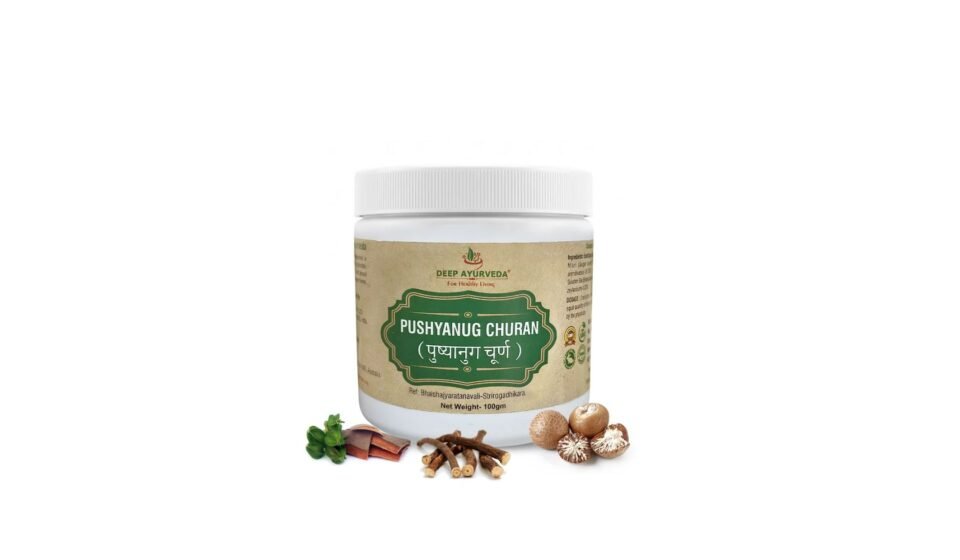
पुष्यानुग चूर्ण: महिलाओं के स्वास्थ्य के लिए पारंपरिक रूप से इस्तेमाल किया जाने वाला आयुर्वेदिक फॉर्मूलेशन

Women’s health concerns such as excessive vaginal discharge, unusually heavy menstrual bleeding and other forms of abnormal genital discharge have been discussed in Ayurveda for centuries. Among the classical formulations associated with these presentations is Pushyanug Churna, a multi-herbal Ayurvedic powder traditionally described for conditions including Pradara, Raktapradara and Shvetapradara.
What makes Pushyanug Churna interesting is not simply the number of herbs it contains, but the way its ingredients are traditionally understood to work together. Its predominantly astringent and bitter profile, along with properties such as Grahi and Stambhana, forms an important part of its Ayurvedic therapeutic rationale.
At the same time, traditional use and modern clinical evidence are not the same thing. Contemporary research has investigated Pushyanug Churna in specific women’s health conditions, including abnormal vaginal discharge associated with bacterial vaginosis, but this does not mean that the formulation should be considered a treatment for every type of vaginal discharge or menstrual problem.
This article explores Pushyanug Churna from three perspectives: classical Ayurvedic understanding, available modern research and practical safety considerations.
What Is Pushyanug Churna?
Pushyanug Churna is a classical Ayurvedic polyherbal formulation prepared in powder form (Churna). It contains a combination of herbs traditionally selected for their Rasa (taste), Guna (qualities), Virya (potency), Vipaka (post-digestive effect) and therapeutic actions.
In Ayurvedic literature, the formulation is associated particularly with disorders described under terms such as Pradara and Raktapradara. It is also traditionally discussed in relation to Shvetapradara, a presentation characterized by excessive whitish vaginal discharge.
Rather than viewing Pushyanug Churna as a formulation for one modern diagnosis, it is more accurate to understand it through the symptom patterns and doshic considerations used in Ayurveda.
This distinction matters because an Ayurvedic term and a modern medical diagnosis do not always correspond exactly.
Where Does Pushyanug Churna Fit in Classical Ayurveda?
Classical Ayurvedic references describe formulations for abnormal discharge and excessive bleeding according to their underlying Dosha, Dhatu, Srotas and clinical presentation.
Pushyanug Churna is traditionally characterized by properties that may be particularly relevant when Kapha and Pitta are involved in presentations associated with excessive discharge or bleeding.
A 2024 review of Pushyanug Churna describes its formulation in terms of predominant Kashaya (astringent), Tikta (bitter) and other tastes, along with Sheeta Virya and predominantly Kapha-Pitta-shamaka properties.
This Ayurvedic pharmacological perspective provides a more meaningful explanation of the formulation than simply calling each herb a women’s health herb.
Why Is Pushyanug Churna Traditionally Associated With Women’s Health?
The primary reason is its classical association with conditions involving excessive discharge and bleeding, particularly presentations described under Pradara.
In Ayurveda, the clinical approach does not begin with a disease name alone. The physician considers the nature of the discharge or bleeding, its quantity, associated symptoms, digestive status, Dosha involvement and other individual factors.
This is important when discussing Pushyanug Churna today.
For example, two women may both report white discharge, but the underlying causes may be completely different. One may have normal physiological discharge, while another may have an infection or another gynecological condition requiring medical evaluation.
Therefore, the traditional Ayurvedic use of Pushyanug Churna should not be interpreted as meaning that every form of vaginal discharge has the same cause or requires the same approach.
Understanding Pradara in Ayurveda
Pradara is an important Ayurvedic concept when discussing Pushyanug Churna.
The term broadly relates to excessive discharge, and classical Ayurvedic descriptions distinguish different presentations based on the characteristics of the discharge and the associated Dosha.
Depending on the presentation, the discharge may differ in:
- colour
- consistency
- quantity
- smell
- associated discomfort
- relationship with the menstrual cycle
- accompanying systemic symptoms
Ayurvedic assessment therefore goes beyond simply asking whether discharge is present.
This is one reason why a qualified Ayurvedic practitioner may consider the individual’s complete symptom pattern before recommending a formulation.
Pushyanug Churna and Shvetapradara
Shvetapradara literally refers to a presentation involving whitish discharge. It is commonly compared in modern discussions with leucorrhoea, although these terms should not automatically be treated as identical medical diagnoses.
Some vaginal discharge is completely normal. Cervical and vaginal secretions can naturally change during the menstrual cycle, around ovulation and during hormonal changes.
The concern arises when discharge becomes unusually heavy, persistent or associated with other symptoms.
For example, discharge accompanied by:
- unpleasant or strong odour
- itching
- burning
- pelvic pain
- fever
- abnormal bleeding
- pain during intercourse
- green, yellow or grey coloration
deserves medical assessment rather than self-treatment based solely on the presence of white discharge.
What Does Modern Research Say?
This is an area where the discussion around Pushyanug Churna becomes particularly interesting.
CCRAS has documented clinical research evaluating Pushyanug Churna in Sweta Pradara in relation to bacterial vaginosis. A publication from this research has appeared in the Journal of Research in Ayurvedic Sciences.
This provides modern clinical research interest in the formulation, but the finding should be interpreted carefully.
A study investigating Pushyanug Churna for a particular clinical presentation does not establish that the formulation treats every cause of vaginal discharge.
That distinction between specific research evidence and broad therapeutic claims is essential when interpreting Ayurvedic medicines responsibly.
Pushyanug Churna and Raktapradara
Another important traditional association of Pushyanug Churna is Raktapradara, a term used in Ayurveda in relation to excessive uterine bleeding.
Modern medicine recognizes many possible causes of heavy menstrual bleeding, including hormonal disturbances, uterine fibroids, adenomyosis, endometrial conditions, certain medications and bleeding disorders.
Therefore, heavy menstrual bleeding should never be assumed to have a single cause.
From the Ayurvedic perspective, Raktapradara is assessed according to the individual’s Dosha involvement and other clinical features. The classical properties of Pushyanug Churna are traditionally considered relevant to presentations where Pitta, Rakta and excessive flow are involved.
Historical CCRAS work has also investigated Pusyanuga Curna in relation to Rakta Pradara. Such older research is valuable as part of the historical development of Ayurvedic clinical research, but it should not be presented as equivalent to contemporary large-scale clinical evidence.
When Is Heavy Bleeding a Reason to Seek Medical Care?
Seek prompt medical evaluation if menstrual bleeding is unusually heavy, prolonged or accompanied by:
- dizziness or fainting
- marked weakness
- breathlessness
- severe abdominal or pelvic pain
- pregnancy
- bleeding after menopause
- bleeding between periods
- bleeding after sexual intercourse
Heavy bleeding can sometimes result in iron-deficiency anaemia or indicate an underlying condition that needs diagnosis.
Pushyanug Churna Through the Lens of Ayurvedic Pharmacology
One of the most useful ways to understand Pushyanug Churna is to look beyond its ingredient list.
Rasa: The Importance of Kashaya and Tikta
A number of ingredients in the formulation possess Kashaya (astringent) and Tikta (bitter) tastes.
In Ayurvedic pharmacology, Kashaya Rasa is traditionally associated with properties such as absorption and astringency, while Tikta Rasa is associated with lightness and specific actions on Pitta and Kapha.
The significance of these tastes becomes clearer when considered alongside the formulation’s traditional Grahi and Stambhana actions.
Sheeta Virya
The formulation is traditionally described as having predominantly Sheeta Virya.
Within Ayurvedic theory, Sheeta Virya is associated with cooling qualities and is traditionally considered relevant in conditions where Pitta and heat-related manifestations are prominent.
However, Ayurvedic pharmacology is not based on one property in isolation. The therapeutic interpretation depends on the combined actions of the formulation and the patient’s individual constitution and disease pattern.
Grahi and Stambhana
Two terms frequently encountered when discussing Pushyanug Churna are:
Grahi — traditionally associated with the ability to absorb or help check excessive fluidity.
Stambhana — traditionally associated with restraining excessive flow.
These concepts help explain why the formulation has traditionally been associated with excessive discharge and bleeding.
They should, however, be understood as Ayurvedic pharmacological concepts, not automatically translated into modern biochemical mechanisms.
What Are the Ingredients in Pushyanug Churna?
Pushyanug Churna is a multi-ingredient formulation rather than a single-herb remedy. Classical descriptions include numerous botanical ingredients, each contributing particular Ayurvedic properties.
Commonly discussed ingredients include herbs such as:
- Patha
- Jambu
- Amra
- Pashanabheda
- Rasanjana
- Ambashtha
- Shalmali
- Lajjalu
- Kutaja
- Lodhra
- Bilva
- Musta
- Ativisha
- Dhataki
- Yashtimadhu
- Arjuna
The exact presentation of ingredients can vary between classical references and commercially manufactured products. Botanical identification, sourcing, processing and formulation standards should therefore be checked against the specific product label.
Why Are So Many Herbs Used Together?
This is where a formulation-based understanding becomes more useful than looking at herbs individually.
Ayurveda traditionally develops formulations according to a combination of properties and actions rather than choosing herbs solely because each one has an isolated benefit.
In Pushyanug Churna, the combination of astringent, bitter and other complementary properties is part of the rationale traditionally used for its association with excessive discharge and bleeding.
This is often described as the formulation effect—the therapeutic interpretation of the complete combination rather than reducing the medicine to one active herb.
How Does Ayurveda Traditionally Explain Its Action?
A simplified Ayurvedic interpretation can be represented as:
Dosha involvement → affected tissues and channels → altered discharge or bleeding → selection of herbs with appropriate Rasa, Guna, Virya and therapeutic actions
This approach differs from the modern pharmaceutical model, where the primary focus is often on identifying a molecular target or biochemical pathway.
For this reason, statements such as this herb increases hormone X should not be inserted into an Ayurvedic article unless supported by appropriate modern evidence.
A stronger and more accurate explanation is to describe what Ayurveda traditionally observes and how the formulation is understood within that framework.
What Does Modern Research Tell Us About Pushyanug Churna?
The evidence surrounding Pushyanug Churna can be divided into three broad categories.
1. Classical evidence
Ayurvedic texts provide the historical basis for the formulation’s traditional indications and pharmacological interpretation.
2. Ayurvedic scholarly research
Modern Ayurvedic reviews have analyzed the formulation according to Rasa, Guna, Virya, Vipaka, Dosha and therapeutic actions.
3. Clinical research
CCRAS has conducted clinical research involving Pushyanug Churna in specific women’s health presentations, including Sweta Pradara in relation to bacterial vaginosis.
The important takeaway is that evidence exists, but it is condition-specific.
Traditional use can tell us why a formulation has been used historically. Clinical research can tell us what has actually been investigated. Neither should automatically be expanded into claims that have not been demonstrated.
How to Take Pushyanug Churna
The appropriate dose of Pushyanug Churna depends on the specific product, formulation, patient and practitioner’s assessment.
Classical dosage references and commercial product directions should not automatically be treated as interchangeable.
What Is the Traditional Anupana?
Anupana refers to the substance taken along with an Ayurvedic medicine to support its administration and therapeutic context.
Tandulodaka (rice water) is traditionally mentioned in connection with Pushyanug Churna in Ayurvedic discussions.
However, people should follow the dosage and administration instructions provided for the specific product they are using or the instructions of their qualified Ayurvedic physician.
Taking a larger quantity does not mean obtaining faster or better results.
Is Pushyanug Churna Safe for Everyone?
No Ayurvedic medicine should be assumed to be suitable for everyone simply because it is made from herbs.
Extra caution is appropriate for:
- pregnant women
- breastfeeding women
- children and adolescents
- women with unexplained vaginal bleeding
- women with very heavy or prolonged periods
- people taking multiple medicines
- people with significant chronic health conditions
If symptoms are persistent or recurrent, identifying the underlying cause should take priority over prolonged self-treatment.
Pushyanug Churna and Pregnancy
Pregnancy is a special situation in which self-medication should be avoided.
If a pregnant woman experiences vaginal bleeding or unusual discharge, she should seek appropriate medical evaluation rather than attempting to manage the symptom independently with Pushyanug Churna or another herbal formulation.
The same principle applies to breastfeeding: discuss the use of any concentrated herbal formulation with a qualified healthcare professional before starting it.
Common Misunderstandings About Pushyanug Churna
Pushyanug Churna is only for white discharge.
Not exactly. Its traditional Ayurvedic indications are broader and include presentations associated with Pradara and excessive bleeding.
Every white discharge is a disease.
No. Physiological vaginal discharge can be normal. Its quantity, appearance, smell and accompanying symptoms matter.
Ayurvedic medicine can treat any vaginal infection.
This is an unsafe generalization. Different infections have different causes and may require specific medical treatment.
Traditional use means the medicine has been clinically proven for every indication.
Traditional use and modern clinical evidence are different categories of evidence.
If a little works, more will work faster.
Increasing the dose without professional guidance is not a safe approach.
When Should You See a Doctor?
Pushyanug Churna should not become a reason to delay diagnosis.
Consult a qualified doctor or gynecologist if you experience:
- persistent or recurrent abnormal vaginal discharge
- foul-smelling discharge
- itching or burning
- pelvic pain
- fever
- unexplained vaginal bleeding
- very heavy periods
- bleeding between periods
- bleeding after intercourse
- bleeding during pregnancy
- bleeding after menopause
These symptoms can have multiple causes, and the correct treatment depends on the underlying condition.
The Bottom Line
Pushyanug Churna is a classical Ayurvedic polyherbal formulation traditionally associated with conditions described as Pradara, Raktapradara and Shvetapradara. Its traditional therapeutic rationale is closely linked with properties such as Kashaya Rasa, Sheeta Virya, Grahi and Stambhana.
Modern research has also examined the formulation in specific women’s health contexts, including abnormal vaginal discharge associated with bacterial vaginosis. However, the available evidence should be interpreted according to the condition actually studied rather than generalized to every type of vaginal discharge or menstrual problem.
The most useful way to understand Pushyanug Churna is therefore not simply as a medicine for women, but as a specific Ayurvedic formulation with a particular pharmacological profile and traditional clinical context.
If you are considering using it for abnormal discharge, excessive bleeding or another gynecological concern, the most important first step is to understand what is causing the symptom. A qualified Ayurvedic physician or appropriate medical professional can then determine whether Pushyanug Churna is suitable for your individual situation.
Frequently Asked Questions About Pushyanug Churna
What is Pushyanug Churna used for?
Pushyanug Churna is a classical Ayurvedic formulation traditionally used for conditions such as Pradara, Shvetapradara and Raktapradara, particularly involving excessive discharge or bleeding.
Is Pushyanug Churna used for white discharge?
Yes, it is traditionally associated with Shvetapradara (excessive whitish vaginal discharge), but persistent or unusual discharge should be evaluated to identify its underlying cause.
Can Pushyanug Churna be used for heavy menstrual bleeding?
It is traditionally associated with Raktapradara, but unusually heavy or prolonged menstrual bleeding should be medically assessed to rule out underlying causes.
What are the main ingredients in Pushyanug Churna?
It is a multi-herbal Ayurvedic formulation containing ingredients such as Lodhra, Kutaja, Musta, Dhataki, Yashtimadhu and Arjuna, along with several other herbs.
How should Pushyanug Churna be taken?
Dosage varies by product and individual needs; follow the product label or take it under the guidance of a qualified Ayurvedic physician.
Is Pushyanug Churna safe during pregnancy?
Pregnant women should avoid self-use and consult a qualified healthcare professional before taking Pushyanug Churna or any concentrated herbal formulation.
Can Pushyanug Churna be taken for a long time?
The appropriate duration depends on the individual’s condition, so prolonged use should be undertaken only with guidance from a qualified Ayurvedic practitioner.
Does Pushyanug Churna treat every type of vaginal discharge?
No. Vaginal discharge can have different causes, so persistent, foul-smelling or symptomatic discharge should be medically evaluated rather than self-treated.


[…] चूर्ण (Pushyanug Churna) आयुर्वेद में वर्णित एक पारंपरिक […]